
ADM 116 contains Admiralty subject case papers, with records spanning 1852–1965. A researcher can find an operation, claim, wreck or administrative decision by working from a ship or subject into Admiralty indexes, case numbers and the original piece. The key distinction is that a case file documents official business; it is not automatically a crew roll, eyewitness list or proof of individual service. The archival route and the evidential route have to be tracked separately.
Understand Why the Admiralty Created Cases
The Admiralty did not always file every incoming letter as a standalone item. During the nineteenth century it increasingly assembled related incoming letters, outgoing replies and minutes into subject cases. An ADM 116 piece can therefore represent a sequence of administrative actions, not a single letter written on the catalogue date.
Before calling a case “an inquiry,” examine how the original papers describe it. A subject label such as wreck, supply or operations may embrace requests, proposals, reports and a later decision. None of those stages should be merged, and an allegation in a covering letter is not equivalent to a Board finding.

Start with Ship Names and Known Subject Words
The National Archives recommends searching ADM 116 and ADM 7 by keyword, including the name of a ship where known. Write variants of a vessel’s name and verify its period of service before accepting a hit. A ship name can recur over generations, and a place name can identify a station or a location of correspondence instead of an incident.
Save the full reference and date range of each plausible result. A broad catalogue heading is not a transcription of the file. Do not report that a person was present merely because an event concerned a vessel on which that person may have served at some other time.
Use ADM 12 to Reach the Case Number
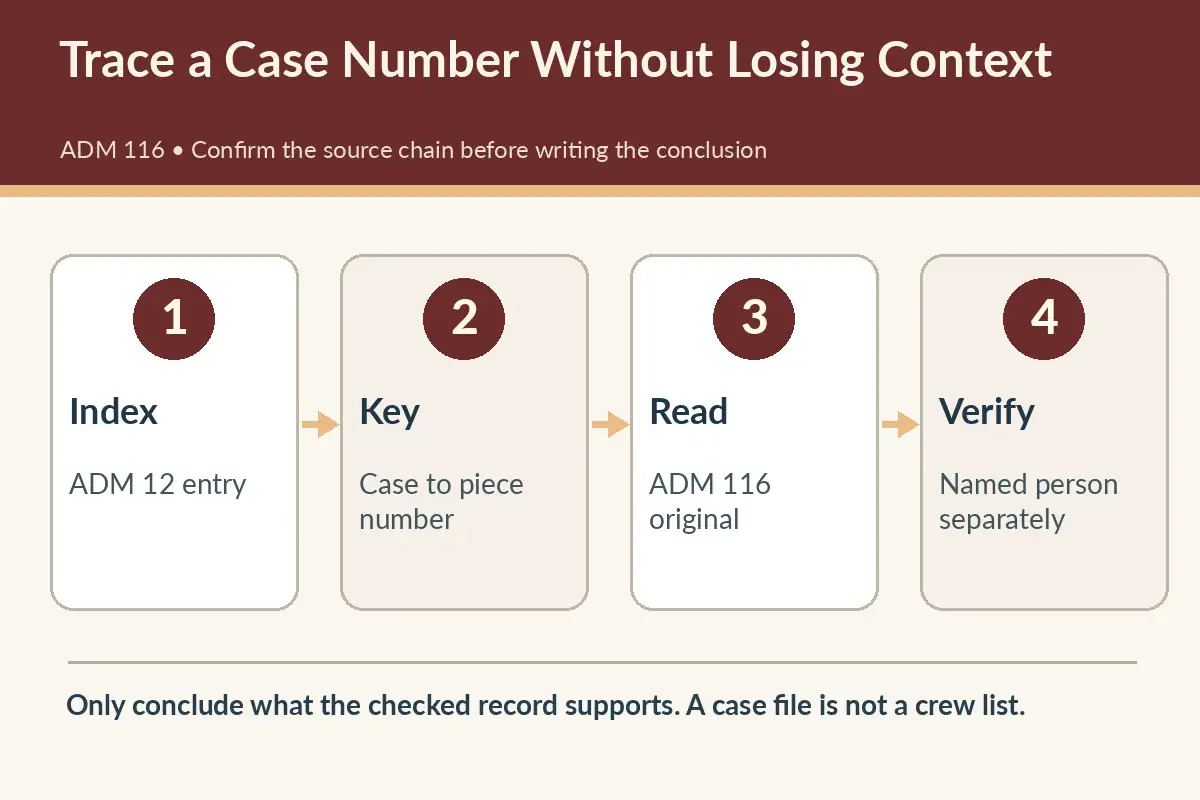
ADM 12 contains indexes and digests useful for navigating Admiralty correspondence. For many later papers the index supplies a case number rather than a modern ADM 116 piece number. The official guide notes that the printed Key to Admiralty cases is held with the printed ADM 116 finding aid at Kew.
Keep an explicit crosswalk: ADM 12 reference, index heading, original case number, key entry and final ADM 116 reference. If a digit or abbreviation is unclear, preserve the reading with a question mark until the key confirms it. A case number alone is not a reliable citation to the original.

Distinguish Navy Board Material from Admiralty Files
ADM 106 concerns Navy Board correspondence, whereas ADM 12 indexes Admiralty business. They are not interchangeable filing sequences. A dockyard issue may have involved more than one body, particularly before institutional changes in the nineteenth century, but surviving records must be followed through their actual creator and reference.
Check ADM 1 correspondence and ADM 7 miscellaneous material when the case key points elsewhere or the ADM 116 search fails. The archive notes that some related case papers were filed outside ADM 116. A negative result is therefore a statement about a route searched, not proof that the Admiralty never dealt with a subject.
Read a Case as a Dated Administrative Sequence
Within the original file, list each paper separately: incoming letter, report or enclosure, minute, recommendation, outgoing reply and any later annotation. Record the author, document date, received date if visible and the specific action described. This prevents a file-wide date from obscuring the chronology of a particular decision.
Where one official disputes another, describe both claims with attribution. An approval minute may authorize investigation but not establish that the action occurred; a report of a proposed voyage need not prove departure. Trace the next administrative document and independently look for operational or ship-level corroboration.
Prove an Individual Seaman from Person-Level Sources
An incident file might name an officer, witness or claimant. That person’s role must be taken from the words of the document, not inferred from rank or ship association. Seek appropriate service, muster, appointment, pay or ship-log evidence for the date and vessel concerned.
An individual could transfer ships, appear in a case only as correspondent, or have a common name. Compare service number when available, rate, age, origin, dates and overlapping assignments. A naval file that documents a ship does not automatically supply a roster of all hands present on a day.
Cite the Original and Record Search Limitations
Use the complete ADM 116 piece number and a folio, page or enclosed-paper locator where available, together with the ADM 12 and printed-key references that led to it. The path matters because it allows the next researcher to reproduce the archival retrieval.
The ADM 12 index system changed in usefulness after 1922, and access conditions vary by file. When a record is closed, uncatalogued at item level or available only at Kew, write that explicitly. Do not imply that a free catalogue listing is a downloadable image of the source.
A Worked Example of Cautious Attribution
Consider a catalogue record describing an Admiralty case about damage to a vessel. It may contain a captain’s report, a repair estimate and correspondence with different offices. The presence of all three does not show that repairs were completed, that a named seaman caused the damage, or that the same crew remained aboard. A claim about the physical repair needs a dated return or shipyard account; a claim about a person needs independent service evidence.
Make the path auditable by writing down the search expression, the ADM 12 index volume if used, the numbered case entry from the printed key and the eventual ADM 116 piece. The older case number is a way to reach the item, not a replacement for the full archival citation. If two index headings lead to one case, note both without counting them as separate independent sources.
A minute approving an inquiry is evidence of official intent. A statement giving the outcome of an inquiry requires the subsequent report or decision. In both instances the source’s author and date matter as much as the archive code; a later summary can misstate or compress an earlier event.
How We Research the Original Archival Evidence
Our approach begins with the document itself, not a surname match or a search snippet. For a Admiralty case, we log the archival creator, full series and piece reference, date and scope of the item, and the question under test. We then check ship identity, date range, case number, paper type, and the exact administrative decision. A missing field is recorded as missing, not reconstructed from another person’s record. This procedure distinguishes what was written at the time from a plausible modern interpretation.
We cross-check ADM 12 and ADM 116 alongside independent named naval records. We keep a separate column for contradictory observations, use contemporaneous spelling as a citation anchor and allow multiple candidates to remain unresolved. Where a catalogue summary substitutes for an original not yet inspected, we say so. The National Archives guidance cited below supplies the record-class boundaries; it does not certify any named historical person as a match.
More Research Method Guides
Sources, Access, and Evidence Boundaries
The following official research guidance explains the holdings and the search route: The National Archives: Naval Correspondence Adm12 Indexes And Digests. The National Archives: Royal Navy Operations Correspondence 1660 1914. The National Archives: Ships Wrecked Sunk. Check each catalogue entry for the particular piece’s access conditions and ordering options. A source description is not a substitute for reading the original image, and digitization varies by collection.
Our editorial and affiliate policy is available in the affiliate disclosure. No purchase is required to follow the record-class decision process, although a repository or third-party image supplier may charge for document copies or access. Check the current terms directly before paying.
No. It is a series of Admiralty cases; verify individual service with person-level naval records.
An index may give a historical case number that needs the printed Key to Admiralty cases.
Often. Try vessel names and subject terms, then inspect dates and original references before deciding it is your vessel.
Not necessarily. Reports, proposals, minutes and execution records may describe different stages.
Check the index variant, ADM 7 and ADM 1 leads, and document which filing route was actually searched.