
The Admiralty Pink Lists in ADM 187 can place a commissioned Royal Navy ship or naval air squadron at a listed port during the Second World War. They do not map a vessel continuously at sea or name everyone serving aboard. Begin with the ship identity and a specific date before drawing a family-history conclusion. This guide gives a precise source route, identifies what the archive can and cannot show, and names the independent documents needed before a personal or geographic conclusion becomes defensible.
Identify the Vessel Before Matching a List Entry
Begin with the complete ship name, the approximate year and, where available, its pennant number, class or type. Naval names were reused and similar abbreviations occur in contemporary sources. The precise historical identity is more reliable than an undated recollection that a relative sailed “on a cruiser.” Record whether the target was a commissioned ship, an auxiliary vessel or a naval air squadron. Each kind of unit might appear differently, and a familiar name alone does not justify linking a catalogue description to your ancestor.
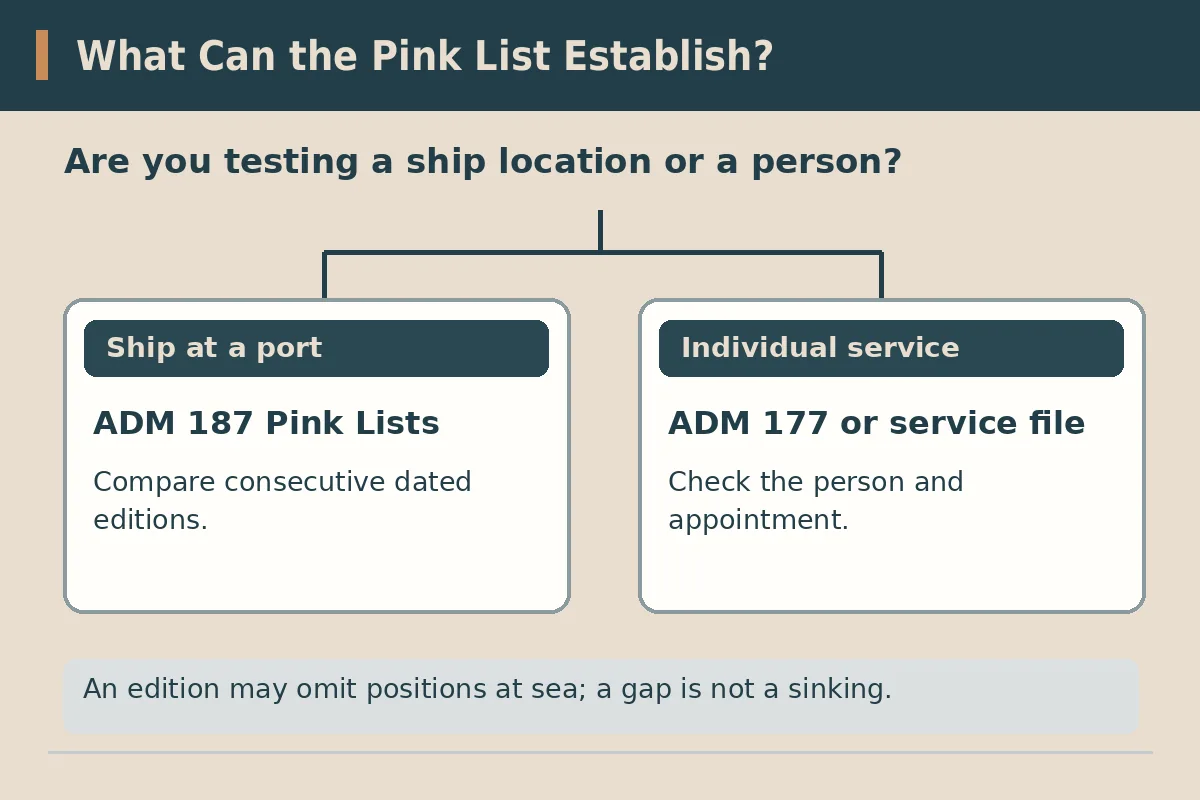
The National Archives guide to Royal Navy operations in the Second World War explicitly calls ADM 187 the Pink Lists. It says the lists were issued twice weekly and reported locations in port of HM ships and Naval Air Squadrons in commission, not their positions at sea. Start from that narrow purpose. A fleet-location listing is not a muster roll, a sailing order or a diary of every operation. Knowing this before reading the series prevents a blank line from becoming an invented disappearance or a port entry from becoming a fabricated arrival date.
Compare Dated Pink List Editions Rather Than One Screenshot
Search the ADM 187 series within the National Archives Discovery catalogue, noting the date ranges of the particular piece rather than assuming the whole series is a digital name index. Locate the original dated edition and transcribe the heading, vessel label, reported port and any qualifications exactly. A list may be arranged by station or location, so browsing a relevant volume is often more productive than typing a ship name into a whole-catalogue search. Record whether you inspected an original image, a full list or only a catalogue description.
Create two rows for successive editions, with the actual issue dates written separately from any event date that the list might mention. If the ship is listed in one port in one edition and a different port in another, the lists document two observations; they do not give the departure, route, arrival time or intermediate activity. An unlisted interval needs investigation, not a guess that the ship was damaged, lost or on a particular mission. The dates establish the window within which other sources might refine the movement.
Before calling the list a complete picture of the fleet, read its heading and coverage notes. A listing compiled for administrative circulation may not update every movement immediately, and wartime security could affect what was recorded. Compare the list to an independent dated source and explain any discrepancy as a question for further research rather than automatically privileging the most dramatic account.

Keep Port Positions Separate From Operational Movements
Because a Pink List is not designed to plot an at-sea track, do not draw a continuous line between its reported ports on a map. Search the appropriate ship log, war diary, operational account or naval report if the research question concerns the voyage between two observations. Confirm that the additional document covers the same hull, the relevant date and the kind of event sought. An Admiralty wartime compilation may contain retrospective summaries rather than an order issued at the moment an operation took place.
The official guidance also identifies other differently colored wartime lists. ADM 208 Red Lists concern minor war vessels in home waters; ADM 209 Blue Lists concern shipbuilding. They are not chronological replacements for ADM 187. Select among them based on vessel type and the factual question, not because they happen to share a format. When a list describes a vessel under repair, check the wording and its issuing context; do not assume repairs were completed or that the ship was available for service.
Investigate a Crew Member Through Independent Personnel Sources
A family letter dated near a ship listing may suggest a connection but cannot independently prove that the writer was aboard the vessel that day. Seek a personal service record, a dated appointment, a relevant crew or officer list, or correspondence explicitly naming both person and ship. The wartime confidential Navy List in ADM 177 can provide officers’ ranks and their ship appointments, according to the National Archives guide. It should not be treated as a complete roll of ratings and civilian workers.
For a hypothetical example, assume a sailor named John Brown is said to have served aboard HMS Example. An ADM 187 edition puts a vessel called Example in a dockyard on a certain date. That evidence describes the vessel, not the sailor. You would next need a personal record linking John Brown to the particular ship at a compatible time. Even then, assignment does not necessarily prove participation in every action undertaken by its crew. Preserve the distinction among assignment, presence and participation.

Write a Reproducible Port-History Conclusion
Prepare a compact evidence table with the exact ADM 187 piece, edition date, ship designation, reported port, transcription and link or reading-room reference. Beside that, list every independent source used for movement or crew claims. When the evidence consists of just two snapshots, say the ship was reported at those ports on those dates rather than writing an unsupported journey narrative. Include alternate vessel identities that you ruled out and the basis for rejecting them.
A careful public summary might state that the ship appears in a specified Pink List edition and that further records are needed to establish its passage and the service of a named relative. Check spelling, edition timing and any printed correction notices. Where records are missing or unavailable, log what ranges you actually searched. Avoid implying that an absence from the catalogue is an absence from an event: catalogue titles may describe volumes, not individual ships, and some wartime materials were lost or withheld.
For photographs and maps, note the image or chart date. A later photograph of the same class of ship is only an illustration, not a portrait of the specific vessel at the port described. Where you use a modern map, label the geographical comparison as modern and preserve historical port and dockyard names in citations.
More Records and Archives Guides
How We Research This Archive Series
This guide starts with the official description in The National Archives’ research guidance, not a claim that we have inspected a particular person’s private file or a specific original piece. The archival statements here concern the series or research method. A hypothetical example is labelled as such; it is not a newly discovered historical event. We use the Discovery search guidance to distinguish keyword matches from archive holdings and document contents, because catalogue descriptions do not transcribe every word of an original.
For every real candidate, record its historical place or person’s name, the creator, document type, date, full ADM 187 piece or item reference, access restrictions, and the exact claim being tested. The official citation guide explains how to document those references so another researcher can retrace them. An unread document remains a catalogue lead, never proof of imagined details. If a record is missing, preserve the searched terms and dates and examine survival and alternate custodians before interpreting the gap.
Before sharing a conclusion, audit the difference between original source wording and your interpretation. Require independent evidence for any further claim about an individual, property owner, legal effect, or completed action. Respect archival access limits and living people’s privacy. This website also provides an affiliate disclosure; no paid partnership or commercial access is implied by these archival references.
It is the archival series for the Admiralty Pink Lists, including wartime ship and squadron location listings.
The National Archives describes the wartime Pink Lists as issued twice weekly.
No continuous at-sea position can be inferred; the official guide describes locations in port, not positions at sea.
No. Look for a separate person-level service or appointment source.
Give the full ADM 187 piece, list edition date, entry details and the exact copy inspected.