
Taff Vale Railway employee material survives in The National Archives under RAIL 684, but an archival entry rarely supplies a complete biography. The company, work location and period must be established before a matching name can safely be tied to an ancestor. This guide gives a precise source route, identifies what the archive can and cannot show, and names the independent documents needed before a personal or geographic conclusion becomes defensible.
Prove the Railway Company Before Searching a Surname
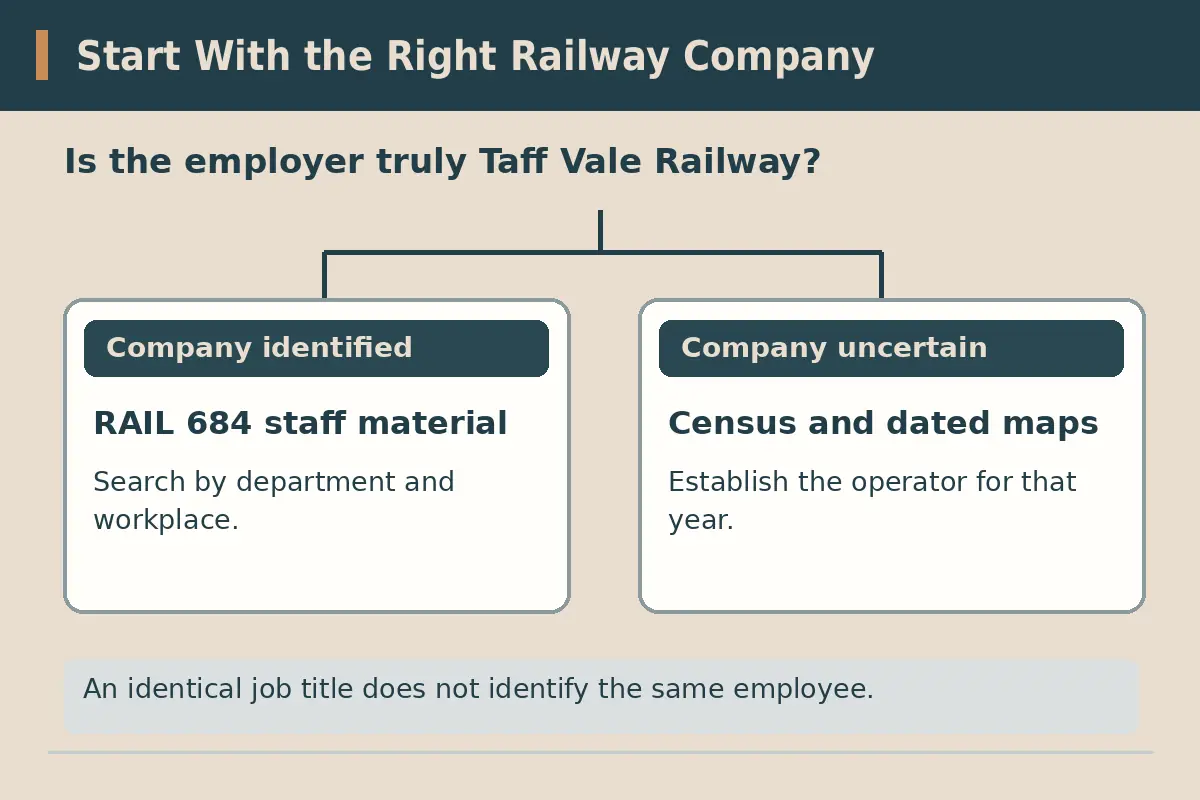
A family story may say that a man worked “on the Taff Vale line,” but that phrase could mean the company that employed him, a stretch of route he used, or simply the railway closest to his home. Before looking for a person, date the story using a census, dated letter, marriage certificate, local newspaper or occupational entry. Identify the station, depot, workshop or line described. Consult contemporary company maps, not a modern rail-network map, because ownership and operating arrangements changed. This company-first gate avoids treating every Welsh railway worker as a Taff Vale employee.
A worker recorded in 1901 with the occupation “railway porter” has an occupational clue, not a company name. A household address near a station supplies geographic context, but a person might have traveled daily to a different depot. Write down the exact census wording and consider neighbors with similar jobs as leads rather than proof. Where the source directly names the company, quote that wording. Where it does not, state only that Taff Vale Railway is a candidate employer requiring further evidence.
Locate Surviving RAIL 684 References Precisely
The National Archives railway-workers guide lists surviving Taff Vale Railway staff papers under RAIL 684/55, RAIL 684/73–82, and RAIL 684/94–120, alongside RAIL 1057/1857/2. Its appendix gives an approximate company-level date span of 1890–1924. Those references are a map to holdings, not a claim that every piece contains the same kind of staff register or that its pages cover every year in that span. Check each piece description in Discovery before deciding which is relevant to the known workplace and period.
Search within RAIL 684 using the place, department and occupational variants appropriate to the job. The railway-workers guide notes terms such as “traffic” or “coaching” for station occupations, “locomotive” for drivers and fitters, and “goods” or “commercial” for employees moving merchandise. If a catalogue result supplies a piece number rather than a named worker, record that reference and confirm viewing or copy options. A catalogue snippet is not an indexed transcription of a register page. An empty surname search cannot establish that no employee existed.
A common failure is to use an online index hit as if it represented a complete company archive. The guide makes clear that preservation is uneven and may reflect only a fraction of the payroll for some kinds of workers. Describe what was searched and which company branch or department it covered. If a worker does not appear, consider alternate employment, a different register arrangement or missing coverage before concluding the family story is false.
Read Service, Pay and Absence Fields Separately
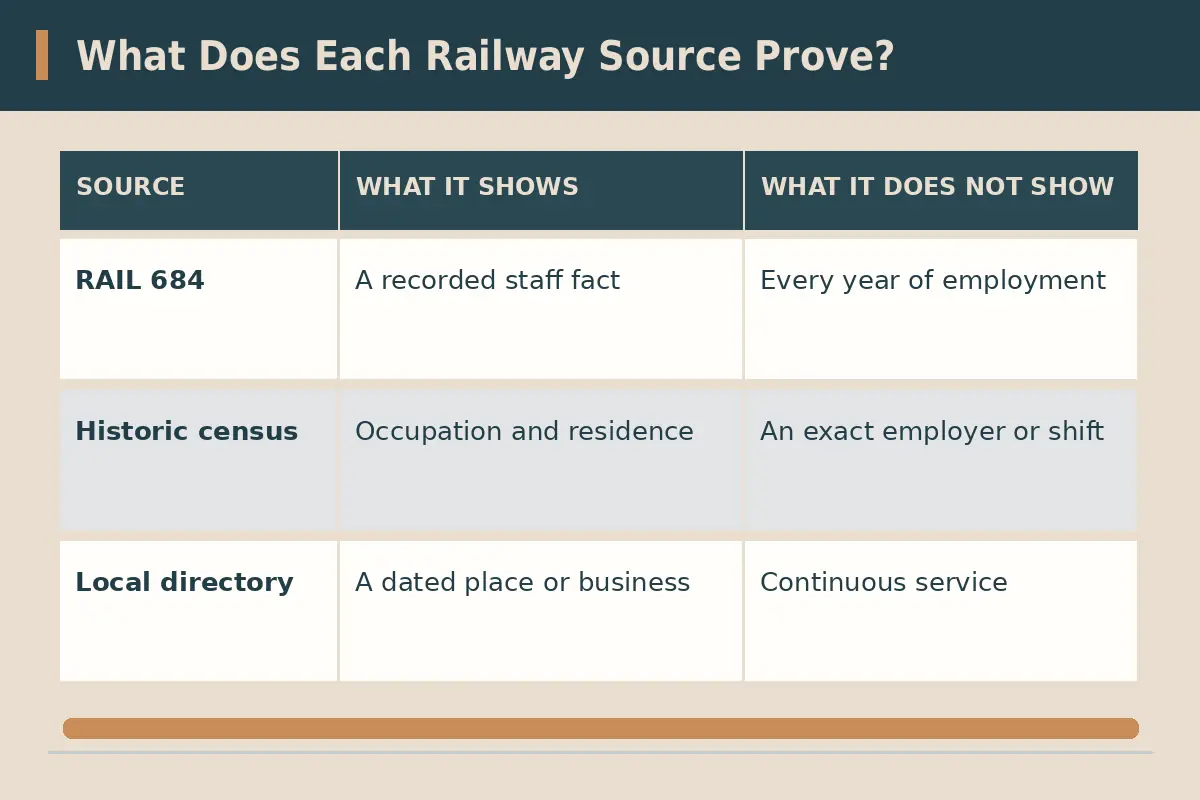
The National Archives describes staff registers and salary records as primarily administrative and financial. Depending on the original volume, entries might identify occupation, location, pay, changes of job, absences, fines or benefits. Do not assume these columns occur on every page. Inspect column headings, legends and the opening pages before transcribing a name, and keep the dates attached to the actions they describe. A pay increase documents a recorded pay action; it is not automatically evidence of a promotion. An illness absence is not a medical diagnosis.
Photograph or transcribe the full row with adjacent headings, page number and any employee number actually present. Record initials exactly, including spelling variants and corrections. If the same name appears twice, compare department, appointment date and location before combining them. A staff record for one year may not bridge a long period between census observations. Preserve that gap in the timeline, even if a later family biography confidently says someone served for decades. Gaps are research questions rather than permission to invent intervening posts.
Use Independent Welsh Records to Test Identity
A distinct identity test brings the company record together with dated census schedules, civil registration, local directories and, where relevant, newspaper notices. Put each candidate in a grid with name, approximate age, residence, occupation, employer if explicitly stated, and the source date. A worker at a Cardiff-area location and a same-name worker in another valley should remain separate until common identifiers emerge. Staff numbers, where surviving, can help, but their meaning and persistence must be checked against the company record itself.
For a hypothetical example, suppose a 1911 household return reports a railway signalman named Thomas Evans and a RAIL 684 page includes “T. Evans” at a station. The overlap is promising, not decisive. Determine whether the employment entry has a staff number, station or dated change. Then seek an independent address or age from a directory, a later staff note or a civil record. A match based on surname and occupation alone is particularly weak when both are common across a large railway workforce.

Write a Narrow Conclusion and a Reusable Citation
The safest conclusion reports exactly which archival entry appears to concern which worker, with a confidence level and the basis for that assessment. Keep separate columns for direct observation, plausible interpretation and unresolved conflict. If the first and last surviving entries are dated a decade apart, do not silently write “employed continuously for ten years.” The phrase “recorded in the railway’s staff materials on these dates” is often defensible when continuous service is not. Distinguish work in a district from residence there and a listed wage from annual earnings.
Record the creator, archive series, full piece, page or folio, heading, and source access method. If the volume was accessed through a provider’s image collection, cite the original RAIL reference and the image location separately. Recheck amendments or continuation notes before making a final assertion. Your research log should also list negative searches with the departments and volumes inspected. This produces a traceable account even when the worker remains unidentified and makes any later discovery easier to incorporate without rewriting the family story.
Preserve the historical company name in each citation. Taff Vale Railway operated within a changing network, and the later identity of a route does not retroactively identify its earlier employer. Search local archives and the National Railway Museum for complementary materials where the National Archives holds only administrative fragments. A company history can help interpret names and reorganizations but cannot, by itself, place an individual employee on a train.
More Records and Archives Guides
How We Research This Archive Series
This guide starts with the official description in The National Archives’ research guidance, not a claim that we have inspected a particular person’s private file or a specific original piece. The archival statements here concern the series or research method. A hypothetical example is labelled as such; it is not a newly discovered historical event. We use the Discovery search guidance to distinguish keyword matches from archive holdings and document contents, because catalogue descriptions do not transcribe every word of an original.
For every real candidate, record its historical place or person’s name, the creator, document type, date, full RAIL 684 piece or item reference, access restrictions, and the exact claim being tested. The official citation guide explains how to document those references so another researcher can retrace them. An unread document remains a catalogue lead, never proof of imagined details. If a record is missing, preserve the searched terms and dates and examine survival and alternate custodians before interpreting the gap.
Before sharing a conclusion, audit the difference between original source wording and your interpretation. Require independent evidence for any further claim about an individual, property owner, legal effect, or completed action. Respect archival access limits and living people’s privacy. This website also provides an affiliate disclosure; no paid partnership or commercial access is implied by these archival references.
It is the National Archives record series for Taff Vale Railway company material, with specific surviving staff references listed in the railway-workers guide.
No. There is no comprehensive national name index covering all railway employees, and surviving company records vary.
The official staff guide lists RAIL 684/55, 73–82 and 94–120, but check descriptions and the date of your query.
No. It proves only what its dated fields record; a continuous career requires further records.
Compare the precise workplace, dates and occupation with contemporary censuses, directories and civil evidence.