
The National Archives identifies surviving Barry Railway employee material dated approximately 1886–1923 in RAIL 23/46–60, RAIL 23/64–65 and RAIL 1057/2245. These references offer a company-first route to staff evidence, not a comprehensive national railway employee database. Begin with the railway, approximate employment period and the worker’s job or station, then inspect the relevant original volume before stating when an individual worked or where they served.
Establish That the Employer Was Barry Railway
An ancestor described as a railway worker in South Wales is not automatically an employee of the Barry Railway. Companies shared districts, depots and nearby junctions, while employment could move between firms during a working life. Begin with the person’s dated address, railway occupation, possible station and the precise employer named in an independent document. A census entry saying only “railway porter” gives an occupation, not a company or station appointment.
The National Archives railway workers guide lists Barry Railway staff records for 1886–1923. It points researchers to pieces RAIL 23/46–60 and RAIL 23/64–65, together with RAIL 1057/2245. This range is a list of archival holdings, not a promise that every clerk, laborer or temporary worker appears in each volume. Physical and administrative arrangements differ from one company to another and even between departments of the same company.
For every possible candidate, create a preliminary identity line: exact name as written, age or birth date if known, latest verified address, job, station and a document that connects the worker to the company. Add alternate spellings and distinguish people who share common Welsh surnames. If the only clue is a family story about trains, keep Barry Railway as a hypothesis until a directory, employment record, union record or company announcement gives the needed connection.
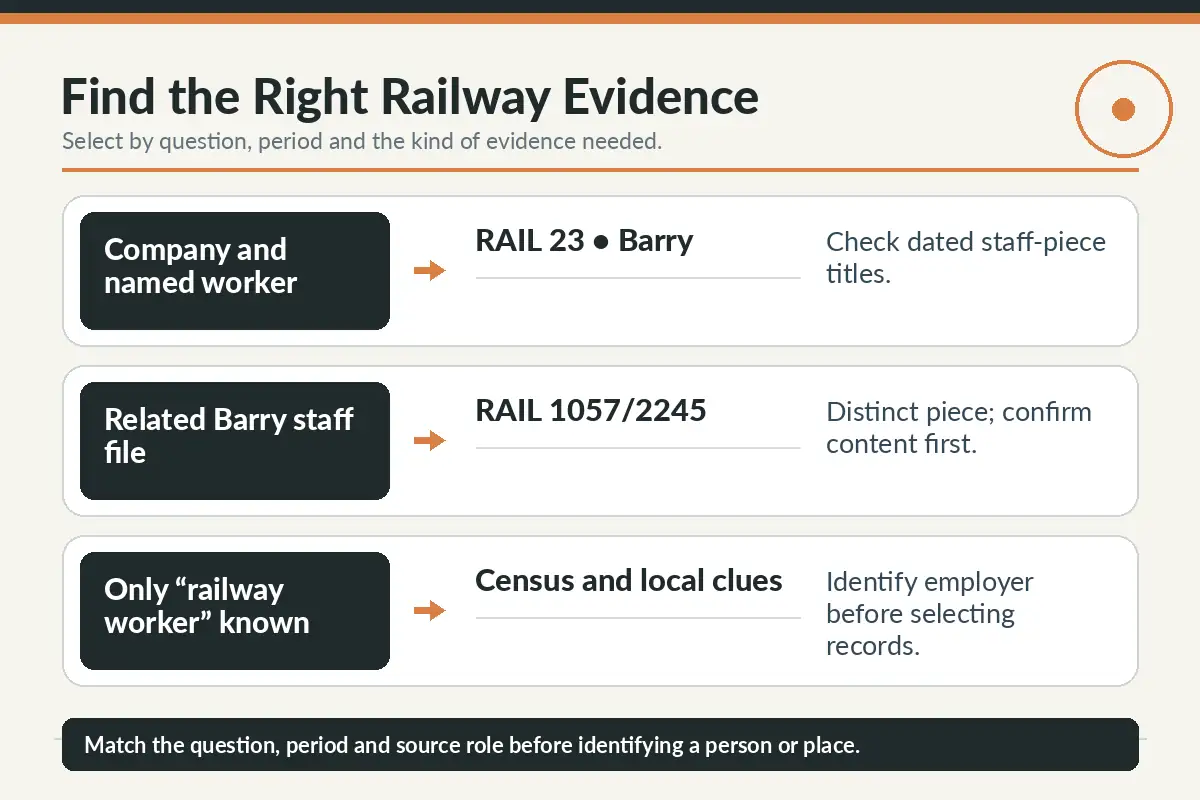
Use the Barry Railway Piece Ranges as a Route
The official guide explains that railway salary registers, staff registers and personnel papers do not all provide the same fields. Salary books often focus on clerical pay, while staff registers may cover job, workplace, starting pay, changes or fines. Do not write a field list as though it describes every Barry Railway volume. Select a specific RAIL 23 piece by date and catalogue title, examine the original headings, then identify the evidence it actually contains.
Browse the RAIL 23/46–60 and RAIL 23/64–65 ranges with the documented period in mind. RAIL 1057/2245 is also listed as a Barry Railway reference, but it should be cited independently: proximity in a research guide does not make it consecutive with RAIL 23. Save piece number, page, entry number and original ordering. If a volume is sorted by department or employee number, a simple alphabetical page search may miss the right person.
The National Archives warns that no central railway employee index covers all companies, and that surviving records for navvies and casual workers are thin. This matters for a negative search. An unsuccessful query might mean a person was employed elsewhere, a particular section was not indexed, a different job category was recorded, or the appropriate volume has been lost. Record the scope of the search and avoid turning “not found in this volume” into “never worked on the railway.”

Read Staff, Pay, and Discipline as Different Claims
A listed starting wage can show the rate recorded for an employee, not necessarily every amount the person took home. Fines, sick pay, allowances and bonuses can be recorded in different places, while deductions may have changed over time. If a staff book has separate dates for engagement, transfer and departure, copy each with its original heading. Do not calculate a continuous career from the earliest and latest observed dates without checking gaps.
A railway disciplinary notation is an administrative claim or finding within the company’s record, not a criminal conviction. The word “dismissed” requires its exact date and context and does not automatically establish permanent unemployment. Similarly, a station is a workplace clue, not proof of family residence in that village. To link a worker to an address, use a census, electoral register, rate book or other independent residential record.
Job titles also changed. A “guard” or “fireman” in a historical railway document has a specific occupational setting that should not be modernized without explanation. Record promotions as events documented in a staff source, distinguishing an assigned grade from a confirmed period performing the duties. A locomotive register naming a vehicle cannot by itself identify its regular driver or crew. Keep separate evidence lanes for the person, the workplace and any train or engine.
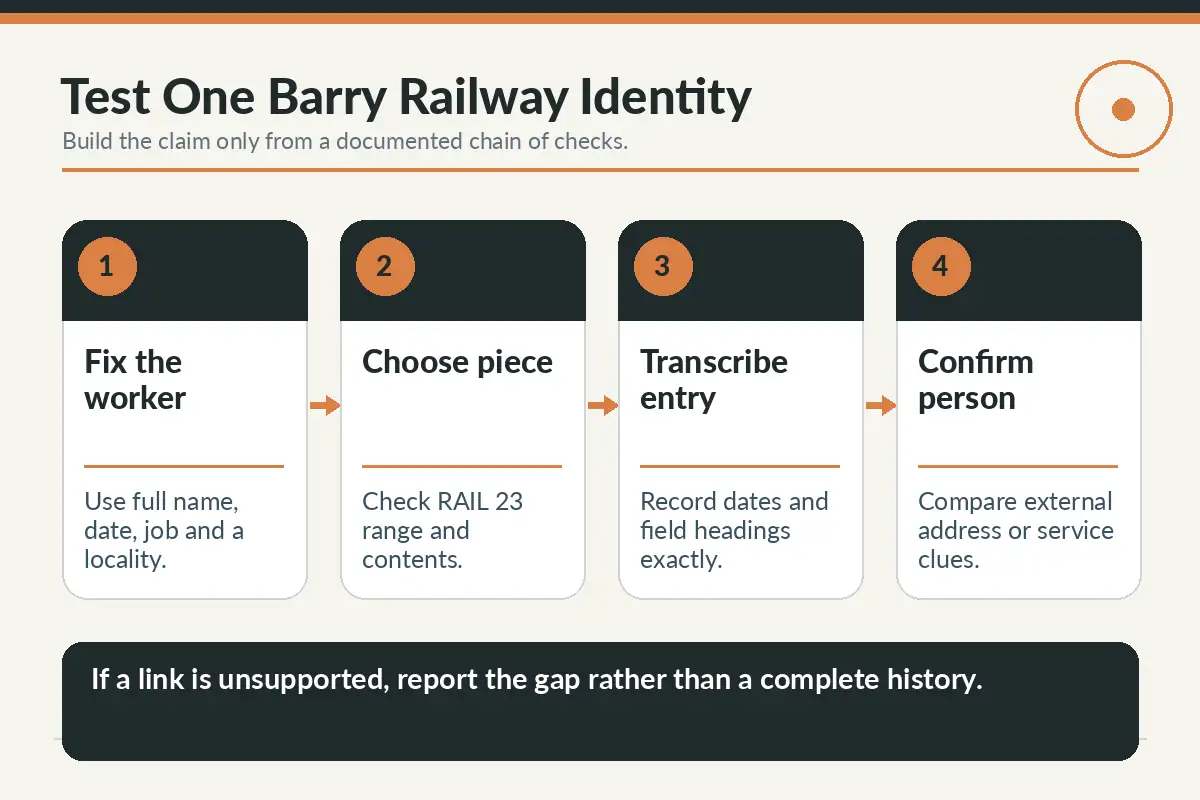
Reconstruct a Career Without Filling Gaps
Create a chronology with rows for every dated employment entry and separate rows for externally verified residence, marriage, military service or other life events. In one column record the exact source; in another state what the entry establishes; in a third list unresolved alternatives. A transfer to a station might precede the date of a family’s move, and a retirement notation need not coincide with the date the person left a town. That difference may be an important research finding rather than an error to smooth away.
For an individual who appears only once, test the identity using birth year, middle initials, job, neighborhood and dates from independent records. Resist copying a complete career from a similar namesake. A worker may move between railway companies, but a transition is not proven simply because records in two firms contain the same name. Look for a joining date, previous-employer statement or a dated external source that bridges the apparent change.
A suitable conclusion might read: “The named person appears in a Barry Railway staff volume for this date and position; the remainder of the alleged thirty-year railway career has not been confirmed.” If no entry is found, report precisely which pieces and names were checked. The outcome can guide a move to local archives, railway staff association records or a different company rather than creating an unsupported narrative.
More Records and Archives Guides
How We Research Barry Railway Staff
We anchor the exact Barry Railway dates and piece references in The National Archives railway workers guide. Its descriptions of payroll, staff and personnel registers support the warning that one archive category is not a full biography. The Discovery guide explains volume-level searching, while its maps guide helps researchers separate historic station locations from today’s boundaries.
The locomotive and ticket in our illustration are original teaching artwork, not images of an identified Barry Railway employee or engine. We do not claim that a specific person appears in a particular volume without reading it. See our affiliate disclosure.
The National Archives railway workers guide lists Barry Railway staff holdings dated 1886–1923. Individual volumes may cover narrower periods.
The official guide lists RAIL 23/46–60, RAIL 23/64–65 and RAIL 1057/2245. Consult each catalogue description before requesting a piece.
No. The census occupation can identify the type of work, but the employing company requires other evidence.
No. The National Archives cautions that few records survive for casual workers and railway construction laborers.
No. Staff, train and locomotive records answer different questions; a specific crew assignment needs direct supporting evidence.