
COPY 2 is a series of commercial Label Books, dated 1873–1912, assembled from pasted labels, cards and advertisements registered through the historical copyright process. Search it by a realistic registration-year range, browse the relevant scrapbook leaves and identify what was actually pasted there. A printed product name is not sufficient evidence of a business proprietor, a trademark assignment, or a purchase by the family you are researching.
Start With a Printed Object, Not a Modern Brand Story
A surviving food tin, soap wrapper, shop card or poster fragment can lead to the Label Books, but first document the object itself. Photograph the whole item, record the exact wording and distinguish the original surface from a later collector’s handwritten annotation. Note a probable date range based on material and typography only as an estimate, not a conclusion. Transcribe unusual spellings. A label produced for an old factory might appear on later merchandise long after the original design date.
The National Archives describes COPY 2 as scrapbooks of labels, cards and commercial advertisements, dated 1873–1912. Their arrangement matters more than a convenient modern keyword. Unlike an image search that silently mixes digitized objects, catalogue descriptions and modern reproductions, the scrapbook locates a deposited design within a historical filing system. An actual dated leaf can support a registration-era claim; it does not show how widely the goods circulated or when the packet on your desk was manufactured.
Before searching, write a three-part question: what design is being compared, when could it have been registered, and which person’s or firm’s role needs confirmation? Keep a fourth line for a competing explanation, such as a retailer’s label applied to a product made by someone else. This prevents an attractive match from turning a small piece of commercial ephemera into an unsupported family business history.

Browse COPY 2 by Year and Leaf
The official copyright guide says entries in COPY 2 are located by choosing a year range and leafing through the original Label Book, not by trusting an all-purpose name index. Begin with the suggested period of production, allowing for a registration date before or after the specimen in hand. Record each consulted piece, date span and the pages or leaves actually checked. If the archive provides a description rather than a scan, request the item or an image before reporting the label’s wording as observed.
For each candidate image compare distinctive visual details: border shape, letter forms, illustration, product description and any address or legal phrase printed within the frame. Similar brands might reuse the same graphic convention; an exact design match requires more than a matching animal, crest or color. Copy punctuation and measure uncertainty about blurred print. The archive’s own leaf order is evidence about filing, not evidence about chronological order of the label’s commercial use.
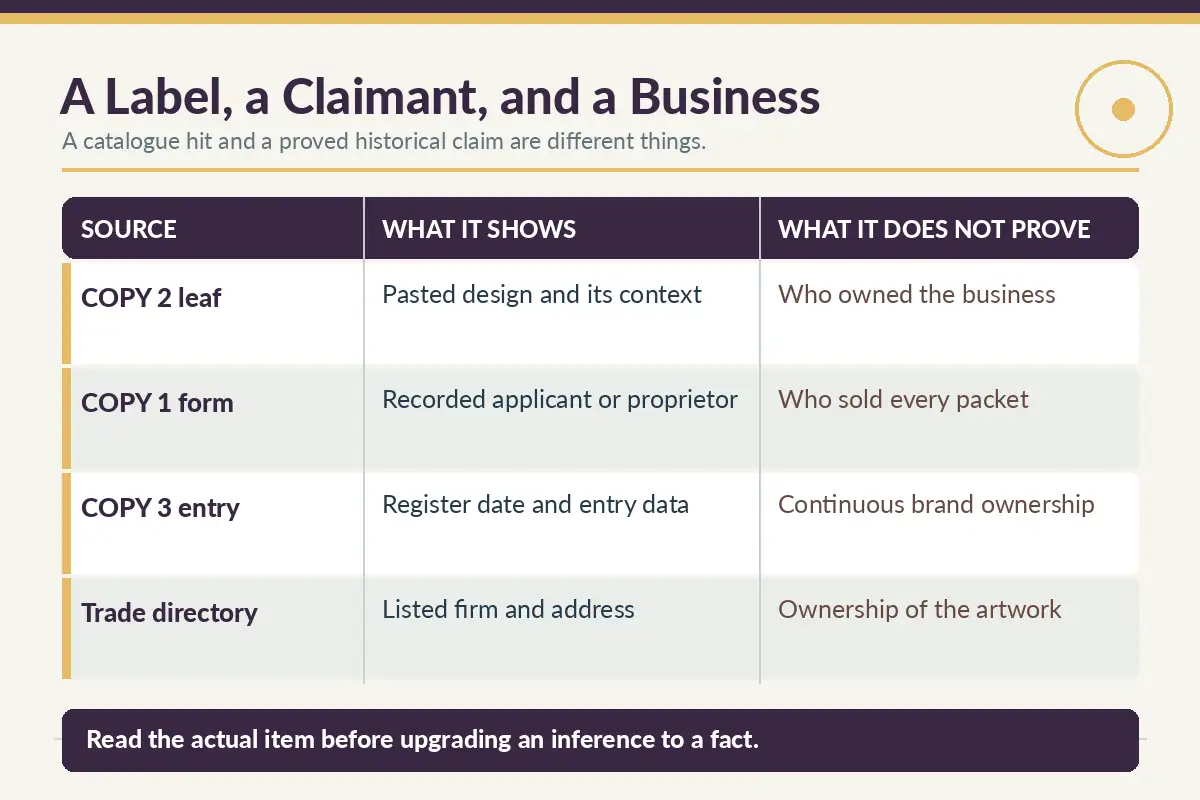
Some Label Books duplicate material in COPY 1, the copyright entry forms. That is a valuable cross-check, not grounds for assuming the two are interchangeable. An entry form may have the registration particulars and named copyright proprietor that the pasted label lacks. Keep separate citations for a COPY 2 image, its possible COPY 1 counterpart and any COPY 3 register entry. The links must be verified at a matching entry, not imposed because the years are close.
Separate Five Roles in a Commercial Label
An old advertisement may include a product brand, manufacturer, trading firm, retailer and printer. None is automatically the legal copyright proprietor. Build a role table with columns for the exact printed words, their position on the label, the role explicitly stated, and the independently documented identity. The phrase “sold by” may identify a retail outlet; “manufactured for” may indicate a supplier arrangement; a street address could be a distributor rather than the family residence.
The copyright process itself adds further roles. The official guide describes a copyright proprietor and an author or creator, and explains that registration forms may carry attached representations. Identify the recorded party without assigning that person every role depicted in the design. Even a signature on an entry form may establish who submitted or claimed rights, rather than who designed, printed, stocked or sold a physical item.
Compare an apparent address with a dated trade directory, company file, property rate book or local newspaper. Treat each as evidence for a particular date and purpose. A directory listing demonstrates that a business advertised or was listed at an address; it does not prove the owner’s home address. A later trademark filing might document another legal right, but it cannot be read backward as proof of the precise scope of a Victorian copyright deposit.

Test the Image Against the Business Timeline
Construct a time grid with separate rows for the oldest dated COPY 2 deposit, the date of the surviving package, a directory listing, a company notice and any documented sale or transfer. Leave dates empty if the source does not state them. Where a registered design resembles a later package, label the connection “possible reuse” until the exact composition or a dated manufacturer document confirms continuity. A brand can persist through mergers and licensing without a straight family ownership line.
If the item contains portraits, views of premises or illustrations of workers, do not identify the people based on location or costume alone. Ask whether the image is documentary, staged or allegorical. The photograph research guide distinguishes copyright-deposited pictures from the independently documented event or person. The same caution applies to an illustrated shop front: the graphic may be a promotional claim rather than a measured plan of a real building.
A useful research statement names the precise limit: “A label with this wording appears in the COPY 2 Label Books in a volume covering the stated period; the relationship of the pictured commercial name to the original copyright proprietor still requires checking in the registration papers.” This leaves readers with a retraceable fact and a concrete next record, without overpromising a full business pedigree from one pasted specimen.
More Research Method Guides
How We Research Copyright Label Books
We use The National Archives copyright-records guide for the COPY 1, COPY 2 and COPY 3 distinctions, the 1873–1912 COPY 2 span and the browse-by-year method. Its photographs guide helps distinguish deposited image content from proven historical identities. The official Discovery search guidance sets limits on keyword-only searching.
Our illustrated label is original instructional artwork, not a claimed reproduction of a preserved commercial design. We do not report an exact label registration unless the corresponding original is identified. Read our affiliate disclosure for information about editorial relationships.
The National Archives identifies COPY 2 Label Books as spanning 1873–1912. Check individual volume date ranges rather than assuming every year or kind of label is equally represented.
Not reliably. The archive advises selecting a year range and browsing original books; catalogue text may not transcribe everything pasted on a leaf.
No. COPY 2 is the label scrapbook series. COPY 1 holds entry forms and attached materials, and some designs occur in both series.
Not on its own. A product name, a copyright proprietor and a trademark holder may be different people or organizations.
Compare contemporary trade directories, rate books, company records and independent family documents before assigning ownership or residence.