
A 1921 Ministry of Labour draft invitation about women’s work and training survives as LAB 2/1591/CCW283/1921 in The National Archives’ educational resource. It refers to a committee considering training and employment schemes after the First World War. The document is useful evidence of an official proposal and its intended recipients; it does not show that an invitation was sent, accepted, or led to a particular woman being employed. That document-stage distinction is the core of this research route.
The National Archives reproduces a draft letter inviting Miss Isabella Drummond, Miss Lena Ashwell and Dr Louisa Garrett-Anderson to join a committee. Those women are named as proposed recipients of the draft, not thereby proven members of a committee. LAB 2 holds Ministry of Labour correspondence on many subjects, so even finding a relevant LAB 2 reference requires checking both the document’s creator and its specific procedural role.
Read the 1921 document at its actual procedural stage
The National Archives’ teaching resource presents a draft letter associated with women’s work and training in 1921. Its wording proposes adding three professional women to a committee; the form “to be sent to” is a clue about intended dispatch, not proof of completed delivery. Transcribe the document’s status and date before writing a biographical sentence about an invitee.
For each named woman, the direct fact is that an official draft names her as a proposed recipient. A later historian might reasonably ask whether she joined the committee, contributed to policy, or worked in a related scheme, but those are different questions. Look for an acceptance, minute or formally issued appointment instead of making the draft do work it was not created to do.

Separate the committee from the women it hoped to help
The Central Committee on Women’s Training and Employment was concerned with training and employment opportunities for women affected by postwar conditions, according to the published letter. A committee’s purpose is a policy statement; it does not supply a list of beneficiaries. A family story about retraining after 1918 should begin with the woman’s locality, occupation and dates, not an assumption that she used this particular committee.
A woman can be named in the committee correspondence as a proposed adviser while another woman is the potential recipient of a training scheme. These roles are not interchangeable. Build a role column with entries such as minister, official, intended committee member, applicant, trainee and employee. The roles indicate which kind of independent source could prove the next stage.
Find the wider Labour correspondence without assuming an index is a file
LAB 2 contains general Ministry of Labour correspondence, so search within the series by committee name, subject, date and known document reference. A broad keyword hit might be a file title or description rather than digitized correspondence. Preserve all of the elements of LAB 2/1591/CCW283/1921 rather than replacing the reference with a shorter filename or a modern blog title.
Search both personal names and the institutional subject, allowing for alternative punctuation and changing committee terminology. Compare the period before and after the draft for replies or administrative decisions. A subsequent file may document action, but it must be opened and read before being characterized. Two catalogue records can describe separate folders on the same subject without proving that an application succeeded.

Trace a training scheme to an individual only through a bridge
Suppose a family letter says an ancestor received instruction in a trade in 1922. A national plan for training women is contextual evidence, not a record of her enrollment. Look for a training school register, a local authority file, an employer document, a trade-union record or contemporaneous dated correspondence. Name, residence, occupation and time period must support the match.
An employment record may prove a job but not where a skill was learned. Likewise, a class attendance list may establish training but not a subsequent appointment. Keep a two-event timeline: date of training and date of employment, each with its own source. This prevents an attractive narrative about national reconstruction from displacing the evidence for one person.
Evaluate a proposal, a reply and an outcome separately
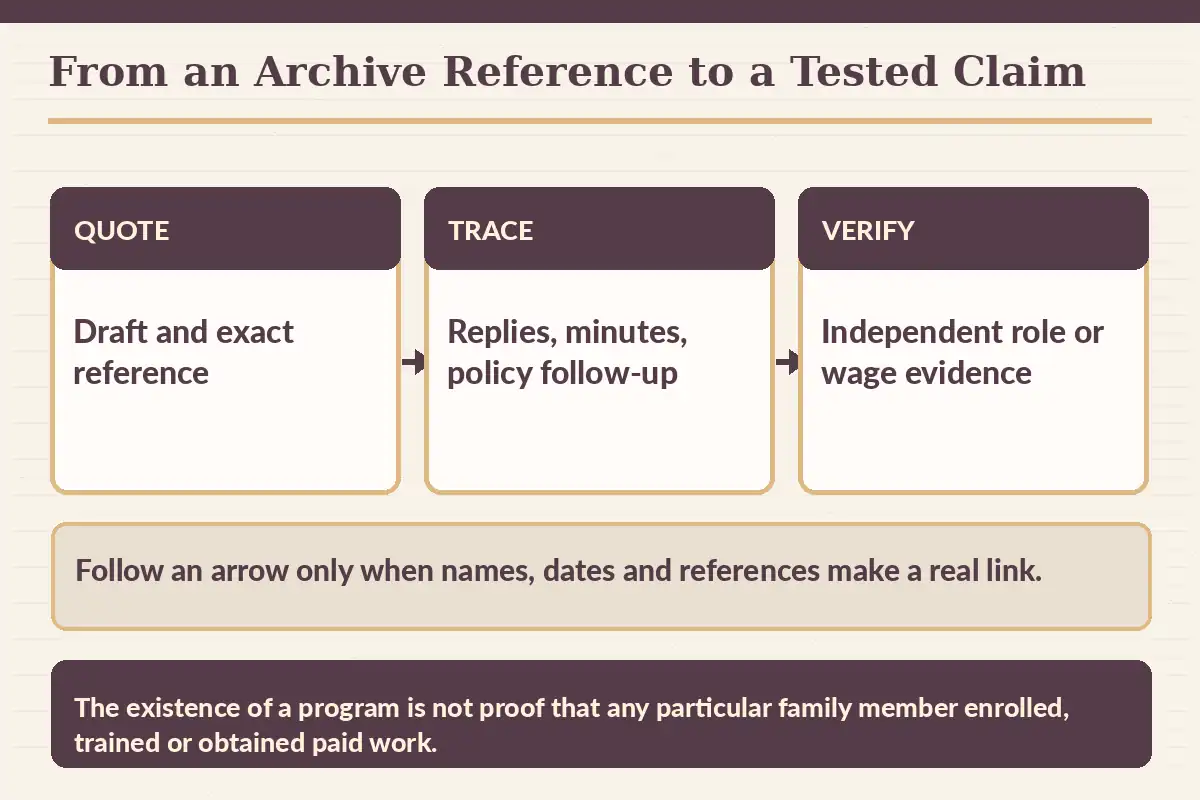
Create a document-stage table: draft, dispatched letter, reply, minute, appointment, scheme operation, individual participation. For every stage, note whether you have direct evidence, a report from a later source or no record. Missing stages should not be filled with assumed success. The distinction is especially important when a document is explicitly marked as a draft.
A newspaper announcement of a scheme can corroborate its public presentation, not necessarily its implementation everywhere. A minister’s assurance may be sincere but predictive. If a local class opened, that supports a more concrete fact, yet individual attendance still needs separate proof. Distinguish the different creators and audiences of these records when evaluating reliability.
Cite the item and write a defensible family-history result
The exact item reference LAB 2/1591/CCW283/1921 matters because LAB 2 encompasses many unrelated areas of work and industrial policy. Give the repository, code, item identifier, creator and original date. If you used the online educational presentation rather than the original manuscript, identify it as a presented transcription or facsimile rather than claiming direct inspection.
A properly bounded conclusion could say that the Ministry drafted invitations to three named professionals in February 1921 as part of an effort to expand a committee’s work. It should not say the recipients served on it without further records, and certainly not that a named ancestor was trained under the program without individual documentation. The next research step is a dated acceptance, committee minute or local personal source.
Make the evidence traceable and reproducible
For the next search, open a source ledger with separate columns for the exact reference, creator, document type, original date, event date, names and roles, location, original wording, inference and the record still needed. A draft invitation is evidence of a proposal, not proof that it was sent, accepted or implemented. Save searches that fail with the terms and actual series coverage; a failed name search in an administrative series is not negative evidence about a person. Only cite an image as inspected when you saw it rather than a catalogue abstract.
When independent sources disagree, preserve the different dates and wording and identify their creators. The existence of a program is not proof that any particular family member enrolled, trained or obtained paid work. Two websites presenting the same archival description are not two independent records. A useful final conclusion names the exact documented fact, the inference left unresolved and a practicable next archive or local collection to consult. Avoid converting administrative context into an imagined family biography.
More Research Method Guides
How We Research and Verify These Archives
We checked archival source guidance on 2026-11-03. The National Archives publishes the 1921 draft letter in LAB 2/1591/CCW283/1921 and names its three proposed recipients and purpose. The source supports a record-search route, not the presence of an invented ancestor in an unexamined file.
We checked archival source guidance on 2026-11-03. The official mining guide lists LAB 2 general correspondence files and distinguishes them from record books and other industrial-relations series. The source supports a record-search route, not the presence of an invented ancestor in an unexamined file.
We checked archival source guidance on 2026-11-03. The official reference guide explains why the item-level components of LAB 2/1591/CCW283/1921 matter in a reproducible citation. The source supports a record-search route, not the presence of an invented ancestor in an unexamined file.
The accompanying illustrations are newly drawn explanatory artwork, not images of particular surviving archival originals. No paid partner or purchase is suggested. Read the affiliate disclosure.
The National Archives identifies it as a 1921 draft invitation concerning women’s training and employment.
The draft alone does not establish this. Look for issued letters, replies and committee minutes.
No. It is administrative correspondence and cannot be treated as a comprehensive list of employees.
No. Locate a local training, employer or personal record identifying that individual.
It identifies the relevant item within a broad series; shortened references can lead to a different document.