
LAB 8 holds Ministry of Labour and successor Employment Department policy files. Its most useful genealogical question is often what an official proposed, counted or worried about—not whether a particular ancestor obtained a job. The National Archives identifies LAB 8/1499 among 1947 documents recording the skills of people expected on the SS Almanzora. That is a very different source from an employer’s pay book or a worker’s appointment letter.
Identify a Policy File Before Searching a Person
Start with a date, policy subject, occupation and government office. LAB 8 may preserve employment planning, correspondence, briefing papers, surveys and materials from consultations. Not every file is arranged by an individual’s name, and departmental keywords may describe a broad industry rather than one company. Identify the policy question first and use Discovery to narrow to LAB 8, rather than expecting a central register of workers.
A topic like postwar labor shortages could concern recruitment abroad, women returning to employment, training and housing. Those topics connect, but they do not generate one simple personal timeline. Enter exact subject terms from catalogue descriptions; then browse adjacent file references and dates where needed. A file’s cover date is not proof that every enclosed document was created during that whole range or that a proposal was implemented throughout Britain.
Distinguish Surveys, Appeals and Placement Evidence
The National Archives shows that LAB 8/3388 contains March 1968 committee notes discussing a survey of women’s employment. A survey documents reported attitudes, sampling methods and government interpretation; it cannot name every working woman or prove that a particular household joined the survey. Likewise, the official 1947 recruitment poster in LAB 8/1485 is evidence of an appeal, not an individual’s acceptance of work.
Use a four-way source classification: survey result, policy recommendation, recruitment material and confirmed job record. In the last category require an employer or worker-level source such as a dated staff register, wage book, pension file or correspondence naming a placement. Avoid presenting advertisements and committee minutes as though they were employment contracts. Record where the source comes from: government publicity, internal discussion and employer records have different purposes and biases.

Handle Migrant Skills Lists With Care
The National Archives’ account of postwar Caribbean migration identifies a December 1947 list of skills for passengers on the SS Almanzora in LAB 8/1499. This helps explain the skills officials recorded and their attempts to plan labor recruitment. A listed trade does not establish that a passenger received work in that trade in Britain, stayed in the same city or migrated for the reason guessed by an administrator.
Distinguish a proposed passenger list, a ship arrival, a job placement and later residence. These are four separate questions. If a document names a person, compare spelling, age or occupation with a passenger record and local address or employment evidence when available. Do not use one government memo to reconstruct an entire migration story. Historical official correspondence may include prejudicial assumptions; attribute those claims to its authors instead of repeating them as unqualified fact.
Compare Government Committees With Employers
Policy could be debated by interdepartmental committees long before a local office issued instructions. A committee paper’s words—proposed, agreed in principle, referred, or noted—are evidence of procedure, not synonymous outcomes. Compare a recommendation with subsequent circulars or local correspondence that show whether it was transmitted. Then look for independent workplace records if the question is personal employment.
Remember that private employers, public bodies and trade unions maintained separate records. A government claim that an industry could absorb certain workers may conflict with local hiring practice. The historian’s task is to preserve the difference between policy intent and observable outcomes. Use contemporaneous newspapers or oral histories as contextual sources, but identify their authors and dates and do not treat retrospective memory as a substitute for a surviving appointment record.

Choose the Best Labor Record Series
The National Archives’ mining guide distinguishes LAB 8 employment files from LAB 3 dispute record books, LAB 10 industrial relations papers and LAB 27 coal-industry dispute material. A strike question therefore needs a different starting point from an employment-policy question. Select the record group according to the action you want to prove: policy formulation, industrial negotiation, recruitment effort or actual employment.
If a search returns a file about a single industry, read the description before assuming the archive holds individual workers’ details. Policy files can contain selected letters from people affected by decisions, but their survival is uneven and selection is not representative. Even a named claimant in a ministerial case file may show only that a request arrived. Track the later response and practical effect rather than treating the original request as resolved.
Reconstruct a Dated Policy Trail
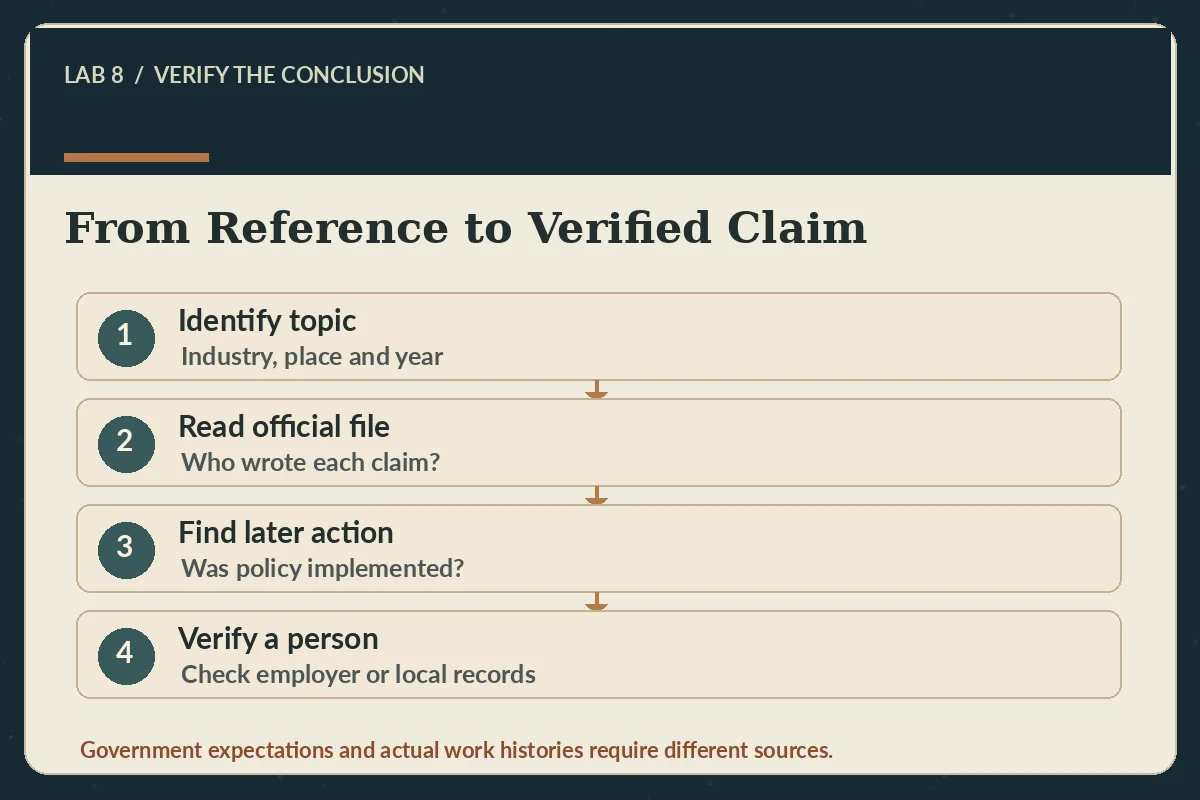
Suppose you are researching work opportunities for Caribbean migrants in late 1947. First identify the date and provenance of the skill list, then separately check shipping records and press accounts for arrivals. Search any subsequent Ministry of Labour correspondence for recruitment measures and compare it with local employers or trade-union records if available. Only make a person-specific claim when a named, dated source actually supports it.
For a 1960s women’s employment project, build a different trail: survey date, sample and question asked; committee response in LAB 8/3388; later departmental communication; then employment statistics or wage records appropriate to the locality. A national survey percentage cannot be applied to a particular family. It gives context and questions for further research, not a missing personal biography.
Note the Missing Records and Administrative Bias
State whether the evidence is a draft, copy, internal minute, publication or original incoming letter. Official discussion can minimize the voices of women, migrants and workers whose circumstances were being discussed; some groups appear chiefly as categories on tables. Record their words separately wherever firsthand statements survive, and avoid reducing individuals to labels assigned by the state.
A negative catalogue search is not evidence a person never worked or moved. LAB 8 was not designed as a complete individual employee registry, and holdings vary by topic and period. When no employer record is found, write the research limit precisely. This preserves a verifiable account and helps the next reader search local archives without being misled by an attractive but unproved story.
More Research Method Guides
How We Research Sources and Boundaries of Proof
Our research method starts with the official subject guide and compares it with a second archival source. We record the holding archive, series, piece, document date, compiler and whether the document itself was inspected. A catalogue description is a lead, never a substitute for reading the original. We distinguish an administrative statement from a later event and a plausible interpretation from independent confirmation. Not every person, date or place can be proved from a surviving record; damaged, missing or unindexed items are noted explicitly. For information about our commercial relationships, review the affiliate disclosure.
No. It primarily contains employment-related administrative and policy files.
No. It documents an appeal, not an individual placement.
No. Seek employment and residence evidence separately.
Committee discussion of findings from a women’s employment survey.
Compare later instructions, local implementation records and dated worker-level evidence.