
The National Archives identifies AIR 20 as a series of unregistered Air Ministry papers useful for research and development, alongside registered files in AIR 2 and the Air Historical Branch material in AIR 1. An unregistered technical file is not automatically a flight log, a production authorization or evidence that a proposed device was actually flown. To use AIR 20 responsibly, identify the precise paper, its author and date, and whether it records an idea, a planned investigation, results or a decision. Different document stages require different claims and different corroboration.
Distinguish Unregistered Papers From Other Air Ministry Files
Begin with the question and the time period. For early aeronautics up to around 1919, The National Archives calls AIR 1, Air Historical Branch papers Series I, a major resource. For later administrative and technical research, it points to registered AIR 2 files, AIR 8 Chief of the Air Staff papers and unregistered AIR 20 material. Those are possible alternatives based on creator and subject, not the steps of a single compulsory process. An inquiry into experimental design might involve several offices, so record which office created or received each paper before concluding it was an official decision of the entire Air Ministry.
Use Discovery to search the specific technical term, project name, organization or year within AIR 20. A catalogue title can summarize a file’s main topic, not every enclosure or version. If a report is described as an experiment, open the actual piece when access allows and check whether the label refers to a laboratory test, a model, a planned trial or flight activity. Equipment specifications and drawings can exist without an approved prototype. An item that is not digitally available still may be consultable at Kew or available by copy order after you obtain its full reference.

Read Technical Documents as Staged Evidence
Create a stage column for each document: proposal, approval, test instructions, observations, compiled conclusions or later historical commentary. A letter recommending a design change is a recommendation, not confirmation that the workshop built it. A memorandum requesting a flight trial is not a dated flight report. Even a test results table may concern a model, engine or component rather than a complete aircraft in service. Capture the experimental object, units, stated test conditions and document date before explaining what the result means. If these are unavailable, keep the conclusion conditional rather than supplying missing performance figures.
Separate the date of a paper from any earlier experiments it cites. Some technical files are compilations with copy reports, meeting extracts or later annotations. Mark each embedded document and its creator rather than treating the whole file as written simultaneously. The National Archives warns through its guidance that the Air Ministry’s responsibilities changed over time and civil aviation was among its concerns until 1944. Do not infer a project was military merely from the AIR code; determine the actual organizational and technical setting from the content and contemporaneous records.

Test Whether an Aircraft Was Built or Flown
When the research question concerns whether a named aircraft or device actually flew, ask for a dated, independent operational source. A technical approval could be followed by a cancelled order, a ground test, a modified prototype or no construction at all. If a specific squadron is claimed, search appropriate squadron operational records, aircraft movement records and other relevant source classes only where the type and period fit. Do not extrapolate from a general engineering program to an individual pilot, crew or sortie. A photograph of a prototype demonstrates appearance at an undetermined moment, not necessarily flight or operational service.
Imagine a fictional report in AIR 20 proposing a new wing configuration. It names a manufacturer and a trial date but contains no results. That record supports an intended trial, not a successful flight. A contemporary laboratory entry or an independently dated flight log would change the conclusion if it matches the model and configuration. Check revision numbers and specifications: a similarly named later version can cause accidental merging of two projects. Keep those variants separate, even if a modern secondary article presents them as one continuous development program.
Use Parallel Series Without False Causation
The Air Ministry research guide recommends AIR 2 registered files and AIR 8 staff papers as related source routes. Follow them only if your question requires a decision outside AIR 20’s remit. An AIR 8 policy discussion and an AIR 20 technical note may be contemporaneous but need not describe the same trial. Establish explicit identifiers, dates and cross-references before drawing connecting arrows. Likewise, an aircraft type mentioned in an Air Ministry paper does not establish that a named airfield hosted its tests. For a place claim, demand a log, test report or site-specific item that actually names the location.
Keep a technical evidence log with the full series and piece reference, author, date, document stage, equipment name, test environment and the narrow conclusion. Note whether the document is original, a photocopy, a later extract or a catalogue summary. Record a failed catalogue query with its restrictions and coverage limits; absence of an indexed title is not evidence that no design was considered. If a source conflict persists, publish the competing evidence and the missing decisive document instead of choosing the more dramatic story. This produces a history of actual record-keeping rather than reconstructed flights.
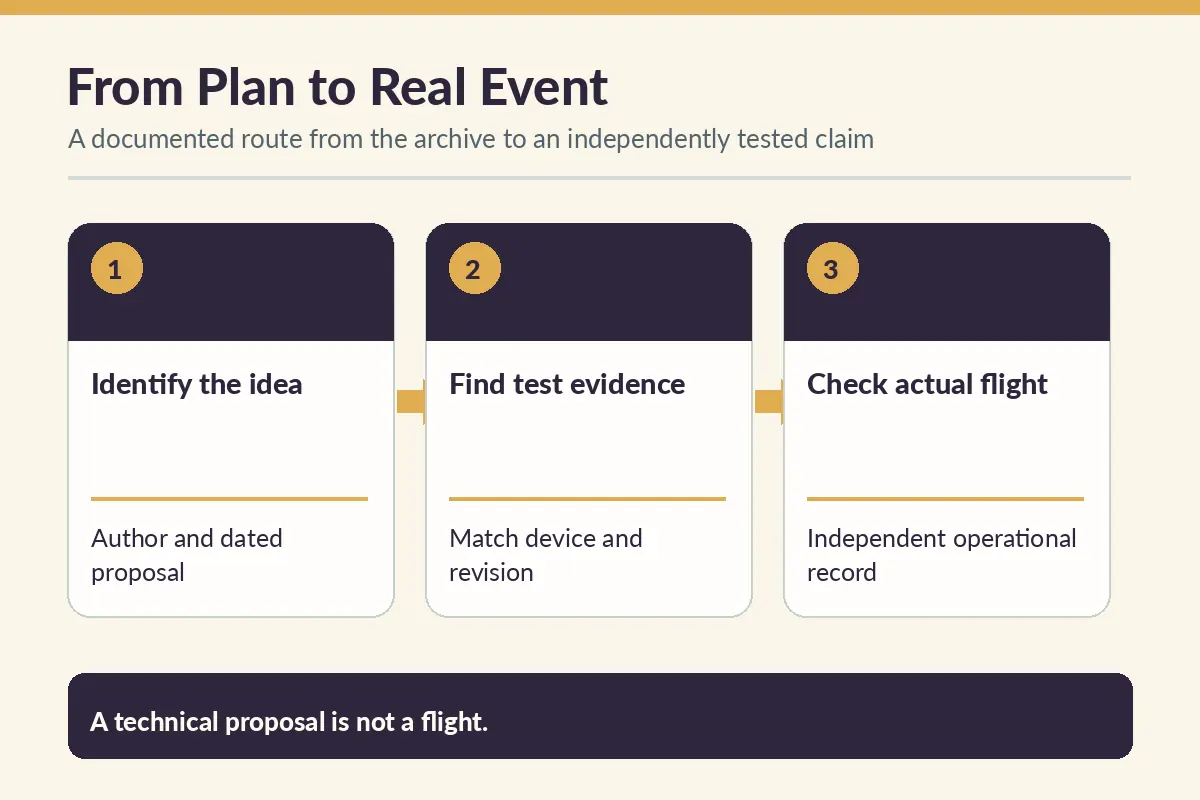
For an early aviation research case, a compact four-question test is effective: What was proposed? What was authorized? What was physically tested? What flight, if any, was documented? AIR 20 may answer one or more of those questions, but you should not mark all four as established merely because they appear in one catalogue description. Label any illustration as an editorial reconstruction, not a facsimile of an Air Ministry drawing. Use contemporary terminology carefully and explain why a technical claim can be reliable for a component yet irrelevant to a named person’s service biography.
More Research Method Guides
How We Research This Archive Series
Our editorial source review on November 8, 2026 used The National Archives research guidance for the archive-specific series and its complementary record guidance for evidence context and access limits. We have not claimed to consult an original file or a named person’s unpublished record. Hypothetical examples are explanatory only. A series description establishes coverage and arrangement, not the facts of every individual document. The graphics explain research decisions and are not facsimile images of historical sources.
A reproducible finding needs the research question, contemporary date and locality, creator or department, exact piece and page if known, a literal description of what is actually recorded, and an independent source where one is available. Keep catalogue descriptions and third-party indexes separate from original page evidence. A negative search establishes only what was searched and what was accessible, not that an event could not have happened. Check the current access conditions and any privacy restrictions before ordering or publishing historical material. See our affiliate disclosure; these archival links are not paid endorsements.
No. It is an unregistered-paper research route, not a comprehensive individual flight-log collection.
No. Look for dated construction, test or production evidence relating to the same model.
The National Archives points to AIR 1 for early aeronautics, AIR 2 registered files and AIR 8 senior staff papers.
Not without an appropriate operational source linking a particular aircraft, unit and date.
Separate the file cover date, each enclosed paper and any experiment date cited within it.