
MH 55 includes British Ministry of Health public-information and exhibition materials useful for understanding how health advice was presented at a particular time. The National Archives highlights a Leicestershire healthgram from around 1929 (MH 55/26), a 1924 Ministry of Health exhibition plan (MH 55/31), and a September 1948 NHS pamphlet (MH 55/965). These are unusually vivid documents for family stories, but they are not patient registers. A government leaflet can establish the advice being circulated, not that your grandfather received, obeyed or needed that advice.
The National Archives account of health in the 1920s provides the first two examples, while its NHS foundation article identifies the later pamphlet. Use each item’s exact archival reference and publication context, rather than turning the MH 55 series into a fictional complete collection of every British family’s medical history.
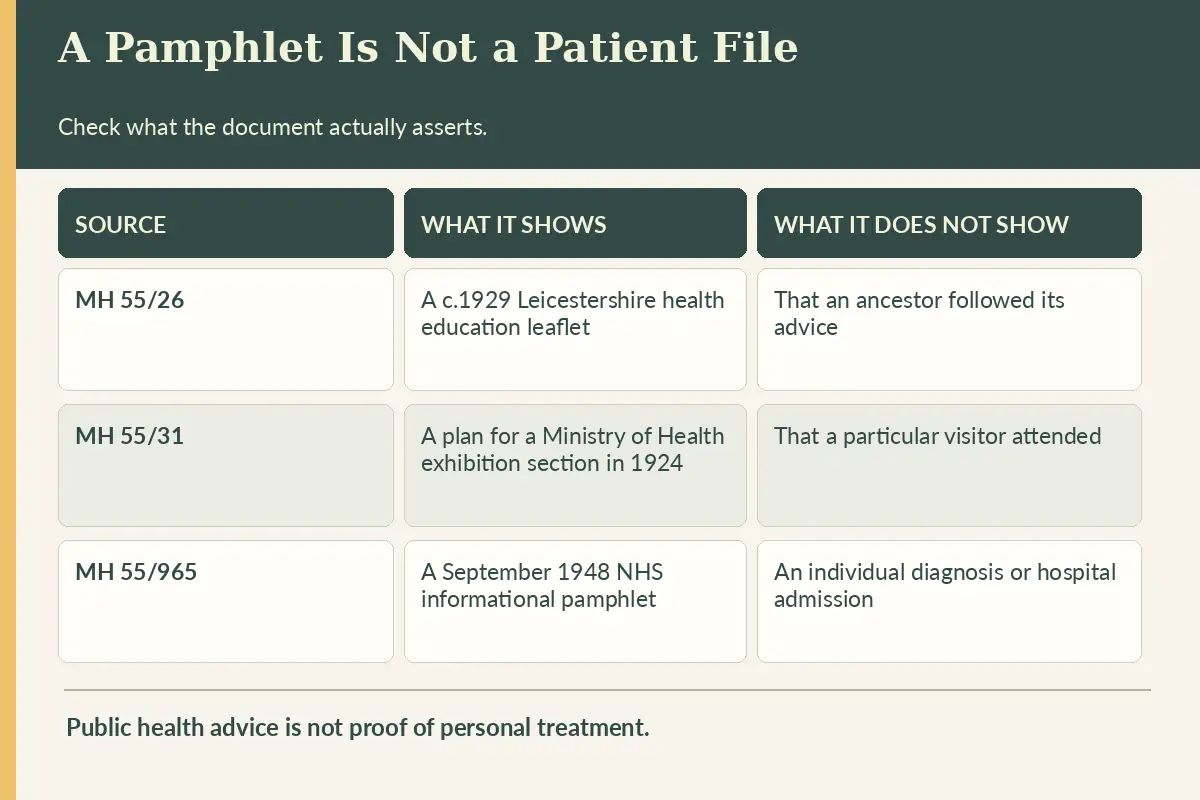
What these three MH 55 examples actually show
MH 55/26 is a healthgram associated with the Leicestershire Insurance Committee, dated around 1929, promoting advice about ventilation and healthy living. MH 55/31 relates to the Ministry of Health section of the British Empire Exhibition at Wembley in 1924. MH 55/965 documents NHS information messaging in September 1948, shortly after the service opened on 5 July 1948. Each item has a different kind of audience and institutional function.
The healthgram demonstrates advice that was written and disseminated in a particular campaign setting. A plan for a display demonstrates an intended exhibit layout, not the number of visitors. The NHS pamphlet represents an official message about a new institution, not universal knowledge among the public. Put the source type beside every claim: leaflet, exhibition plan or pamphlet. Resist describing all three simply as “medical records.”
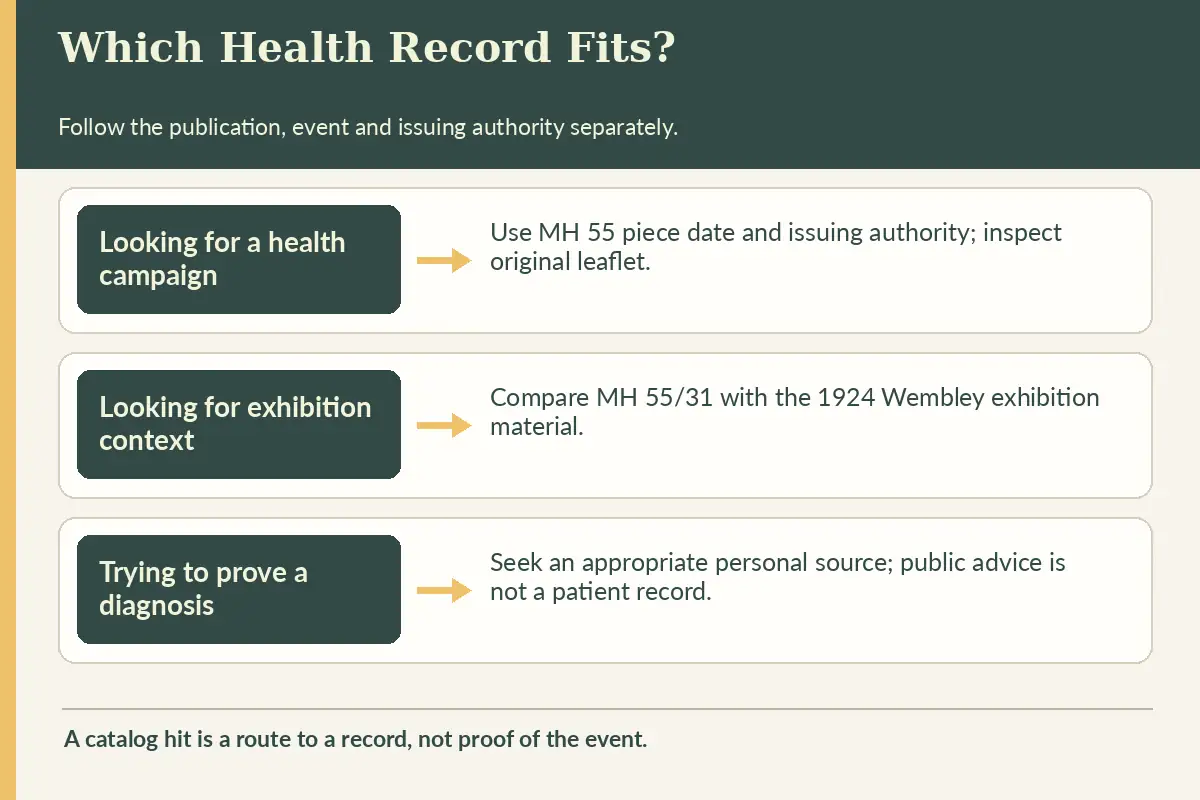
Find the original item instead of an online excerpt
Use Discovery to locate the exact MH 55 references and read the record description, date range, title and access arrangements. A published National Archives article may reproduce one page or summarize a document. That is a reliable guide to an original, but a screenshot from the article is not necessarily the complete object. When possible, inspect the entire item and note the authoring office, printer, series, piece number and version.
If researching a different town, search by local health committee or campaign terminology, but do not assume a national propaganda campaign issued identical flyers in every district. Local arrangements differed. Catalog searches may locate papers elsewhere in the MH department or municipal archives. Record where the item was found and what words are from the document versus the catalog writer’s modern description.
Separate public advice from historical medical reality
Public health advice is a mixture of observation, institutional ambition and the scientific understanding available at the time. An old flu circular can contain recommendations that do not match modern medical knowledge; reproducing it as current health advice would be irresponsible. Read the item as evidence of a past message, not medical guidance for today. Likewise, language about cleanliness, ventilation or disease may reflect the attitudes and limitations of its period.
A family story might say an ancestor feared influenza in the aftermath of the 1918–1919 pandemic. The health materials help describe the environment of public messaging, but they cannot demonstrate the person’s infection, prognosis or treatment. For that separate claim, consult an appropriate contemporaneous personal letter, hospital admission record or death certificate where lawful and available. Identify the informant and source before quoting an illness as fact.
Connect campaigns with towns without inventing audiences
To build a local narrative, record the issuing body, its territory, the campaign date and how the item was intended to reach the public. A Leicestershire flyer is local evidence; it should not automatically be generalized to a Scottish household. The Wembley exhibition was a nationally visible event, yet a plan does not prove that an identified relative visited. A government policy announcement does not show how one doctor or patient behaved.
If a person worked for a health authority, locate employment documents or council minutes that place them in that office. If a child appears in a school photograph from the period, do not assume participation in a public-health class because a healthgram circulated nearby. Maintain a separate timeline for the institution, the public campaign and the individual’s documented life events.
Keep publication and event dates apart
A campaign document can be drafted, printed, circulated and later deposited in a file. Each step can have a different date. For MH 55/26, the National Archives says “around 1929”; do not replace that qualifier with an invented exact publication day. MH 55/31 is a plan from 1924, which does not establish that each planned display remained unchanged through the exhibition. The September 1948 pamphlet was created after the NHS began, not before its start.
Use a date ledger with fields for item date, event it describes, exact or approximate wording, and independent source. If the same graphic appears in a reprint, do not combine all versions into one. Provide page or folio where possible. This small discipline prevents highly shareable historical images from producing incorrect family-history timelines.
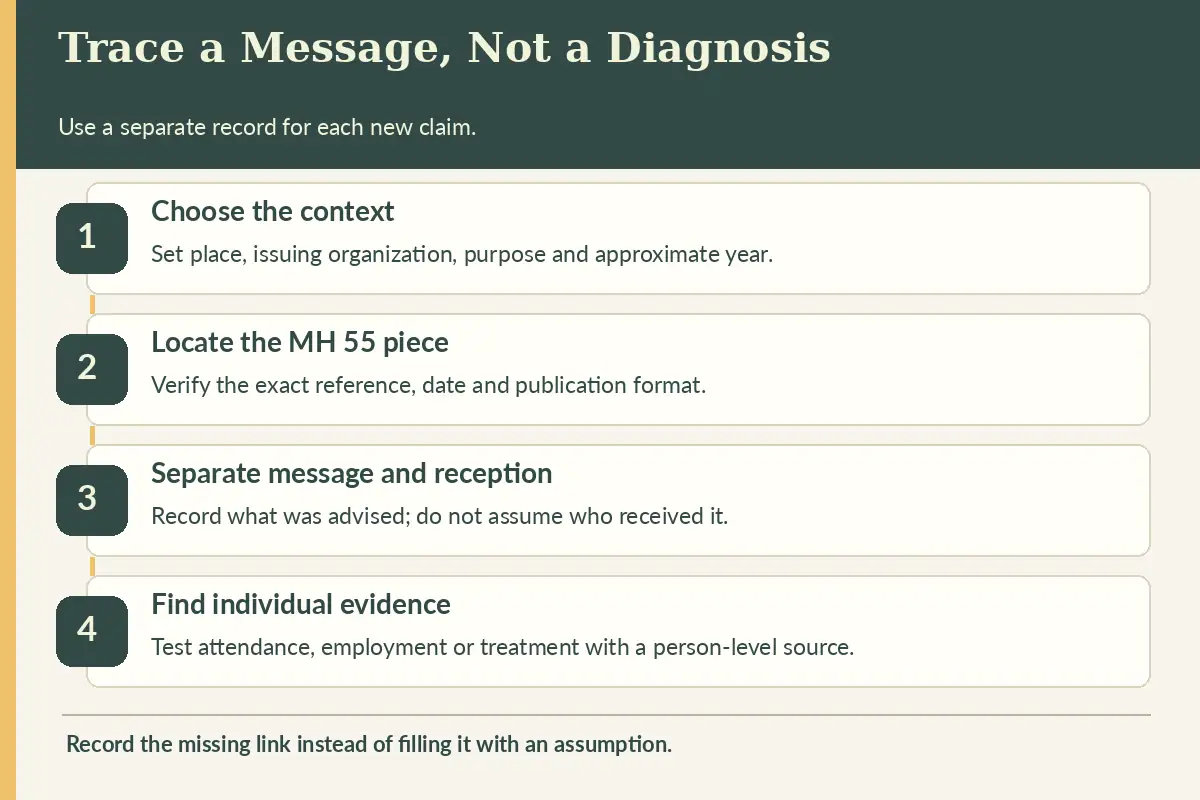
Write useful family context with a firm evidence boundary
A well-supported paragraph might explain that the Leicestershire Insurance Committee was distributing health education messages around 1929, citing MH 55/26, and then separately note which residence evidence places a family in the county at that time. It should not claim that the family read the healthgram without a source showing distribution to that household. Similarly an NHS pamphlet from 1948 can set historical background for a family member’s later hospital recollections without being evidence of the treatment itself.
Save citations, images or transcriptions according to repository terms and distinguish editorial captions from words printed in the item. If a personal medical file is required, investigate its custody, survival and privacy rules instead of trying to force an answer from a government campaign record. The value of MH 55 here is context about what the authorities published; the proof of a person’s experience must come from evidence actually about that person.
More Research Method Guides
How We Research This Record Type
We begin with the archival custodian’s documented series description, its chronology, purpose and preservation limits. Then we compare a different official source, review search coverage and access options, and separate the wording of an original item from our interpretation. We check competing place spellings, chronology, provenance and whether the claimed event could be established by this type of record at all.
Our conclusions remain tied to the date and scope of a cited source. A photograph is not a roster, an administrative card may report an unconfirmed event, and a historical map is not a certificate of ownership. The affiliate disclosure explains the site policy; these research routes are not presented as paid endorsements.
No. The cited MH 55 examples are public-information and exhibition materials, not records diagnosing named people.
The National Archives identifies MH 55/26 as a Leicestershire healthgram dated around 1929.
A 1924 plan of the Ministry of Health section at the British Empire Exhibition in Wembley.
Yes. The National Archives describes a September 1948 NHS information pamphlet under that reference.
No. Interpret them as period evidence and use current qualified medical advice for present-day decisions.