
MH 10 holds circular letters from central Poor Law and health authorities, with coverage described by The National Archives as 1834–1962. A circular can explain what a board of guardians or later authority was told to do. It does not demonstrate that a particular union complied, that a rule applied in every case, or that a named person entered a workhouse. The official health and welfare guide says MH 10 is best approached by browsing dates. Treat the central instruction as the beginning of a testable local question, not its answer.
For a repeatable search, separate three questions at the outset: which office created the source, what that source actually states, and what independent record could test your interpretation. A catalogue hit is a lead, not a complete transcription. Keep source, date, place and role alongside each tentative claim. The diagrams below show alternatives and conditions rather than a promise that every record survives.
Choose the correct authority and year
The poor law was administered by changing central bodies. A directive issued in the 1840s cannot be assumed to have the same issuing authority or legal setting as a circular from the interwar Ministry of Health. Record the authority printed on the document, the date it was issued, the subject heading and the local authorities it addressed. The date of a central circular may be earlier than the meeting in which a local board discussed it. Build a two-date timeline rather than asserting same-day implementation.

The archive’s twentieth-century guide places MH 10 among series that should often be browsed by date. Subject searches can help generate leads but may not expose all the content within a bound circular or file. If the change concerns a specific borough, determine the historically responsible guardians, council or authority before searching their surviving records. Reforms transferred functions; the correct repository and administrative body can change even though the building and population remained in the same place.
Read the instruction without inventing an outcome
Identify whether the circular states a legal requirement, explanatory guidance, recommended practice, a request for statistics, or a notice of an earlier order. Those are different forms of communication. Read the qualifying clauses and effective dates: an instruction might refer only to a type of institution, to a temporary scheme or to a defined class of claim. A diagram that labels every circular ‘law’ risks giving readers the wrong legal status. Quote the exact authority and section before treating it as binding.
A document may request that local authorities report back, but the presence of that request in MH 10 does not mean a reply survives there. Notes, stamps or printed circular numbers can help locate related correspondence elsewhere, yet they must be interpreted as identifiers rather than a person’s history. If a circular expresses an intention to improve treatment, record it as policy intent. To establish what happened, seek contemporaneous inspections, minutes, local expenditure, admission books or relevant case files subject to access rules.
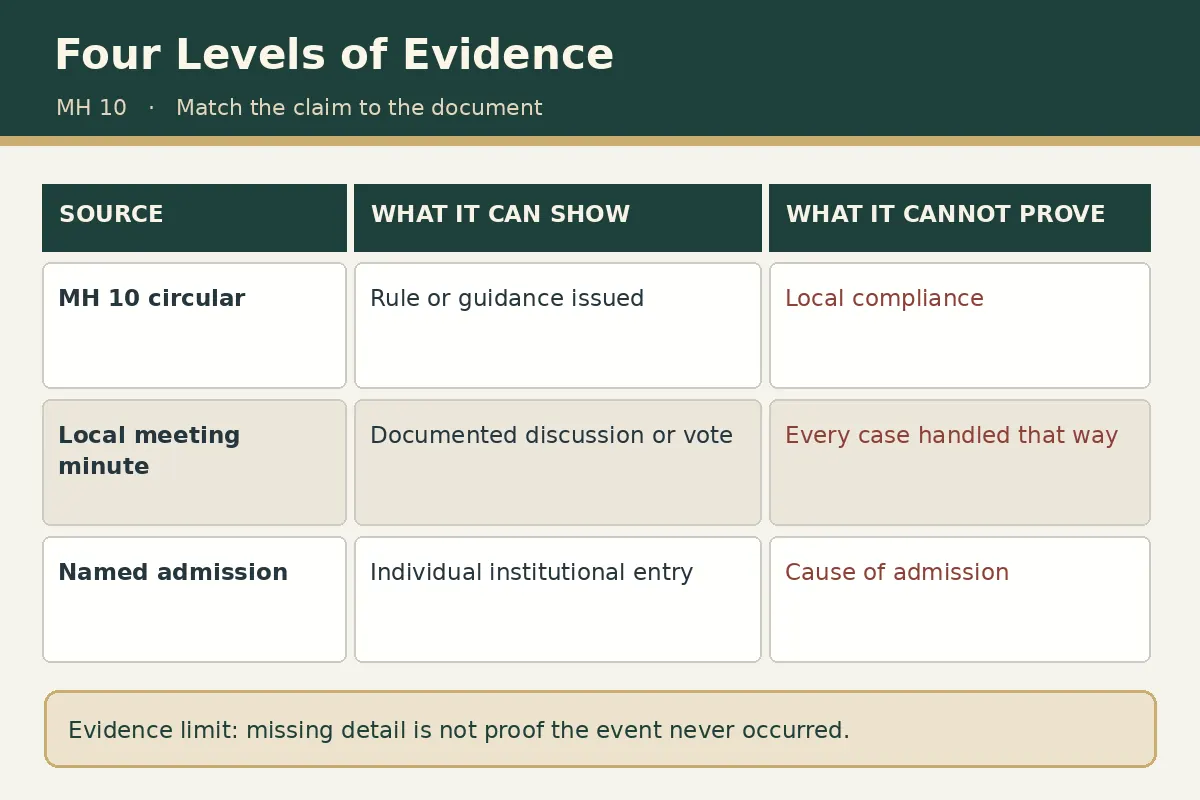
Match the circular with a local decision
Start locally with the minute book of the appropriate board of guardians, the workhouse committee or later public assistance authority. Search around the circular’s issue date and allow for administrative delays. Look for explicit evidence of receipt, discussion, adoption, objection, or deferred implementation. A minute recording that a letter was ‘read’ proves the board considered or received it; that is still weaker than a minute approving a budget, appointing staff or ordering a policy change. Keep these stages in separate columns.
Local records are often held by county or municipal archives rather than the central repository. Their finding aids may organize documents by union, committee and broad date, not by the title of a national circular. Record the historical name of the union and the date when boundaries or functions changed. If the minutes are silent, do not assume the authority ignored the instruction. Look at correspondence with government, accounts and inspection records; none is guaranteed to survive for every place.
Keep institutional and personal records apart
A circular about relief, medical treatment or workhouse accommodation rarely identifies the individual beneficiaries researchers hope to find. Even when it describes an eligibility category, it cannot show that an ancestor received relief. Personal-level evidence may require a surviving admission or discharge register, an outdoor-relief list or a local application, each governed by its own catalogue and access restrictions. Do not convert an institution-wide change into the story of a named person simply because that person lived in the union district.
An administrative record can still improve genealogy by explaining the rules in effect during a documented family event. For example, if an independent entry proves an admission in a specified month, an MH 10 circular may explain the wider official expectations. Cite both sources separately. Clearly mark what comes from the original register and what the circular says about policy. When investigating sensitive cases involving children, disability or healthcare, avoid guessing diagnoses or family circumstances from generalized institutional instructions.

Write a policy-to-practice evidence ledger
Create four columns: ‘central circular,’ ‘local acknowledgement,’ ‘local action,’ and ‘person-level proof.’ Each entry should carry a date, repository reference, and one sentence explaining precisely what it establishes. Leave a cell blank if the relevant evidence has not been found; never fill it with an assumption. This also prevents later research notes from presenting a request for a local report as if it were the report itself. If an instruction was later amended, preserve both versions and identify which was in force at the event date.
Conclude with two statements if necessary: the national authority issued a dated circular, and no surviving record yet located demonstrates how a particular union complied. That is a rigorous research outcome rather than a failure. For repeatability, include both the exact MH 10 item and any relevant local records, plus searches that produced no results. Describing the gap accurately makes future local archive work possible without giving a false personal history to a workhouse resident or an applicant for relief.
More Research Method Guides
How We Research and Verify These Records
Our starting points are research guide from The National Archives additional archival guidance. We checked the series descriptions, dates and stated survival or access limits on November 2, 2026. The diagrams are explanatory reconstructions, not reproductions of historical manuscripts. We distinguish a catalogue summary, an original document, a later transcription and an independently checked claim; none should be silently substituted for another. Use the full piece-level archive reference and folio where available.
Every suggested research route is conditional on the surviving records for the place and date in question. We do not infer a negative historical event merely because a public search yields no result. Dates that appear in later indexes can be editorial and must be differentiated from the date written in an original document. This guide contains no paid partnership claim; see our affiliate disclosure.
No. It documents a central communication; local decisions and actions require separate evidence.
The National Archives recommends browsing circulars by date, then investigating subject and issuing body.
Usually not. Look for individual admission or relief records from the local authority.
The National Archives describes the series as covering circular letters from 1834 to 1962.
A local guardians’ minute book, inspection report, account or named register, depending on the claim.