
Know Which Poor Law Record Is Actually Being Searched
For England and Wales, nineteenth-century letters exchanged between local Poor Law Unions and central authorities survive in The National Archives series MH 12. The official poverty and Poor Laws guide broadly dates this correspondence from 1834 to around 1900. MH 12 sometimes names applicants for relief, workhouse staff and people lodging complaints, but it is not a daily roll of all residents and staff at the workhouse.
A clear research question might concern a person who wrote about denied relief in a particular union, or a clerk named in a dispute during the 1850s. Start by establishing union, event date and document purpose. The relevant local workhouse’s admission register may be at a county archive instead. Central correspondence exists because an issue was reported upwards; everyday institutional activity that never reached the central board may be entirely absent from MH 12.
Identify the Historical Union, Not Just the Workhouse Town
The National Archives emphasizes that a workhouse site and its responsible Poor Law Union can have different names. Its guide offers Slough, served by Eton Union, as an example: searching MH 12 only for Slough may not find the Eton correspondence. Place the reported residence, the union’s administrative name and the workhouse site in separate columns. Confirm the relevant union for the event year before searching catalog descriptions.
A union could encompass more than one parish, so a family’s parish name is not sufficient to find the central letters. Search the county and historical union hierarchy in Discovery and record the union number when the entry displays one. Do not assign a letter to the closest workhouse by modern road distance; archive arrangement follows historical administrative units, not the modern town in a family narrative.
Understand Which MH 12 Volumes Are Digitized
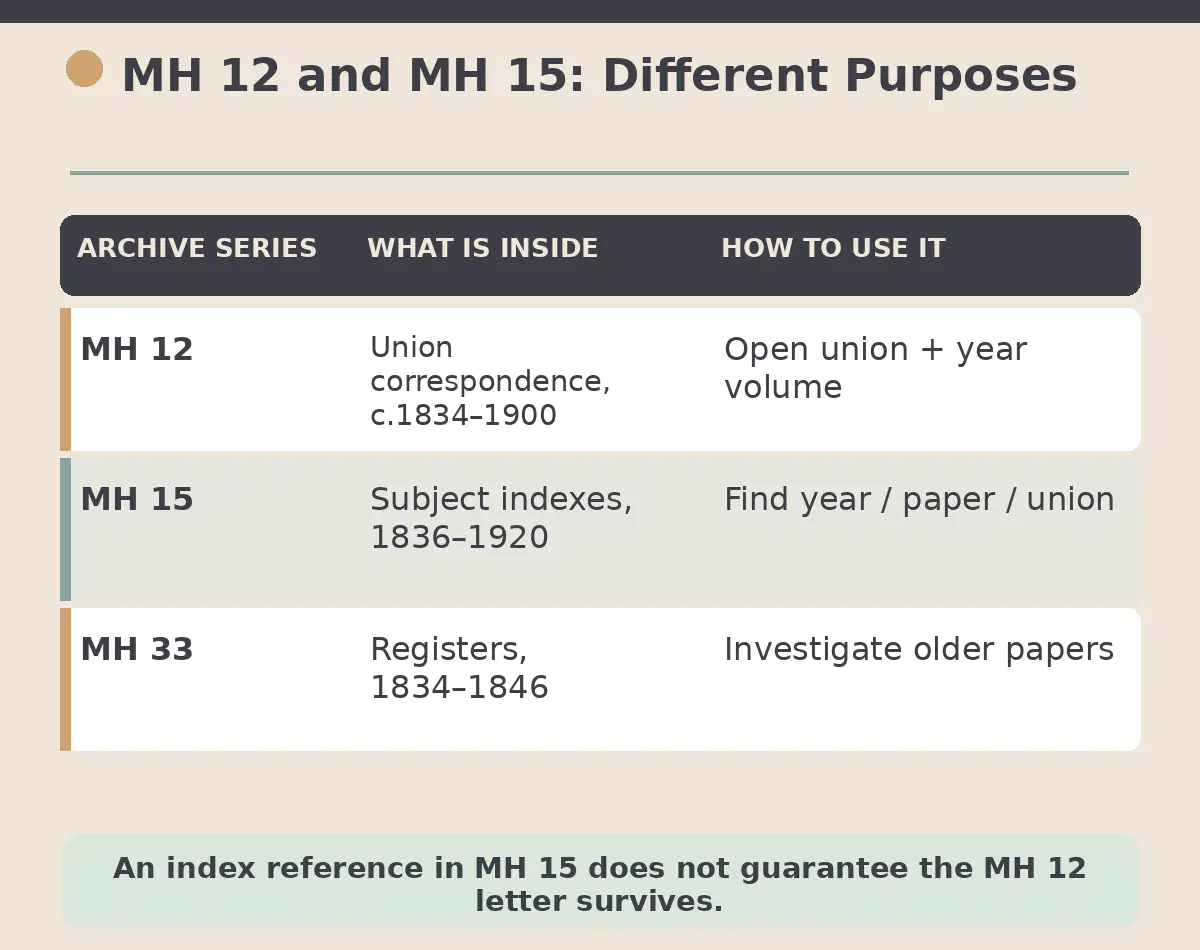
Most MH 12 material is described at union-and-year volume level, not person by person. Some selected unions have been catalogued in greater detail, and some have digitized letters. This is why a search for a distinctive name may produce a digitized letter from one union but no result from an equally plausible neighboring union. The Archives lists selected unions and their digitized or indexed date windows; those limited windows do not describe all MH 12 holdings.
Try a name, place or occupation only after reviewing the available union coverage. If a volume has no detailed descriptions, search by union and date and plan to inspect the correspondence inside. A blank name search is not evidence that a person never wrote. Keep the catalog reference to the volume, then note individual paper identifiers and folios when they appear in the original correspondence.
Use MH 15 Subject Indexes to Find an Uncatalogued Letter
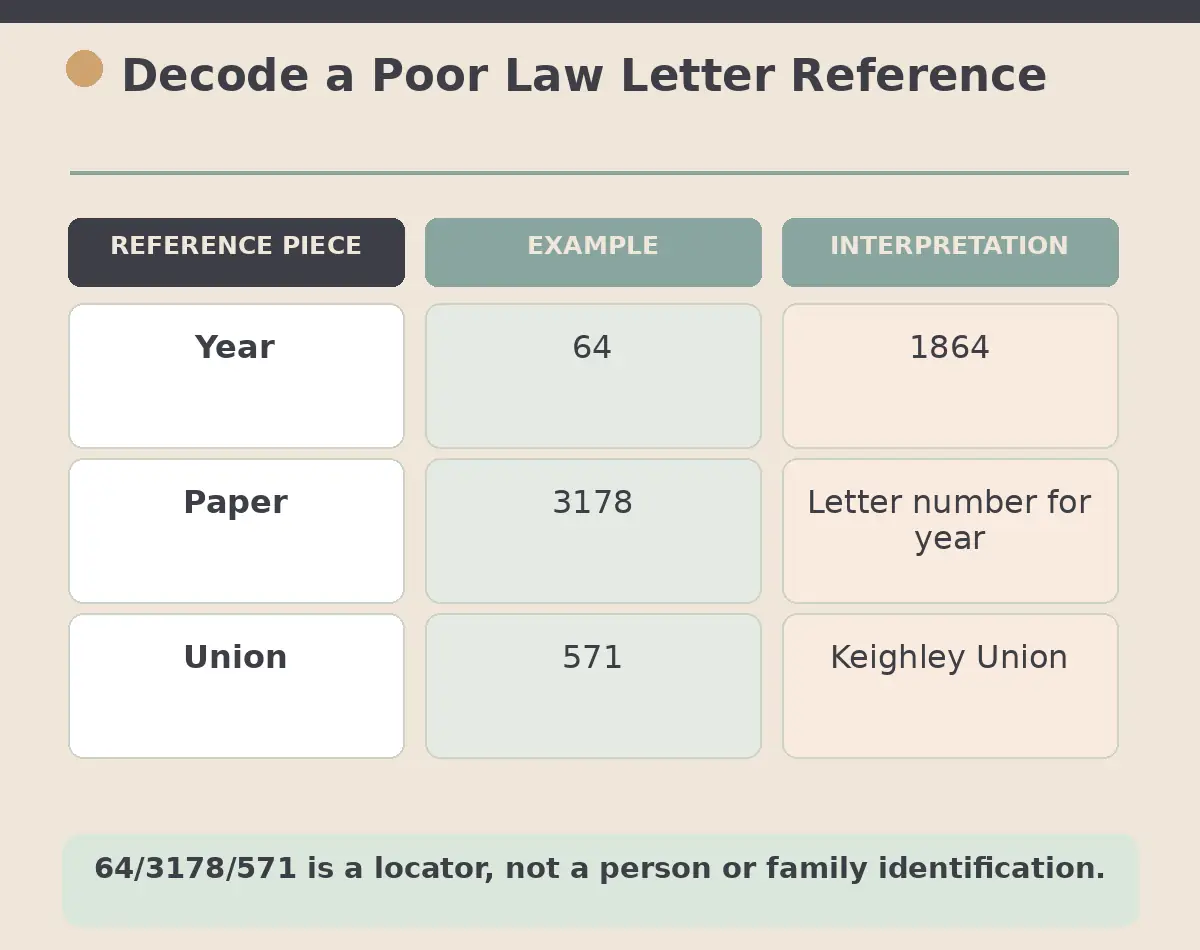
The MH 15 subject indexes can provide a route into correspondence that lacks item-level cataloging. The Archives’ official guide decodes a sample reference, 64/3178/571, as paper 3178 of 1864 for Keighley Poor Law Union 571. Locate the union’s corresponding MH 12 volume covering that year and find the paper inside. Keep the three reference elements separate: year, paper and union number are not a person’s birth date or document page number.
MH 15 index books differ in date spans and subject divisions. Up to 1855 they are annual; later volumes can cover ranges with multiple subject divisions. A single subject heading does not exhaust all relevant correspondence. The Archives also explains MH 33 registers for 1834–1846 and notes that some later MH 15 entries may be the only trace of correspondence destroyed after 1900. An index reference is a locator, not proof the underlying letter survives.
Read Administrative Opinions and First-Person Complaints Separately
When you open a paper, identify who wrote it, who received it and whether it is a direct personal statement, a guardian’s report, a clerk’s summary or a later central-office annotation. These are distinct layers of evidence. A complaint that relief was refused documents an allegation or experience reported to the board, not an automatic finding that officials acted unlawfully. A central response may impose a recommendation without establishing what happened to the family afterwards.
For example, The National Archives highlights a 1842 letter by Thomas Henshaw with reference MH 12/9232/46. It demonstrates how a named individual’s words can survive in the broader correspondence. This is an archival illustration, not a substitute for proving the identity of your own namesake. Record the writer’s address, occupation and family statements only as the letter actually gives them.
Link Letters to County Workhouse and Parish Records
The National Archives’ separate workhouse inmate guide directs researchers to local and county archives for admission, discharge, birth, death and staff registers. These are independent collections with different coverage. Use MH 12 to identify a reported controversy or application, then check whether a local institutional register corroborates a person’s stay. Do not treat a letter mentioning the workhouse as an admission entry.
A parish record may identify a baptism or burial but not explain why assistance was sought. In the same way, a census may put a person in an institution at one moment without proving the substance of an 1840s complaint. Keep one line per claim: letter writer, reported household, recipient and local institutional event. Contradictory evidence should remain visible rather than collapsed into a polished family story.

Interpret the 1900 Boundary and Survival Gaps Correctly
The main MH 12 sequence reaches approximately 1900, and the Archives reports that most post-1900 papers were destroyed by fire during the 1940s. Other government correspondence and indexes survive in different MH series. If your target lived in 1908, do not assume the relevant local relief event should be retrievable from MH 12 merely because the poor-law system continued. Check the correct chronological and administrative record class instead.
Likewise, a subject entry surviving in MH 15 may point to a lost or unlocated paper. Record that split as “index survives; original correspondence not yet established,” not as a fully inspected letter. Build an explicit source-status ledger: cataloged letter, digitized original, union volume not inspected, index-only reference or confirmed lost. This stops a database snippet from becoming a falsely precise narrative.
Document Search Results With the Year–Paper–Union Key
For a positive finding, cite the document creator, addressee, date, The National Archives series MH 12, full reference and folio or paper number if visible. For an index-only result, cite MH 15 separately and do not pretend the original was seen. If a digitized file includes enclosures, record them in order: an attached witness statement may be a different informant from the clerk’s forwarding letter.
Where a name search gives no result, state which digitized union years or paper volumes were actually searched, and which were outside indexed coverage. If a family is associated with a workhouse town but not a union, the first next action is a historic union-identification check, not an expensive name search. The same evidence logic applies whether documents are inspected online or requested at Kew.
More Records and Archives Guides
How We Research an MH 12 Correspondence Lead
We locate the historical union, verify the date span and detailed description status on The National Archives’ official MH 12 guidance, then use name search or MH 15 subject references as appropriate. We keep the MH 15 year–paper–union locator distinct from the MH 12 volume and only attribute a statement to the person who actually made it.
We then compare the named person with independent local workhouse, parish or census records, without assuming a complaint proved administrative guilt or that a workhouse letter proves residence. We document gaps and surviving-index-only cases in full. The site’s affiliate disclosure is provided for transparency; research steps rely on documented custodial tools, not unconfirmed endorsements.
Central correspondence with Poor Law Unions and other local authorities, mainly 1834–around 1900.
No. Most correspondence is cataloged by union and date; only selected items have detailed name descriptions.
Subject indexes can point from a year, paper number and union number toward relevant MH 12 letters.
No. Some index entries relate to lost papers, especially around the later period.
Often in local or county archives, not the central MH 12 correspondence series.