
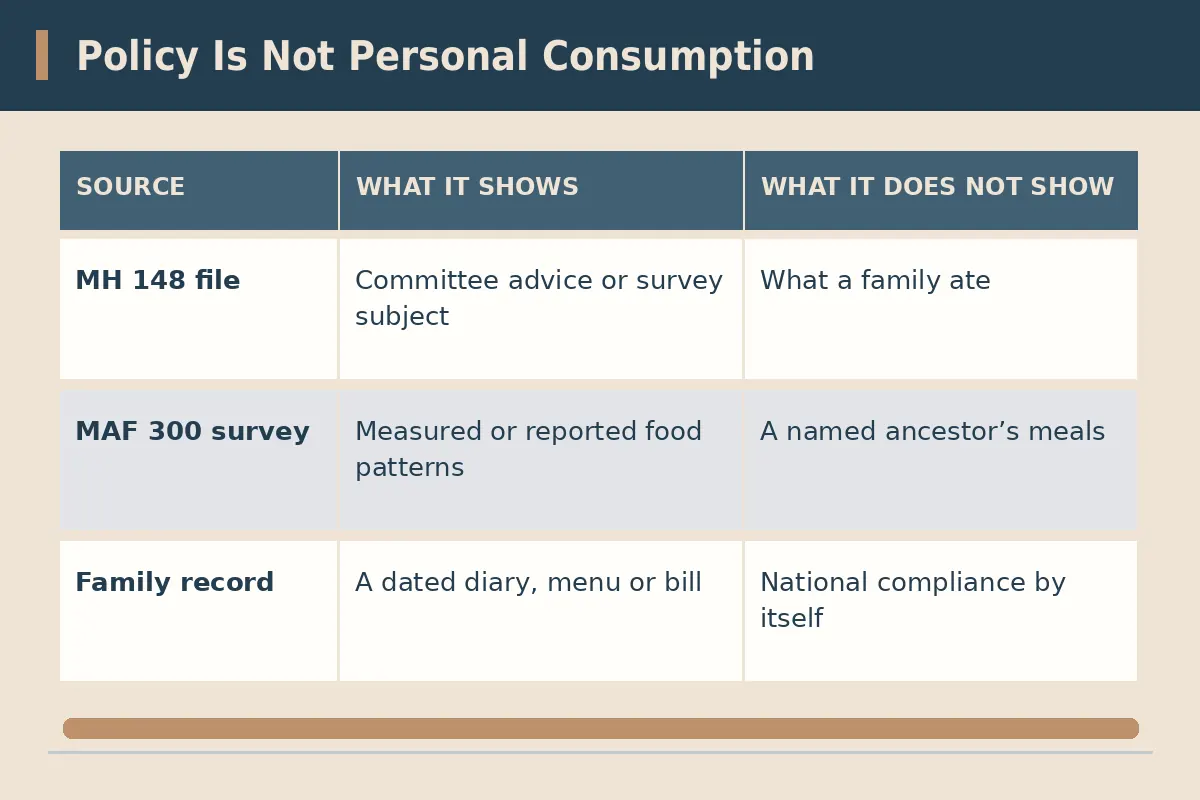
The National Archives lists MH 148 among records of the Committee on Medical and Nutritional Aspects of Food Policy and food-and-nutrition surveys spanning 1948–1992. Such files help trace scientific advice and government deliberation. They do not automatically show the meals, health or purchases of a named historical family. This guide gives a precise source route, identifies what the archive can and cannot show, and names the independent documents needed before a personal or geographic conclusion becomes defensible.
Identify the Policy Question Before Choosing an Archive
Nutrition history contains several kinds of evidence that look superficially similar: committee advice, laboratory assessments, food surveys, national guidance and household diaries. The National Archives names MH 148 for papers of the Committee on Medical and Nutritional Aspects of Food Policy and related food-and-nutrition surveys dating from 1948 to 1992. A file may concern a substance, category of food or public-health question rather than an identifiable meal. Choose the question first: what did officials investigate, what recommendation did they make, or what did a household actually consume?
Search a concrete subject with plausible date limits. The archives mention imported meat, food hygiene and additives among MH 148 topics; do not assume those are an exhaustive list of every file. Keep original committee names, abbreviations and dates. If a catalogue title says “review” or “survey,” avoid immediately calling it a law, a national ban or a finding accepted by government. The document’s own status should be transcribed after reading it. Scientific discussion and political decisions are separate stages in the historical record.

Separate Expert Recommendations from Government Actions
A committee may collect evidence, hear competing interpretations, draft a report, revise a recommendation or refer a matter elsewhere. Record its date, remit, members where documented, and precisely what it recommended. A meeting agenda is not the same as an agreed conclusion. A recommendation to investigate a food additive does not establish that the additive was banned or ever used by a particular manufacturer. Check subsequent publications, regulations or departmental records before claiming implementation. Preserve any disagreement, including minority opinions or documented uncertainty.
Use a timeline with distinct columns for evidence considered, recommendation issued, official decision and enforcement or observable effect. If a later paper cites an earlier report, seek the source rather than relying on a paraphrase. Government policy may evolve across committees or departments, and the title of a file may reflect a later filing practice. A policy historian can establish that a topic was under discussion from the dated record, but should not convert a consideration into a completed action without the relevant subsequent documents.
Hypothetical example: a descendant says grandparents stopped eating a particular ingredient after a government warning. An MH 148 file may show that an official committee reviewed the ingredient, but not that a warning was issued or received. Search for the actual public notice, then examine any contemporaneous household diary or letter. Without a family-level record, the connection remains a plausible context rather than a proved decision.
Read Food Surveys at the Correct Level of Detail
The official environmental-history guide separately identifies the National Food Survey in MAF 300, Food Supply and Consumption material in MAF 243 and other collections. These records may provide aggregate or sampled patterns rather than biographies. Before quoting a percentage or trend, identify the geography, population covered, period, unit and whether the value comes from collection, adjustment or later analysis. “Average consumption” is not interchangeable with “what every household ate.” Some data may exclude people or situations not captured by the survey design.
A household food account, receipt book or institution menu can answer a different question about a particular place and period. Such sources also have limits: a purchased ingredient may not all have been consumed by one person, while a printed menu may not show what was actually served. Correlate with income, wartime ration restrictions or local availability only when supported by documents from the correct period. Do not attach a national health finding to an ancestor as a diagnosis or assume a nutritional recommendation changed their daily habits.
Compare Scientific Evidence with Everyday Records
For family research, create a claim sheet. Write the statement to be tested, such as “this family regularly used a particular food in 1960,” then list the evidence required. An MH 148 discussion might show why officials were concerned about safety or dietary guidance during that period; it does not name the family. A dated household notebook, bill or oral testimony might document purchases or memories, but each needs source appraisal. Separate direct observation, recalled experience and later inference rather than giving all three identical weight.
Where a family story involves school meals, hospital diets or workplace canteens, find the institution and historical local authority before searching menus or procurement records. National policy may set a framework but institutions can implement it differently. Check the exact school or hospital record where surviving and available. Be careful with living people’s health information and avoid inferring a medical condition from food purchasing or national statistics. The practical output is a transparent list of supported dietary facts and untested contextual possibilities.

Document Search Scope and Research Uncertainty
Use Discovery’s department and date filters to locate MH 148 material, but check the individual “Held by” and access fields rather than assuming all items can be downloaded. A search of a committee name alone may miss material catalogued by subject, chemical or food type. Keep a log of each query, alternate term, date range, relevant piece and actual document consulted. An abstract or catalogue record identifies a possible source, not the complete evidence or the final result of an investigation.
If no MH 148 file answers the question, search related official series and identify the custodian of any local institution. The final summary should be proportionate: “a committee considered an issue in a dated file” is often supportable, while “families were ordered to change their diets” requires policy and enforcement evidence. Archive absences can reflect retention, arrangement or access limits rather than indifference. Preserving these distinctions makes food history more accurate and far more useful for genealogy.
Citation model: The National Archives, MH 148/[piece], committee or report name, precise date, document status and pages consulted; then cite an independent published policy or household source for any further assertion. Do not describe a national survey estimate as evidence for an individual family’s dinner table.
More Records and Archives Guides
How We Research This Archive Series
This guide starts with the documented evidence in an authoritative source, not a claim that we have inspected a particular person’s private file or a specific original piece. The archival statements here concern the series or research method. A hypothetical example is labelled as such; it is not a newly discovered historical event. We use the Discovery search guidance to distinguish keyword matches from archive holdings and document contents, because catalogue descriptions do not transcribe every word of an original.
For every real candidate, record its historical place or person’s name, the creator, document type, date, full MH 148 piece or item reference, access restrictions, and the exact claim being tested. The official citation guide explains how to document those references so another researcher can retrace them. An unread document remains a catalogue lead, never proof of imagined details. If a record is missing, preserve the searched terms and dates and examine survival and alternate custodians before interpreting the gap.
Before sharing a conclusion, audit the difference between original source wording and your interpretation. Require independent evidence for any further claim about an individual, property owner, legal effect, or completed action. Respect archival access limits and living people’s privacy. This website also provides an affiliate disclosure; no paid partnership or commercial access is implied by these archival references.
Papers of food policy and nutrition advisory bodies and surveys, with holdings identified by The National Archives for 1948–1992.
No. Seek the actual policy decision, regulation and relevant implementation records.
Not by themselves. Survey findings concern sampled or aggregate patterns, not a particular family.
The National Archives identifies MAF 300 for the National Food Survey and MAF 243 for Food Supply and Consumption records.
Include the piece reference, committee, date, exact document type and page or section used, and distinguish catalogue from original.