
HO 69, the Bouillon Papers, is a route into the British government’s correspondence involving French émigrés and political and intelligence activity during the Revolutionary and Napoleonic wars. The records described here can answer a precise historical question only when the researcher separates what the source actually says from what a later interpretation would require. The first step is to identify a document, its original purpose, the date and place it describes, and the independent evidence needed for a larger family or local-history claim.
Identify the Correspondence Instead of Assuming Arrival
HO 69, the Bouillon Papers, is a route into the British government’s correspondence involving French émigrés and political and intelligence activity during the Revolutionary and Napoleonic wars. The National Archives’ Napoleonic guide describes Philip d’Auvergne, Prince de Bouillon, as the senior naval officer in Jersey who coordinated a French royalist intelligence network between 1794 and 1815. The mere presence of a French surname in this material does not establish that its bearer crossed the Channel, lived in England or received a refugee pension.
Begin with one named person, a documented spelling variant, a narrow date window and the question you actually hope to answer. Are you seeking an exchanged letter, a claimed role in royalist affairs, arrival at a port, payment of relief, or later residence? Each needs different evidence. Keep contemporary labels such as “émigré,” “agent” and “refugee” as wording from a particular document rather than uncritically assigning a permanent social or political identity.
Place Jersey and the War Years on the Map
Jersey was central to this correspondence network, but the subject of a letter might have been in France, Britain, the Channel Islands, at sea or at a place described only indirectly. The 1794–1815 span stated in the Napoleonic research guide concerns the officer’s period of activity; it is not a guarantee of complete HO 69 correspondence for every month. Nor should the wider 1789–1814 French émigré record context given in the immigration guide be silently equated with the life dates or residence of a named correspondent.
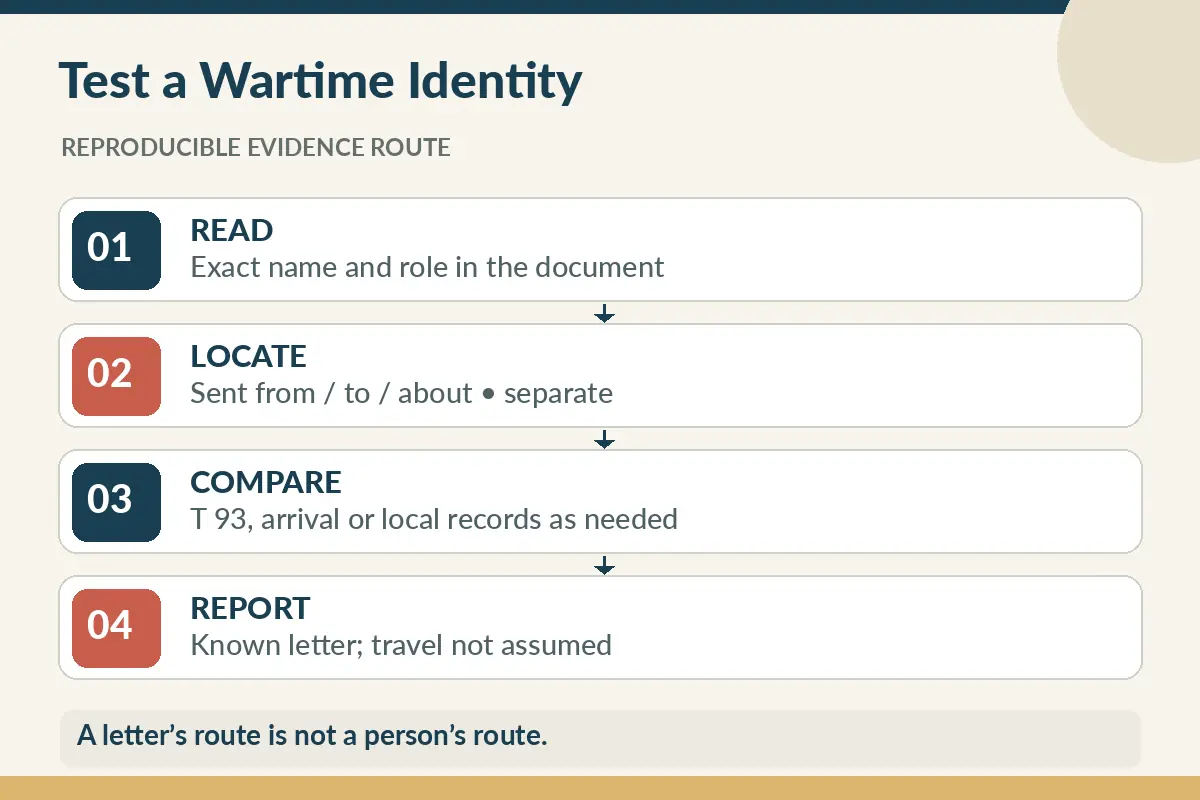
Record four separate places when present: where a letter was written, where it was addressed, where the described event allegedly occurred, and where the person can be independently proved to have been. A letter sent to Jersey can describe events in Brittany without establishing the writer’s arrival in Jersey. Similarly, a forwarded report may be secondhand. Distinguish the date of dispatch from the date a government officer copied or received the text, because the difference can change an apparent sequence of movements.

Search HO 69 Alongside Other Government Files
The National Archives explicitly points researchers to HO 69 for the Bouillon Papers in both its immigration and Napoleonic research guides. Search Discovery within the series and test name variants, place names, associates and dates. Catalog descriptions may index a bundle or a correspondent but not every name in an enclosed letter. A missing individual result is not proof that the person was absent from the correspondence. Browse relevant file descriptions and consult the underlying documents where access allows.
The immigration guide identifies other series for French émigré letters and papers between 1789 and 1814, including Privy Council records PC 1, Foreign Office miscellanea FO 95 and War Office in-letters WO 1. These are alternative search routes, not an automatic chain in which every letter appears. A government office may have received a copy of the same communication, a summary or an entirely different report. Track item dates and text versions before declaring two catalogue hits independent corroboration.

Classify Every Named Person’s Documentary Role
A name could belong to the sender, addressee, courier, translator, informant, beneficiary, accused party, relative or person mentioned in passing. Transcribe the actual role and language of the document before translating it into a biographical claim. A reference such as “the brother of” may be an assertion made by a correspondent rather than independent proof of kinship. In politically sensitive correspondence, accusations, rumors and reports may have been strategically framed for their readers.
Use three evidence fields: what was written, who supplied the information, and how much the writer could know firsthand. If a person is listed as a possible contact in France, that is not a service appointment in Britain. If a letter mentions money, separate the proposal to pay, a recorded disbursement and independent proof of receipt. Do not infer travel from the existence of a planned mission. Preserve alternate identities, titles and spellings without resolving them until another document justifies the match.
Test Relief, Landing, and Settlement Separately
The National Archives distinguishes the letters and papers of French émigrés from name registers and pension lists of the French Refugees Relief Committee, held in Treasury records T 93 for 1792–1828. If a family tradition says that an ancestor received British assistance, search the relevant T 93 material as a separate question. A payment listing can document relief administration, but it is not by itself a full account of when and where someone landed or how long they stayed.
For physical arrival, the same immigration guide discusses surviving certificates of alien arrival in HO 2 and other early sources, while warning that major gaps exist and no comprehensive immigrant-name index survives. Check the actual period and place before assuming a given record type applies. Religious registers, local records, marriage entries and residence documents may independently establish later life. Never turn a secondhand intelligence mention into a confirmed arrival, or absence from a surviving list into proof a person never came.
Write a Source-Bound Émigré Profile
An accurate outcome may be: “A letter among the Bouillon Papers names a person as a correspondent in an exchange involving Jersey; independent arrival and settlement records remain to be found.” That statement remains useful because it pins a name to a dated textual context without inventing a journey. Cite HO 69 with piece and item details, page or folio, letter date, writer, addressee, and whether the name appeared in the original or a later copy. Quote unfamiliar titles exactly in the notes.
Build a short grid of identity tests: name variants, claimed place, documentary role, date, corroborating reference and outstanding contradiction. Compare people with similar names by occupations, locations and associates, not by surname alone. If a file contains defamatory allegations or private family detail, describe the claim with attribution and care. A biography is stronger when it explicitly distinguishes documented communication, plausible interpretation and unverified residence or relationship than when it fills every wartime gap with an invented narrative.
More Records and Archives Guides
How We Research and Verify the Record Claims
The series scope, examples and record limits were checked against the original repository guidance: The National Archives; The National Archives; The National Archives. These sources explain how to locate a collection and interpret record families. They do not authenticate a particular unseen piece, individual person, building alteration or farm that a reader has not yet inspected. A catalogue description is a finding aid, not a full transcription. Preserve original wording and references, check survival and access arrangements, and make each independent source do a distinct job.
Our research standard separates source statements from reasonable inferences and from claims that remain unverified. Quotes in a petition, proposal or official letter are attributed to their authors rather than automatically accepted as established events. We have not asserted that every record is online or free. Our affiliate disclosure explains commercial relationships where applicable; no paid purchase is needed to follow this research method.
No. A correspondent could be abroad or merely mentioned. Seek independent arrival and residence records.
The National Archives describes Philip d’Auvergne as a Jersey-based naval officer coordinating a French royalist intelligence network during 1794–1815.
No. The immigration guide points to T 93 for French Refugees Relief Committee payment records.
The National Archives identifies PC 1, FO 95 and WO 1 as other possible routes for the period; search by subject and date.
It can contain a relationship claim, but the writer’s knowledge and independent family documents should be tested.