
HO 10 colonial lists preserve recorded musters, arrivals and pardons in Australia. Unlike a transport register, they may reveal a later administrative status but need careful dating. Begin with the custodian’s research guidance. See the GenHis affiliate disclosure before choosing an outside access provider.
Distinguish a Muster From a Convict Ship List
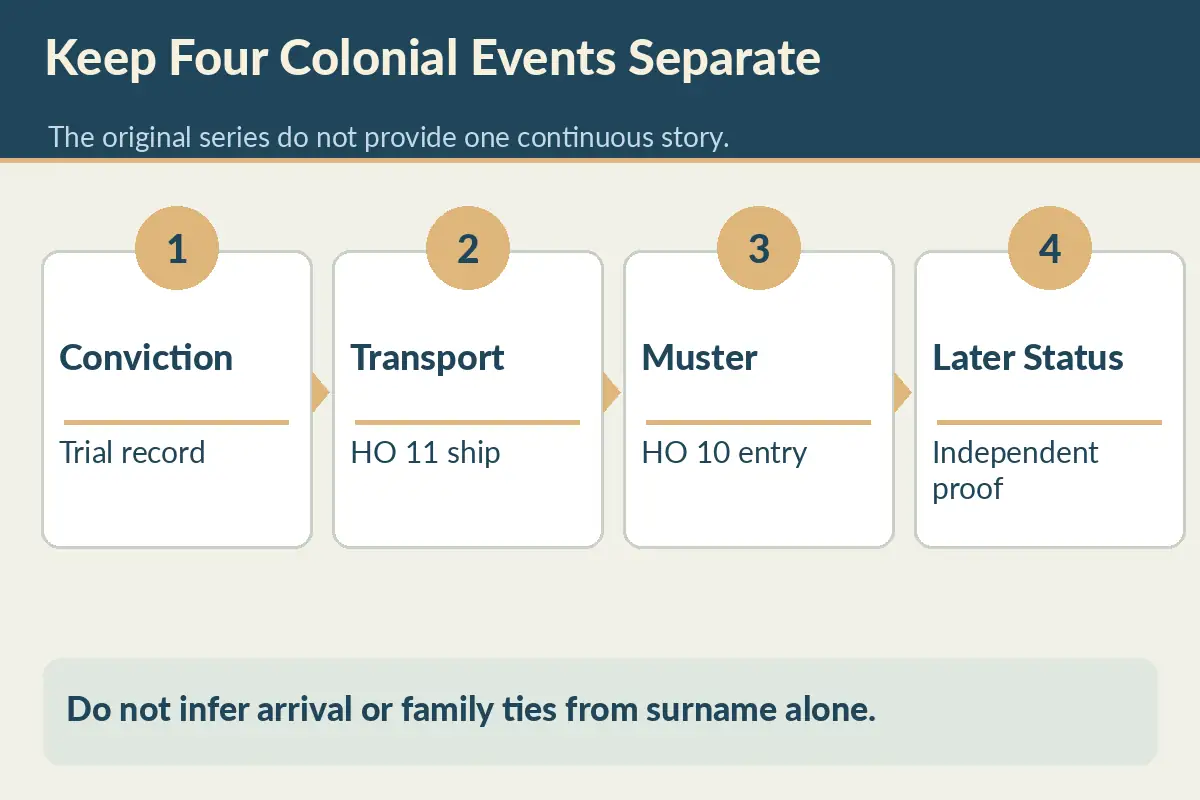
The National Archives places lists of convicts and settlers in New South Wales and Tasmania in series HO 10. These include colonial musters, details of people arriving or embarking, and lists connected with pardons and employment. A muster is an administrative snapshot after arrival, not a passenger manifest. HO 11 transportation registers instead focus on people transported aboard named ships and their convictions. The two series answer different questions and cannot be assumed to contain matching populations.
Begin with a location and an event: transport departure, a colonial population count, a pardon or evidence of work. If the family account concerns a person in New South Wales years after transportation, HO 10 may be more relevant than a departure register. If the event is a conviction in England, a colonial muster alone may not supply adequate legal information. Keep the original source jurisdictions and dates in separate columns.
Use the HO 10 Date and Colony Boundaries
The National Archives guide points researchers to New South Wales lists beginning in 1788, including the 1828 census, and to Tasmanian material from 1846. These are surviving sets described by their contents and coverage; neither colony should be treated as having a complete unbroken annual census. Different original list types may cover only convicts, settlers, arrivals, employment or pardon activity. A volume’s date range is a starting point for inspecting its actual pages.
Identify whether the record describes a New South Wales district, the settlement of Van Diemen’s Land, a ship at arrival or an official return. Place-name usage and boundaries changed, and a person’s address may differ from a ship’s port. Read headings, notes and the last pages for exceptions or totals. Do not assume all lists were created on the same day or by the same reporting authority.

Browse Digital Microfilm When Names Are Not Indexed
The archive explicitly notes that HO 10 downloads are not searchable by an individual’s name. A typed surname in Discovery may therefore fail even when a person appears in a list. Browse the correct piece by colony and list title, then navigate to the relevant district, alphabetic section or numbered return if the volume supplies one. Record page and image numbers, noting that digital images and original folios are different counters.
A document index printed in the volume may be partial; inspect its geographic or alphabetical scope. Variant spellings, abbreviated forenames and status labels can obscure matches. If a page is illegible, compare another image or a local archival copy if one exists rather than guessing a surname. Cite the original document reference, not merely the download link, because digitized microfilm bundles may contain many separate returns.
Interpret a Status Label as a Dated Report
A muster may identify a person as a convict, employed person, free settler or pardoned individual, but exact terminology varies by volume. These statuses require source context; do not map them automatically onto modern citizenship or independence. A notation about employment indicates an administrative report, not necessarily an enduring job or residence. An apparent pardon may need an original pardon or government order to establish its legal scope and date.
Build separate columns for reported status, report date, authority and later independent evidence. A changed status between two musters may reflect a genuine legal transition, reclassification or an indexing problem. Do not invent a continuous personal timeline from two isolated appearances. Some people appear under different surnames or inconsistent ages; preserve each reading until the identity is tested with ship, district and associates.

Connect a Colonial Entry to the Right Voyage
To test whether a HO 10 entry matches a transported ancestor, begin with the person’s name, approximate age, transport ship if recorded, conviction date and original district. Then locate an HO 11 departure register or an Australian arrival record. The same ship might carry different passengers on different voyages. A matching ship name and generic surname alone cannot establish identity, especially among repeated first names.
Supplement the colonial record with parish events, local land or employer papers, court records and newspaper notices. A residence in a muster does not prove property title, and a reported spouse or associate should not become a genealogical relationship without an original event record. For a same-name conflict, retain both candidates and list precisely which documents connect one person to the colonial status you are claiming.
Cite the Muster and Record What It Does Not Resolve
A useful final log captures HO 10 piece, image or folio, colony and district, dated heading, original spelling, reported status, and any ship or employer mentioned. Also capture the survival problem: did you review a complete volume, just selected pages or a catalogue synopsis? If the appropriate year is missing, label it a coverage gap rather than evidence the person left Australia.
The best next action depends on the question still open. To verify transportation, search the correct HO 11 ship register; to confirm a claimed pardon, seek pardon documentation; to locate later family members, move to Australian colonial civil and church records. Report the finding narrowly as a recorded colonial status at a recorded date, not a full biography or a guaranteed route from conviction to settlement.
How We Research Ho 10 Convicts And Settlers
We start with the original legal or administrative question that created this source. First we verify the time and geographical reach of the collection, then inspect the exact item rather than substituting a name index. We transcribe dates and labels in their original setting, note who supplied the information, and test an identifying detail against a separate source. If the relevant item is unindexed, incomplete, destroyed or restricted, we report that condition distinctly from a genuinely negative search. The remaining unknown becomes a specific next-record request, never an invented fact.
More Records and Archives Guides
Official Sources and Research Limits
For the record group and primary arrangement see The National Archives research guide: Describes HO 10 downloadable but not name-searchable lists, New South Wales 1828 census and Tasmania from 1846, contrasted with HO 11.. For an independent description of scope or access, see the related archive guide: Lists the HO 10 records and digital microfilm access as settler and convict records.. An archival call number is a pathway to the evidence, not proof of the facts inside a document that has not yet been examined.
No. HO 10 includes colonial convicts and settlers lists; HO 11 primarily records transportation by ship.
The National Archives says its HO 10 downloads are not name-searchable; browse the relevant volumes.
Yes, the guide specifically identifies that census among its New South Wales material.
Not necessarily. Look for the original pardon or the corresponding official order.
The surviving lists vary by date, district and purpose; absence requires a coverage check first.