
HO 24 is not a single alphabetical list of everybody imprisoned in Victorian England. It is a group of Home Office prison registers and statistical returns covering 1838–1875. The registers concern Millbank, Parkhurst and Pentonville; some volumes instead preserve county-level returns. For a family historian, the first question is therefore not merely whether a surname appears. Identify the institution, the kind of volume and the relevant years before treating a search result as evidence about a particular person.
A prison register may report where a prisoner was received from, the offence and sentence, and a subsequent removal. That chain helps reconstruct custody, but each event has its own meaning. A prisoner moved out of Millbank did not necessarily sail overseas, and a record of conviction does not by itself identify a transportation ship. This guide builds a practical custody ledger and a test for matching the prisoner to the court case and any later destination.
Choose the institution and type of HO 24 volume
The National Archives describes registers for three prisons: Millbank, Parkhurst and Pentonville. Start with the prison named in a family account, trial calendar, newspaper or previous register. When the institution is unknown, write down the court, county, approximate sentence year and age; these are stronger filters than a common surname. Browse the HO 24 series description and piece titles before ordering an item. A broad date on the series does not mean every prison is documented for every year.
HO 24 also includes statistical returns from county gaols and juvenile schools, arranged by county for 1860–1869. Those returns answer administrative questions about numbers and institutions, not necessarily the whereabouts of one named prisoner. In the research log, label a source REGISTER, STATISTICAL RETURN, or UNCERTAIN until its contents can be inspected. Do not copy a national total into a person’s biography or assume an empty table proves the prisoner was absent.

Extract the fields that identify one prisoner
The official series description notes age, marital status, number of children, ability to read or write, trade, place and time of conviction, crime, sentence, earlier offences, and movements into and out of custody. These are possible fields, not a guarantee that each entry is complete. Copy the exact wording, including abbreviations, and record the HO 24 piece, page or folio, prison and entry date. If a database transcription omits columns, inspect the image or original before making conclusions.
Compare the stated age and trade with independent evidence, but remember both can change or be reported inaccurately. A man described as a laborer in a prison register might have held a more specific occupation elsewhere. Married status and children may be the prisoner’s report rather than a survey of his household. Use two or three independent features—age range, conviction jurisdiction, occupation and movement dates—to keep equally named prisoners separate.
Follow receipt and removal without inventing a destination
Use two columns for each movement: what the register literally says and what further source is required. “Received from” identifies an immediate preceding institution or authority when recorded; it does not necessarily identify where the prisoner first entered the justice system. “Removed to” can mark another prison, a hulk, release or an administrative destination. It is not automatically a transport embarkation or arrival in a colony. Copy the date and spelling precisely.
For a claim of transportation overseas, build a second chain: sentence or order, any transfer to a hulk or depot, an independently documented ship and a destination record where available. A planned removal may be reversed. Likewise a register that ends unexpectedly may reflect transfer, a change of book or missing pages rather than an escape or death. Keep gaps visible instead of supplying a convenient narrative.

Test conviction details against court records
A sentence recorded in HO 24 usually points backwards to a prosecution, but it is a later institutional record, not a transcript of the trial. Identify the court and date from the entry. Then search the relevant assize or quarter sessions holdings, local calendars, newspaper accounts or other court records in their actual jurisdiction. If the entry concerns London, distinguish the Central Criminal Court from courts with similar-sounding names. A court calendar may report a charge without establishing a final conviction.
Record conflicts instead of silently correcting them. A prison date may reflect reception rather than sentencing; an offence may be abbreviated and the age rounded. If the HO 24 entry and a trial account disagree, identify whether they refer to the same person, not just the same name. An independent court reference can confirm conviction; it cannot prove every later custodial transfer unless the movement is independently documented.
Separate HO 23 overflow custody from HO 24
HO 23 holds registers relating to prisoners from national prisons lodged in county prisons in 1847–1866. This is not simply a continuation of the same HO 24 page. It arose from the use of county accommodation for prisoners and has its own piece arrangement. If a HO 24 movement names a county gaol, HO 23 may offer a parallel search, but only for its coverage and institutions. Neither series should be searched as an exhaustive national prisoner census.
Use a two-source crosswalk with entry dates, prison names, conviction details and any identifier written in the document. If the dates align but the spelling varies, retain both readings in the ledger. If a county register cannot be found, check its coverage, indexing and condition before treating that as meaningful negative evidence. Never imply that absence from HO 23 proves release or non-imprisonment.
Write a bounded custody conclusion
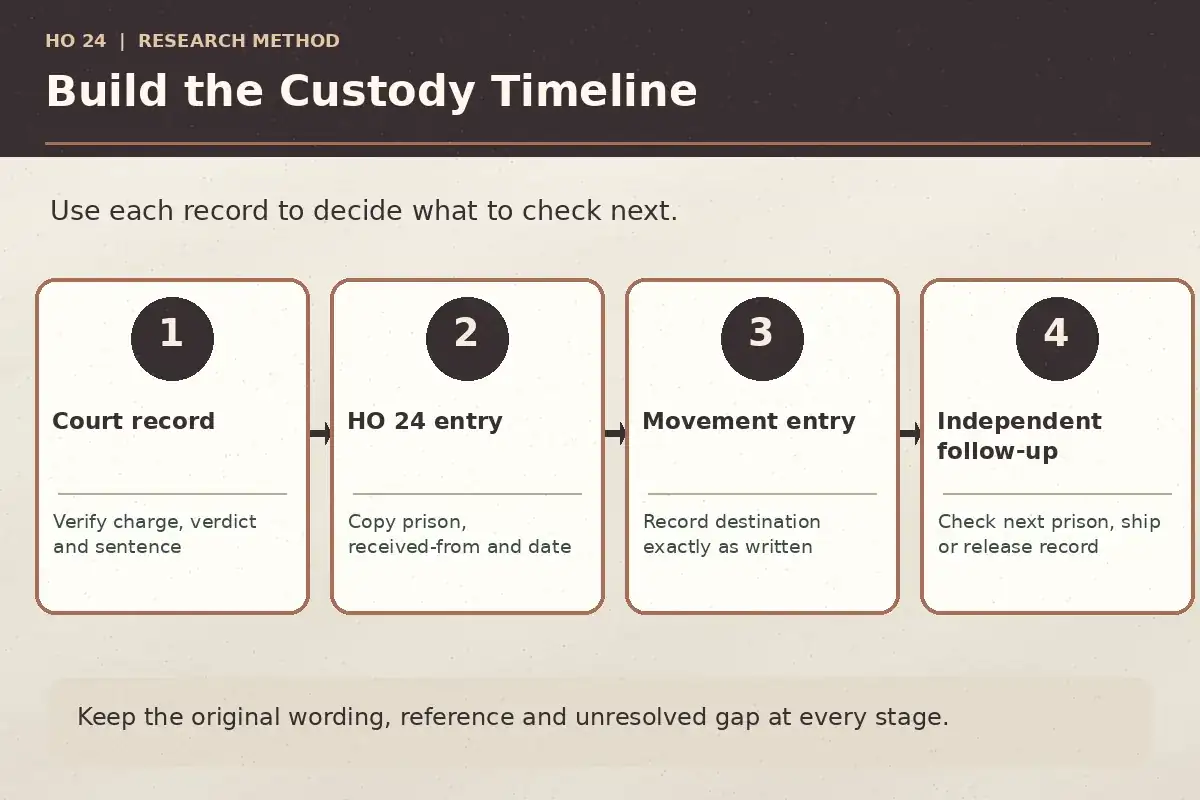
A defensible summary might say that an identified prisoner appears in a named HO 24 volume on a specific date, was reported to have been convicted at a named court, and was removed to a stated destination. Separate this from a later statement that the same person emigrated or was transported, which needs its own source. Use a dated event sequence rather than a single continuous arrow from conviction to transportation.
Keep the source trail reproducible: database result, the original or image, page reference, every uncertain transcription and the separate court record. Note if the HO 24 item is a statistical return rather than a register. The resulting conclusion may be narrow, but it gives a future researcher a reliable starting point instead of an attractive unsupported prison story.
More Records and Archives Guides
How We Research HO 24 Historical Records
We examined the principal National Archives guidance or series description and a complementary custodian or repository source to establish what HO 24 is intended to hold and where the search should begin. A catalogue description describes potential records; it does not mean we inspected every piece or can guarantee an entry for a particular person. The diagrams are interpretive teaching aids, not facsimiles of official records, and their arrows are qualified by the documentary conditions described above.
Cite the repository, full piece reference, title or creator, date, page and access method for each document actually consulted. Keep transcriptions, reported statements, reasonable inferences and missing evidence in separate fields. The affiliate disclosure explains the site’s general policy; no unverified paid recommendation or affiliation is implied by this guide. Check current document access and copying terms with the custodian before relying on an unviewed item.
No. HO 24 includes both individual prison registers and county-level statistical returns.
The National Archives identifies Millbank, Parkhurst and Pentonville, with coverage varying by volume.
No. A removal entry must be linked to independent embarkation and destination evidence.
Sometimes. HO 23 covers prisoners housed in certain county prisons during 1847–1866, not a comprehensive national list.
Use it to locate an image or original; verify the age, court, movement dates and reference before identifying the person.