
A historical Scottish prison admission is evidence that a person was recorded in custody, not automatic proof of a criminal conviction. Scotland’s People offers selected Scottish prison-register images with admission dates extending to 1924. The official Prison Registers guide says the NRS HH21 records include both tried and untried people, with varying details of offense, trial, sentence, discharge, birthplace and occupation. Search the named institution and admission period before making an identity or legal-history claim. Historical medical and penal descriptions also demand careful, respectful interpretation.
Check whether that prison and date are actually indexed
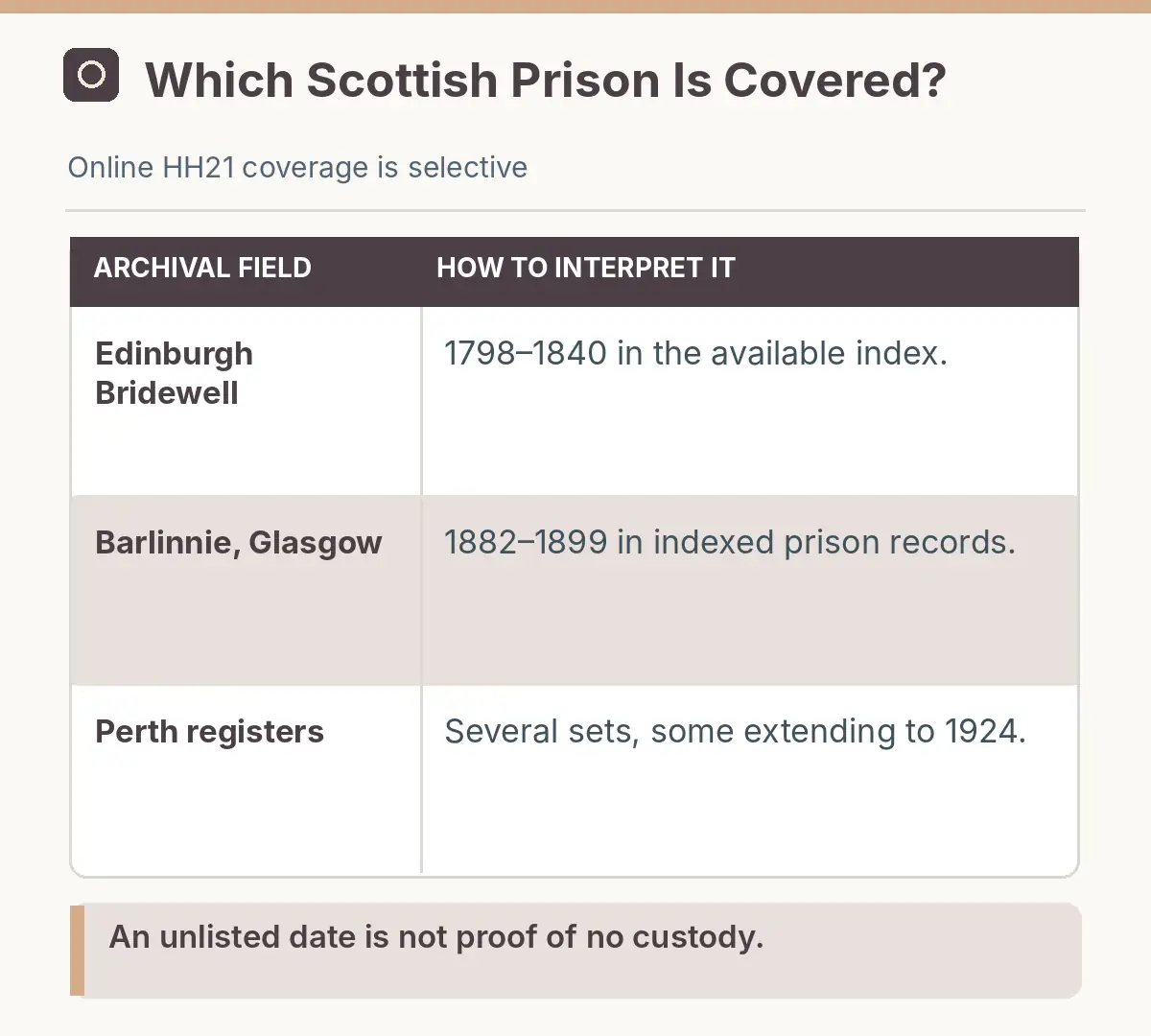
The Scotland’s People search interface currently covers selected registers for Ayr Prison, Barlinnie in Glasgow, Edinburgh Bridewell and Calton, Inveraray, Largs and Perth, including particular Perth criminal-case and historical medical volumes. Not every prison or every year in Scotland is represented. The official guide lists spans such as Edinburgh Bridewell 1798–1840, Edinburgh Calton 1841–1851 and Barlinnie 1882–1899; some Perth series extend into 1924. A surname absent from these indexes may be in another prison, an unindexed volume, or outside the listed dates. First record the source’s precise institution and inclusive years. A broad phrase like ‘no Scottish prison record found’ disguises incomplete coverage and is not an acceptable negative finding. State the exact prisons and admission-year intervals tested and whether you examined original images or only an indexed name list.
Use the admission search fields rather than a vague name lookup
The prison index can be filtered by surname, forename, sex, age range, year admitted, prison, country of birth and trial court. Begin with a documented approximate time and location, using age and birthplace only to prioritize plausible candidates. If the record gives a birth county or occupation, do not retrofit its spelling to the family name you expect. A common-name match in Glasgow may concern several different people admitted years apart. Note the prison’s full name and every candidate record’s original admission date before checking the image. Forename initials and transcription mistakes can impair the search; if no exact result appears, widen the years or examine alternate spelling while keeping a search log. Do not publicly identify a living person’s private circumstances based on a similar historical name. For the same kind of choice in another place, see our guide “NSW Gaol Photographs, 1870–1930”.
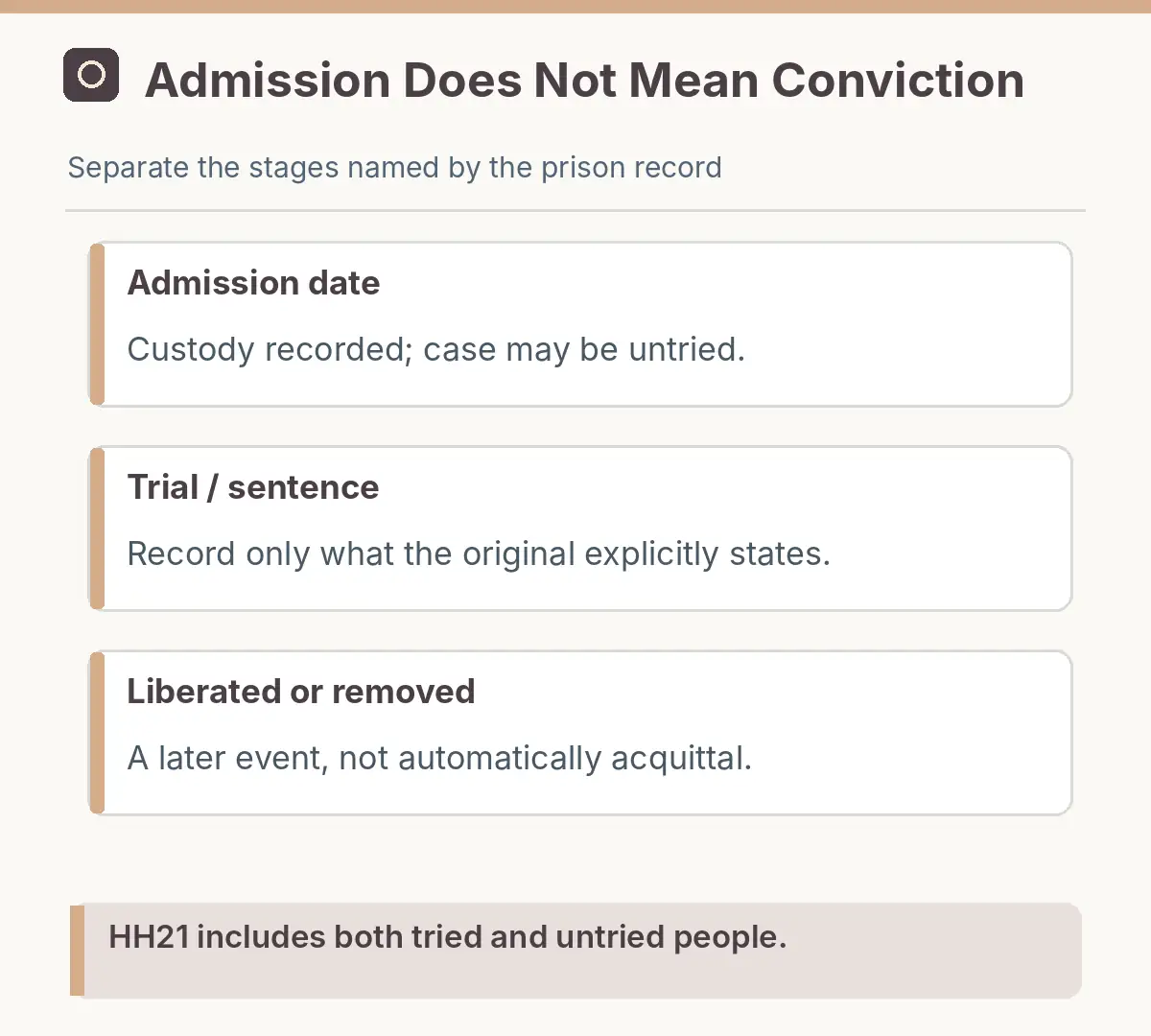
Distinguish admission, trial, sentence and liberation
The archive explicitly says prison registers document tried and untried individuals. The existence of a person’s admission entry therefore cannot be paraphrased as a proven conviction or sentence. In a structured extraction sheet, put date admitted, reported offense or cause of detention, whether and where a trial occurred, any explicitly recorded verdict or sentence, and the date the person was liberated or removed in separate columns. An entry describing allegations may be incomplete or reflect the views of historical authorities rather than an established fact. When no verdict is entered, label the outcome ‘not stated.’ If the person is later transferred, that may explain why a release date appears to be missing in one institution’s book. An untried prison admission should not be converted into a criminal conviction in a public family history, even where a clerk recorded an alleged offense. Keep events chronological, but never fabricate intermediate court proceedings.
Read personal descriptions as historic statements, not judgments
HH21 registers may include age, birth country, address, occupation, height, health notes or religious affiliation, depending on institution and date. These can distinguish a namesake, but recordkeeping conventions and prejudices of the period shaped the entries. The official guide cautions that the materials can include descriptions of violence and historical medical language that is now inappropriate. Quote that wording only when a source-critical argument requires it; prefer neutral editorial summaries that avoid re-stigmatizing people and communities. Such descriptions should not be interpreted as present-day medical diagnoses. If a historical admission label differs from later civil evidence, note the conflict rather than treating one clerk’s phrasing as definitive. Personal histories deserve the same evidence standards as censuses and marriage registers.
Understand Perth journals and attached photographs cautiously
The official guide identifies Perth male convict journals for 1867–1879 and other Perth registers with date gaps, plus separate case-note material. It also explains that certain Barlinnie entries have linked photograph-album pages. This does not mean every inmate was photographed, or that a photograph can identify a person across decades without documentary comparison. Do not infer physical traits from an unseen image or treat a photo as independent proof of a legal judgment. Cite the specific HH21 reference and the image that you actually inspected. If case notes exist under access restrictions, respect those limits and do not seek indirect disclosure of sensitive material. The presence of a case note is an archival clue about custody records, not a modern health classification.
Connect a possible historical inmate to the right family
Suppose a recorded Alexander Stewart was admitted to Edinburgh Calton Prison in 1846. Before deciding this is an ancestor of the same name, compare the register’s reported age, occupation, birth area and any residence or spouse clue against independently dated census and civil or parish records. An admission entry and a matching census street name might still concern unrelated individuals. Make a candidate matrix, keep spelling variants and note evidence gaps. If there is a second Alexander Stewart with a different occupation in the city, leave the identity unresolved until a verifiable bridge appears. Ethical publication matters: do not sensationalize a brief custodial event, exaggerate alleged offenses, or infer that a descendant inherited any trait from an ancestor’s historical record. Write only the claim the document supports.

More Records and Archives Guides
How We Research HH21 Scottish Prison Records
We use the National Records of Scotland’s official HH21 guide for record purposes, trial-status distinctions, available prisons, series gaps and historical sensitivities, and the actual search page to verify filter fields. We do not assume an admission equals conviction and we distinguish missing index coverage from a negative finding. Also, We also avoid publishing restricted personal information. The affiliate disclosure explains site policies; access rules and factual conclusions come from the repository itself.
No. HH21 prison registers may include tried and untried individuals.
No. Scotland’s People lists selected prisons and dates, with additional unindexed or restricted holdings.
An NRS archival record group containing Scottish historical prison registers.
Sometimes. Fields vary by prison and period and should be copied from the original image.
Treat them as dated record language, not current diagnosis or a reason to stigmatize a person.