
Ask About a Transfer, Not Every Occupant
A sasine is a Scottish record documenting the transfer of a right in land or a building, often through sale or inheritance. The National Records of Scotland research guide explains that the register begins in 1617 and can support a long property-history chain. But sasines record transactions, not a roll of everybody living at an address or a census of owners at every chosen date. Start with a particular holding and a plausible ownership event, then select the appropriate index period.
A recorded instrument commonly identifies prior and new owners, the property, the transaction, and witnesses, with price information often present. A name on a sasine can suggest kinship but not always establish it; a person called “of” an estate may have a legal or descriptive designation requiring context. Many Scots were tenants rather than owners and never appeared in a sasine register. That social limit matters when a surname search produces no result, even for a family documented in a parish.
Use Different Finding Aids Before and After 1781
Search methods differ sharply by period. For earlier material, NRS explains that indexes are uneven: the General Register is indexed for 1617–1735, while availability for county or particular registers varies by locality and date. Where a useful index is absent, contemporaneous minute books summarize entries in chronological order and may provide the registration date necessary to find the full sasine. Begin by identifying the historic county and whether the general or a particular register is relevant.
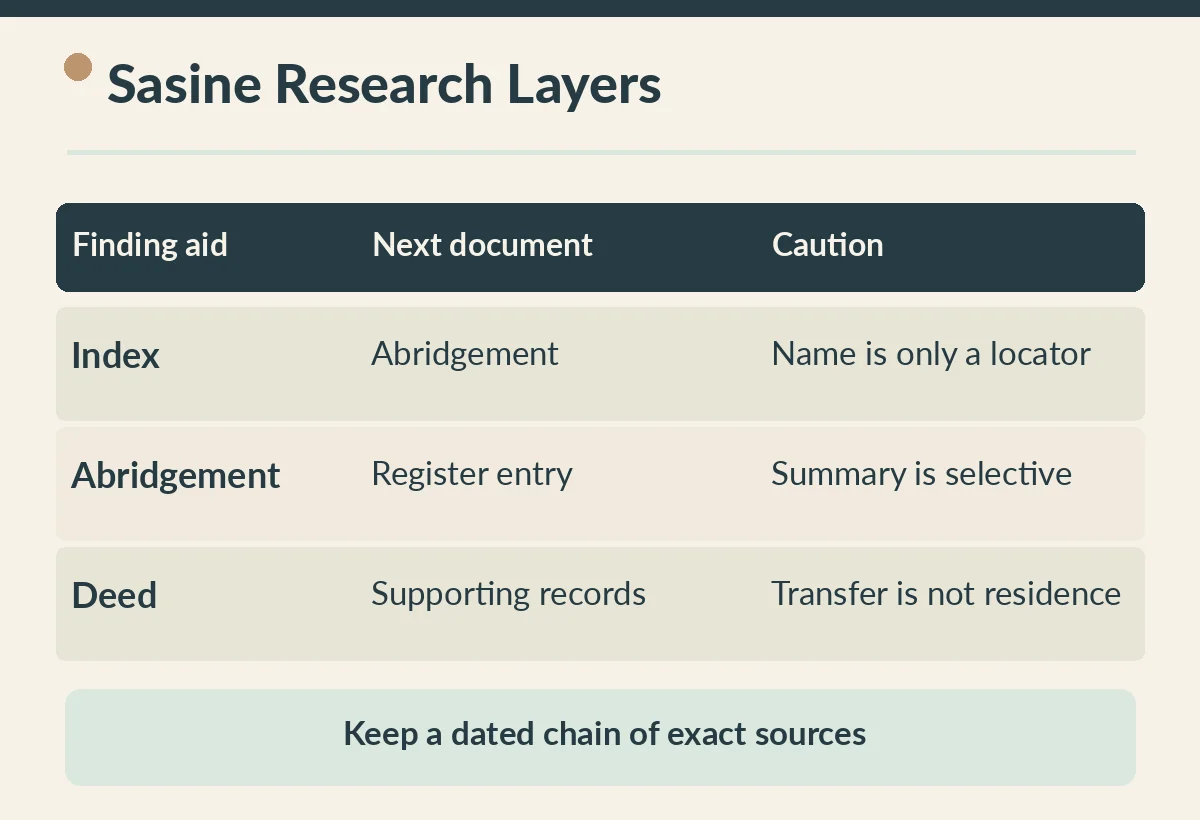
For records from 1781 onward, NRS describes an electronic index based on printed county abridgements. The workflow is an index reference, followed by an abridgement summarizing the transaction, followed by the underlying deed image or register entry where its wording matters. The index is not a facsimile of every instrument and the abridgement cannot always answer a complex title question. Keep county, recording date, volume, page, parties and all reference numbers together.

Start with Search Sheets for Later Properties
Since 1876 the government has maintained property search sheets listing the chronological deeds affecting a property. Registers of Scotland explains that these can identify past and current named owners, deeds affecting title, security entries, and the prices recorded. Starting from a later known address or property can therefore be easier than trying to find a person in centuries of indexed material. A search sheet is a guide to recorded deeds, not a substitute for inspecting a disputed or poorly described transfer.
The register was gradually supplemented and replaced by Scotland’s map-based Land Register, and a modern property search may be needed first to identify whether an older sasine chain applies. Do not assume that every historic building has a current street number or modern plan corresponding to its older description. Document changes in property name, acreage, neighboring lands, and parish or county as separately dated observations. The sheet can help reverse the deed chain, but avoid asserting uninterrupted ownership where the records leave a gap.
Read the Instrument and its Legal Relationships
A typical sasine identifies the grantee, other parties, the type of transaction, the land, the recorded time or date, and witnesses. Early entries can be in Latin and have difficult handwriting; NRS explicitly warns about these obstacles. Transcribe personal designations and place phrases accurately before rendering them in modern English. If an abbreviated entry says that land was conveyed by one person to another, that does not settle whether the parties were parent and child, trustee and beneficiary, or unrelated participants.
Ask four focused questions: what legal interest was involved; who transferred it and to whom; what land description appears; and what earlier instrument is cited. If the deed says that a person was heir to someone, preserve that exact phrasing and look for the succession record supporting it. A witness named on the page is not necessarily related. Separate the deed’s recording date from the agreement or inheritance date if both appear and differ. Build a chain of specific recorded events rather than a story inferred from surnames.
Choose the Right Custodian for a Copy
There are practical differences between finding an archival entry and obtaining a modern supplied deed copy. Registers of Scotland’s ordering guidance states that it holds sasine deeds from 1869 and directs requests for earlier deeds to National Records of Scotland. NRS says paper registers have been digitally imaged and can be consulted in its search rooms. Individual access and ordering methods depend on the repository and material.
Do not imply that an online summary means free downloadable images of every seventeenth-century document. Ask for the correct deed with its county, register, reference, recorded date, named parties and property details. An uncertain reference should be checked against the index or an abridgement before money is spent on a copy. Record the custodian and image or supplied-copy provenance for each stage, because an abridgement from a local archive may not be the same item as the original record.
Avoid Ownership and Residence Overclaims
NRS warns that the sasine register cannot simply answer “who owned this property in 1750?” by opening the book for that year. The relevant person may have acquired it decades earlier, and there might be no new transaction during the target year. The register generally contributes little about tenants, who were far more numerous than owners. Long leases were only permitted for registration after 1858 and were not mandatory, so their absence cannot demonstrate a property was unoccupied.
A fictional example makes the distinction clear: a deed names Margaret Kerr as a recipient of land in one year, and an address directory names a Kerr family in a later year. Until a specific link is made between that property description and the directory address, neither proves the same family occupied the premises. Use valuation rolls, parish registers, estate rentals, census returns and maps to add the missing resident context. The best output is two timelines—recorded legal transactions and observed occupation—not one conflated list.

More House and Local History Guides
How We Research Scottish Sasine Chains
Our procedure begins with a place and estimated deed period; we consult the NRS guide for the relevant general or county particular register and its index coverage. Before 1781 we test the listed indexes and minute books; afterward we use the county index and abridgements. For later properties we first investigate a search sheet where appropriate. We follow the reference back to the underlying entry only when it supports the research question, and cite its exact archival context.
We annotate every link as an observed deed, a property-match hypothesis, a named owner, or a potential resident link needing confirmation. A transfer record is evidence of a transaction, not a census of occupancy, and a dated entry is not necessarily proof of ownership on every intervening day. For clarity about site relationships consult our affiliate disclosure; these are source-led archival instructions without a claimed commercial endorsement.
It is a historical Scottish legal record concerning transfer of interests in land or buildings.
No. The register concerns transactions and owners, not tenants or full households.
Check the county-specific index coverage and use minute books where a suitable name index is absent.
For later properties it may give a chronological list of recorded deeds and owner names to follow.
Registers of Scotland directs requests for deeds before 1869 to National Records of Scotland.