
Find the County and Register Year First
California’s historical Great Registers can identify a voter’s age, residence, place of birth, occupation, precinct, and sometimes naturalization and physical description. They are useful between decennial federal censuses, especially for tracing a particular eligible adult around 1890, but they are not censuses of all household members. Begin with the historic California county, the likely election or registration year, and the person’s voting eligibility under the laws then in force. The FamilySearch Great Registers collection describes broad but uneven coverage by county. A collection title covering a long span does not mean each county has every volume.
The underlying records were created by county clerks, not by a single continuous statewide household survey. A person can appear in several years as an address or occupation changes, and some printed lists represent a registration snapshot rather than the exact date of a move. Record the precinct, source date, and county each time. The absence of a spouse or child from a nineteenth-century voter list is normally expected and is not evidence that the household lacked those members. Search a contemporary census or directory for broader residential context.
Distinguish Manuscript Registers from Printed Indexes
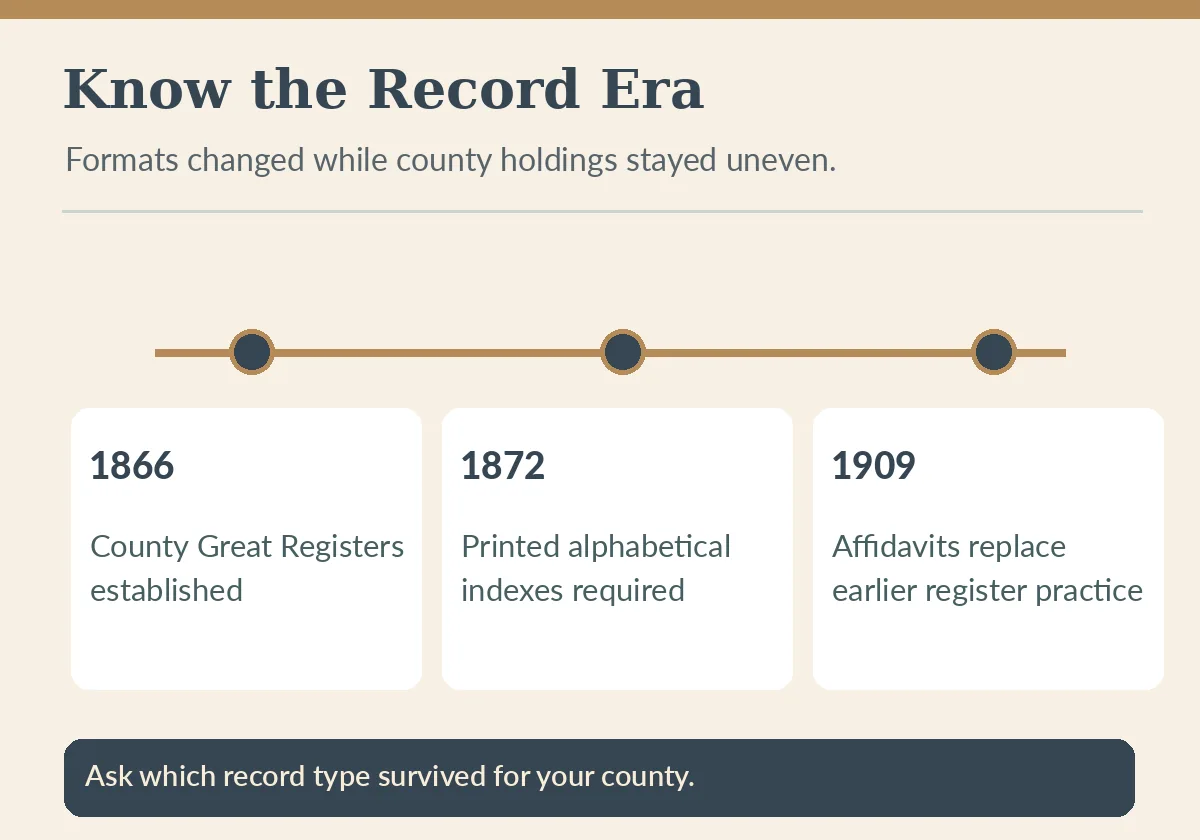
California’s 1866 Registry Act established county Great Registers. The records began as handwritten ledgers. An 1872 revision required printed alphabetical indexes, ordinarily every other year, and the presentation of names and details evolved afterward. Some manuscript entries record registration and cancellation details that may be abbreviated in the printed version. When comparing two records, label the manuscript register, printed list, or later affidavit independently rather than citing all of them as the same document.
The FamilySearch explanation notes that a 1909 legal change replaced the practice of maintaining the Great Registers with registration affidavits and shorter printed indexes. That makes a thin twentieth-century printed name entry different from a late-nineteenth-century manuscript line rich in identifying details. It also means that early and late forms should not be compared column for column as if a missing item had the same meaning. Look for a surviving affidavit when the printed entry no longer gives the birthplace or naturalization information your question requires.
Read the Fields without Creating False Kinship
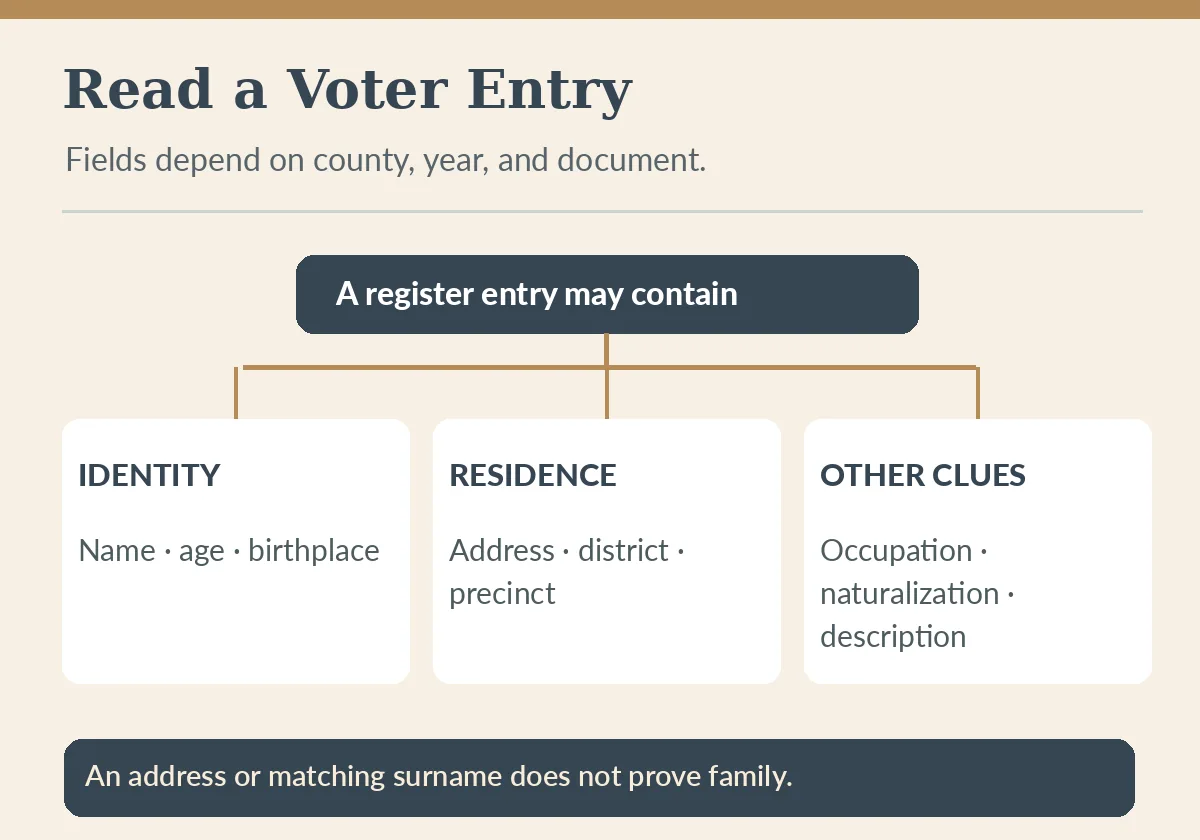
A typical register can give full name, age, place of nativity, occupation, residence, voting district or precinct, and perhaps court and date of naturalization. The Sacramento County clerk records finding aid describes 86 volumes and notes that some contain height, hair and eye color, distinguishing marks, and cancellation dates. Availability varies by county and edition, so do not promise a physical description or exact naturalization citation for every entry.
An entry for two adults sharing a surname and street can suggest a family cluster but cannot prove marriage or parent-child relationships. An address may record reported residence at registration, not legal property ownership. Naturalization fields may help direct you to a court archive, but the voter register is not itself a substitute for the original naturalization proceeding. Copy the exact birthplace wording even if it uses a historical country name, and preserve address changes without automatically interpreting each change as the sale of a family home.
Respect Historical Barriers to Registration
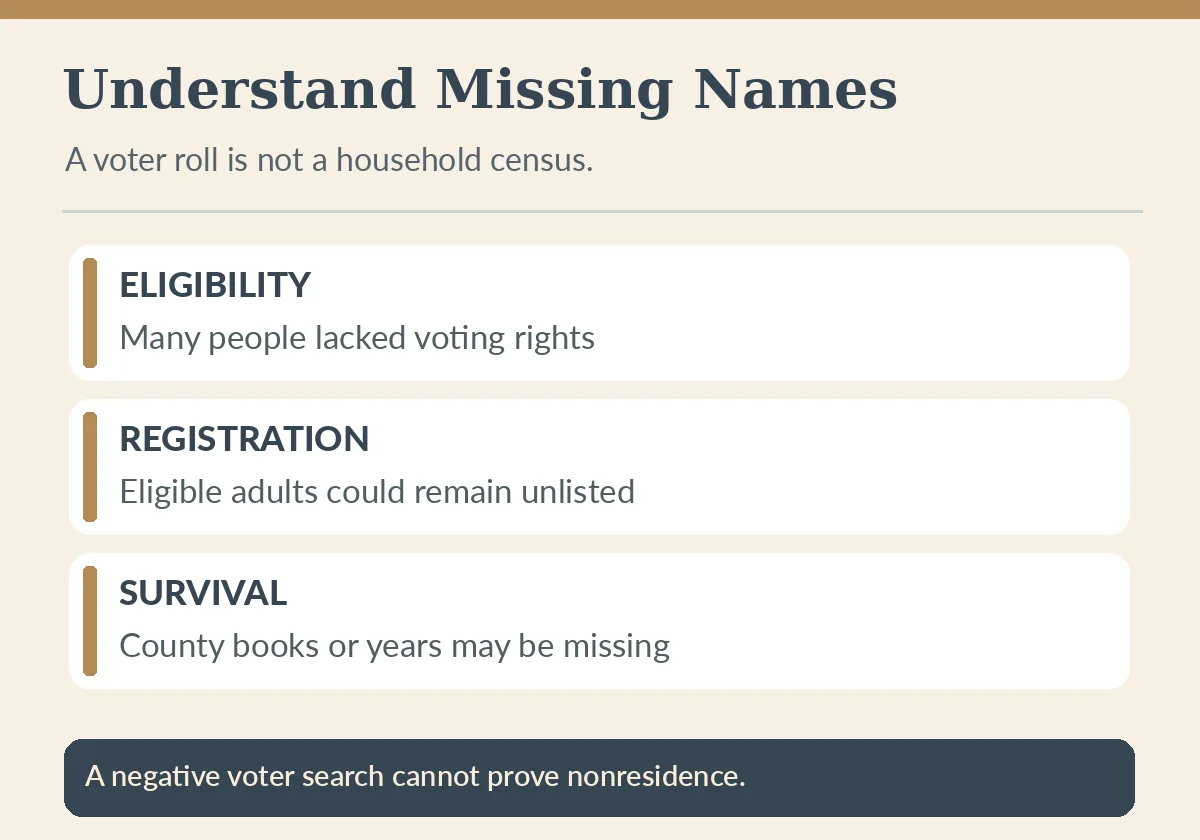
Registration laws restricted who was listed. California women obtained state voting rights in 1911, so an earlier list’s omission of women does not reflect whether they resided in the county. Other eligibility and discriminatory barriers affected many people differently over time, particularly Black, Indigenous, and Chinese residents. It would be misleading to conclude that an ancestor was absent from California because that individual is missing from a voter register. Voting status, legal exclusions, access to citizenship, and actual participation are separate historical questions.
Use exclusion notes as limits on the record set, not broad claims about an individual’s political identity. Even an eligible voter might never have registered; damaged or lost volumes and gaps in county indexing add further uncertainty. A Great Register proves that someone was listed under the recorded particulars, subject to identity confirmation. It cannot establish political opinions, how anyone voted in a secret ballot, or the absence of nonvoters. Where an omitted person belongs to a group denied voting rights, prioritize other contemporary sources instead.
Find the Custodian and Test a Name Match
Some records can be searched online, but surviving original books and indexes may remain in county archives or libraries. San Bernardino County Historical Archives, for example, explicitly holds Great Registers from 1866 to 1908 for in-house viewing. The Online Archive of California finding aid identifies Sacramento County holdings separately. Do not treat one county’s archival span as a statewide schedule. Check the specific keeper’s current policies before arranging a visit, and write down the bound volume’s year, division, and page before photographing or transcribing.
Build a same-name comparison with columns for age, reported birth state or country, occupation, precinct, address, and registration date. If two entries differ greatly in age or birthplace, keep both candidates open until an independent source resolves them. Check nearby entries and cancellations only if the specific register actually contains those marks. When a name search is empty, expand to adjacent years or counties, consider historic spellings and precinct changes, and record that coverage was checked rather than jumping to a conclusion that the person never lived there.
More Records and Archives Guides
How We Research California Great Registers
We verify record-class changes in the FamilySearch collection notes and compare at least two county archival finding aids before creating a year-based search recommendation. This guards against silently applying Sacramento’s variable fields or San Bernardino’s 1866–1908 access range to all California counties. We distinguish printed indexing dates, manuscript registration dates, and the 1909 shift toward affidavits. A useful citation identifies a county, exact edition or volume, precinct and page, plus the physical or digital holding institution.
Our evidence checklist treats a voter listing as a historical registration statement, not a family relationship or complete population enumeration. We make the exclusions explicit because otherwise a failed search would disproportionately produce false negative claims about historically disenfranchised people. An independently created census, city directory, naturalization file, or deed chain supplies a stronger test of identity and residence. Site linking terms appear in the affiliate disclosure; these custodian links serve research, not a stated paid arrangement.
No. They list people eligible to register as voters under the laws of the time, not everyone living in each household.
County registration ledgers were established. From 1872 printed alphabetical indexes became a regular feature, with different details from manuscripts.
The reporting system and printed format evolved; registration affidavits can carry details missing from shorter lists.
A listing can point to a court or reported date, but consult the actual naturalization file for independent documentation.
Women had not yet obtained state voting rights. Absence from an eligibility-limited register says nothing about her county residence.