
Start with the Ship’s Eventual Destination
To find a person departing Britain by sea between 1890 and 1960, search The National Archives series BT 27, available through commercial searchable indexes and digitized passenger lists. First decide whether the ship was bound for a destination outside Europe and the Mediterranean: that is the crucial route boundary for outward lists. A passenger sailing only on a European coastal itinerary may never have appeared in the surviving BT 27 class. Use the National Archives passenger guide to check the current provider and scope before interpreting an empty name search.
Most outward lists in the period survive, but not every ship’s list was kept, some have been lost, and no nationwide exhaustive record of all embarkations exists. The guides describe lists for ships leaving UK and Irish ports for places such as North America, India, Australia, and New Zealand. They exclude travelers who boarded those ships later en route, even if the same ship ultimately sailed across the ocean. Therefore separate the vessel’s itinerary from the individual’s embarkation port; the two facts are not interchangeable.
Separate BT 27 Departures from BT 26 Arrivals
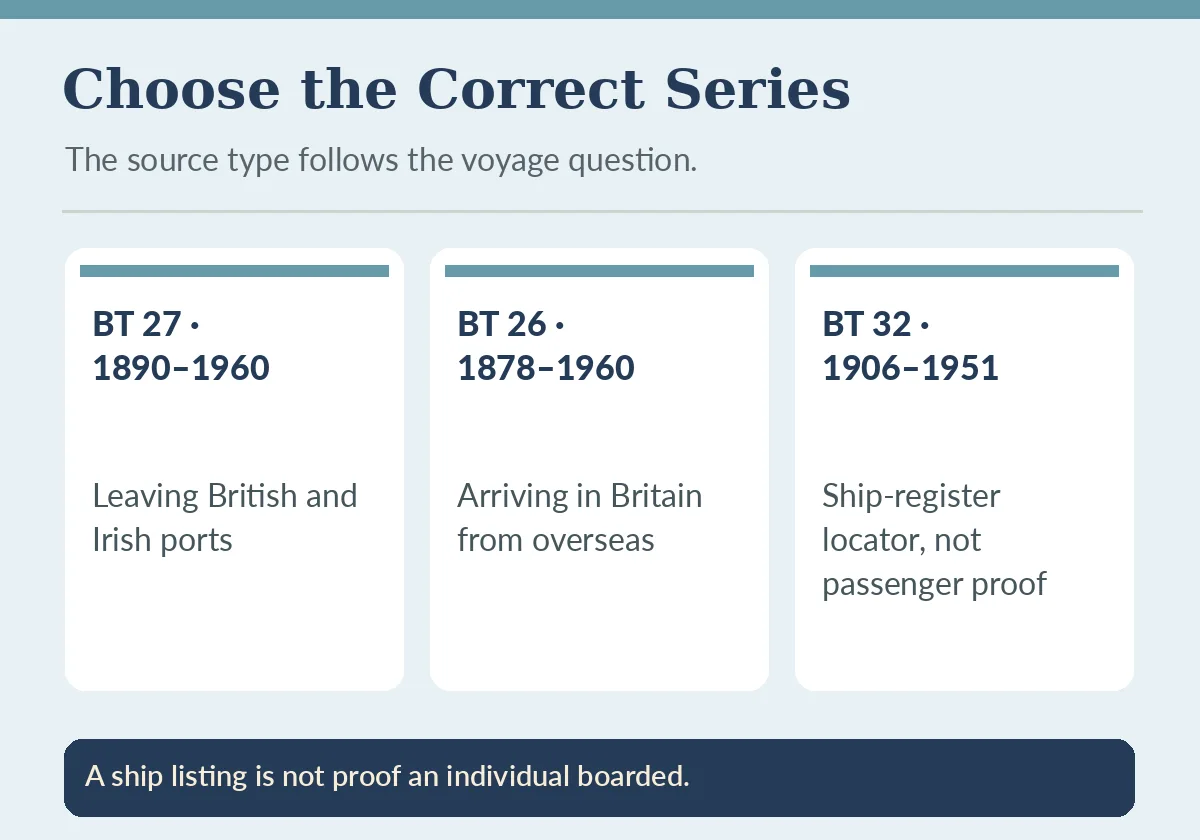
BT 27 is the outward-passenger record class for 1890–1960. BT 26 instead concerns ships arriving in Britain, with principal surviving coverage from 1878 to 1960. A person traveling outward from Liverpool to Canada should be sought in BT 27, while a return voyage to a British port from beyond Europe belongs to BT 26. Neither series by itself is a complete record of a person’s lifetime migration. If your only clue is an overseas arrival card, work backward to an estimated UK departure and identify the route before searching by surname.
The emigration guide also identifies BT 32, registers of passenger lists from 1906 to 1951. These registers concern ships and movements, not a substitute for every named passenger. Before 1908 the BT 32 register scope is restricted to Southampton, Bristol, and Weymouth. After 1920 the registers commonly provide more precise arrival or departure dates. Use BT 32 to help locate the vessel and month where a surname OCR search fails; do not cite a ship register as proof that a specific person boarded.

Use Date, Ship and Port to Recover a Lost Name
Start from a reasonable travel window derived from the documented overseas arrival. Search surname variants alongside approximate age, departure year, destination, or ship name if the provider supports them. A surname transcription can fail because a handwritten list is faded, a given name is abbreviated, or an indexer interpreted a letter differently. When a voyage is known, browse nearby entries and relevant list images rather than repeatedly adjusting the spelling in a narrow search. Preserve the handwritten name as seen and the searchable database form as separate observations.
The National Archives notes that individual lists vary in their fields; some report age, occupation, last address in the United Kingdom, destination, or other identifying information. Never insist that a missing occupation column means the passenger was unemployed. Also consider passengers from other countries who traveled through British ports. Nationality or residence should be read from the list when present, not deduced from the departure port. A child on the same list as an adult is not automatically proved to be that adult’s son or daughter.
Compare Departure with Arrival Evidence
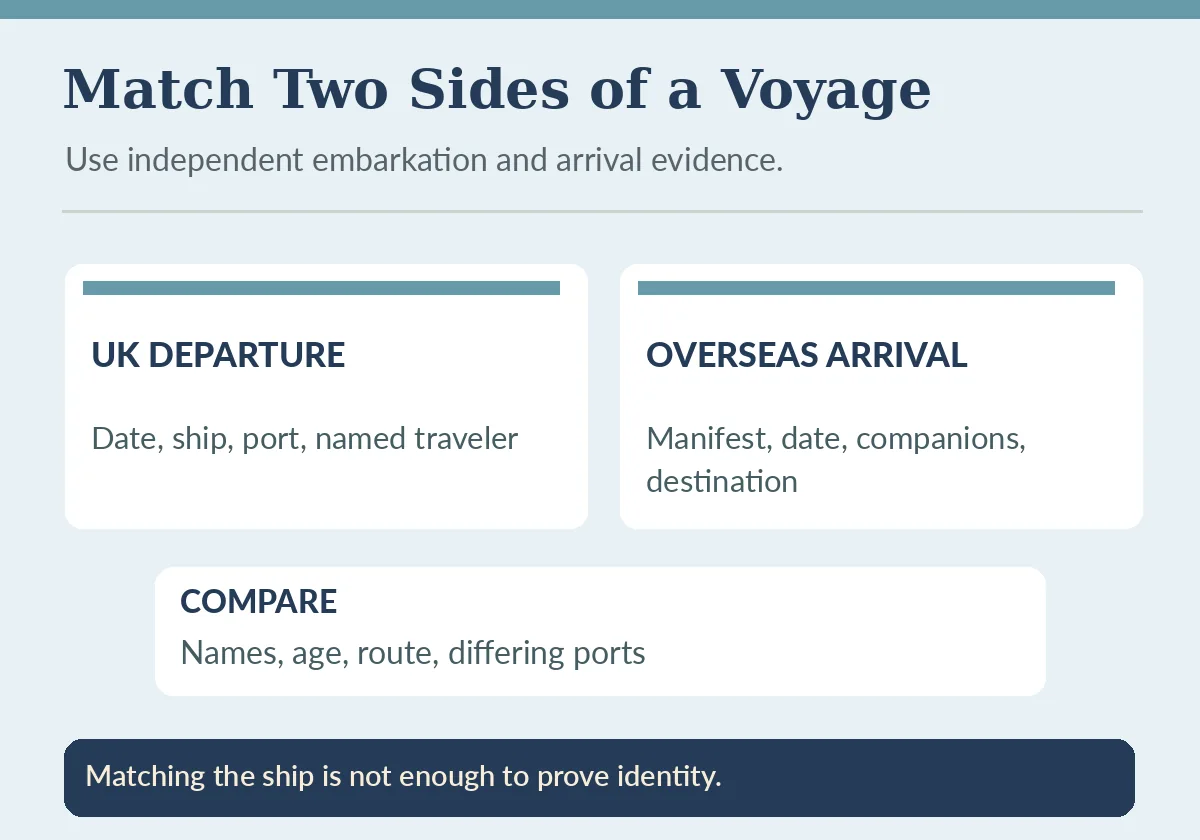
Use a two-event worksheet: one line for the British embarkation and another for the overseas landing. Record each observed date, ship spelling, passenger name, age, traveling companions, class or destination when present, and the independent archival citation. Check for differences created by calendar date, intermediate port calls, transcription choices, or onward travel. A ship could have multiple ports of call; two lists referring to the same vessel do not necessarily describe exactly the same passenger subset.
When a name occurs on an arrival manifest but not BT 27, first ask whether the traveler joined the ship after it left Britain. The National Archives explicitly warns that people boarding later en route are not included in its outward lists. Then consider missing documents or a route outside coverage. For a British departure person appearing in several plausible manifests, compare traveling companions, age, occupation, and destination address before accepting identity. A matching surname and ship alone may be inadequate for a common name.
Record Access and Limits Before Paying
The official passenger-list guidance identifies BT 27 through Findmypast and Ancestry, with fees or subscription access depending on the provider. Treat a free search result and a purchased original list image as different evidence products. Confirm coverage and image availability on the current provider page before spending money. An index can omit meaningful neighboring passengers, marginal changes, or a line of handwriting essential to identifying an individual.
No sea-passenger lists survive at The National Archives after 1960 in these series, and it says no air passenger lists survive there. A post-1960 emigration story therefore needs a different source type, perhaps a shipping company or documentation maintained in the destination country. Log what years, routes, variants, and providers were checked so a later negative conclusion reflects known surviving coverage rather than only one failed website search. Keep a clear distinction between a lack of records and a record stating absence.
More Records and Archives Guides
How We Research BT 27 Voyages
Our route chart begins with the National Archives’ own passenger and emigration guides. The major screen is the destination and embarkation condition for BT 27, not an assumption that all emigrants leaving Britain were cataloged. We then separate BT 26 inbound arrivals and BT 32 ship registers by function and record dates. Every proposed passenger match must be checked against the original page where access is possible, and then against an independent arrival or destination document.
The illustrations emphasize voyage selection and documentary comparison rather than promise nonexistent global passenger coverage. The research note retains uncertainty when a ship is documented but an individual’s boarding is not. External access prices can change and are not endorsed here. Refer to our affiliate disclosure for site policy; archive research links do not imply an affiliate arrangement.
The National Archives identifies 1890–1960 as the outward passenger list period for this record series, with surviving-list gaps.
Not as ordinary Europe-only outward voyages. Coverage is built around ships with an eventual destination beyond Europe and the Mediterranean.
No. The National Archives states that passengers joining a ship after its British departure do not appear in those outward lists.
BT 26 contains inward lists for ships arriving in Britain; BT 27 records qualifying outward departures.
No. BT 32 is a register of passenger lists and vessel movements. Use it as a ship locator, then locate the actual passenger list.