
Norwegian parish registers can document baptisms, marriages and burials long before routine nationwide civil vital-registration systems. The Norwegian National Archives provides guidance on church books (kirkebøker), and its Digitalarkivet offers both searchable transcriptions and scanned pages. A crucial distinction is between the minister’s book (ministerialbok) and, where preserved, the parish clerk’s parallel copy (klokkerbok). Begin with the correct prestegjeld and sokn, then transcribe the actual entry before claiming a parent, birth date or marriage.
Identify the parish before choosing a Norwegian book
Start with the last independently documented locality: a 1900 census farm name, a marriage location, or an emigrant’s stated parish. A farm name is often an address or identifier, not a fixed inherited surname. The relevant prestegjeld (clerical district) may contain several sokn (parishes); both levels matter when looking at book inventories. Use the National Archives’ church-book guide to learn how Norwegian registers are organized, then search Digitalarkivet by parish and approximate years.
A person described as ‘from Bergen’ in a foreign census may actually have lived in a nearby rural parish. Verify jurisdiction with local maps, contemporaneous church volumes and a second family event. Place names can recur across Norway. Note the county, prestegjeld, sokn and parish-book date range in the research log; don’t select a book simply because it contains the first matching surname. Write the modern standardized name in a separate field so the original spelling remains intact. Our guide “Norway 1900 Census” adds more detail on this.
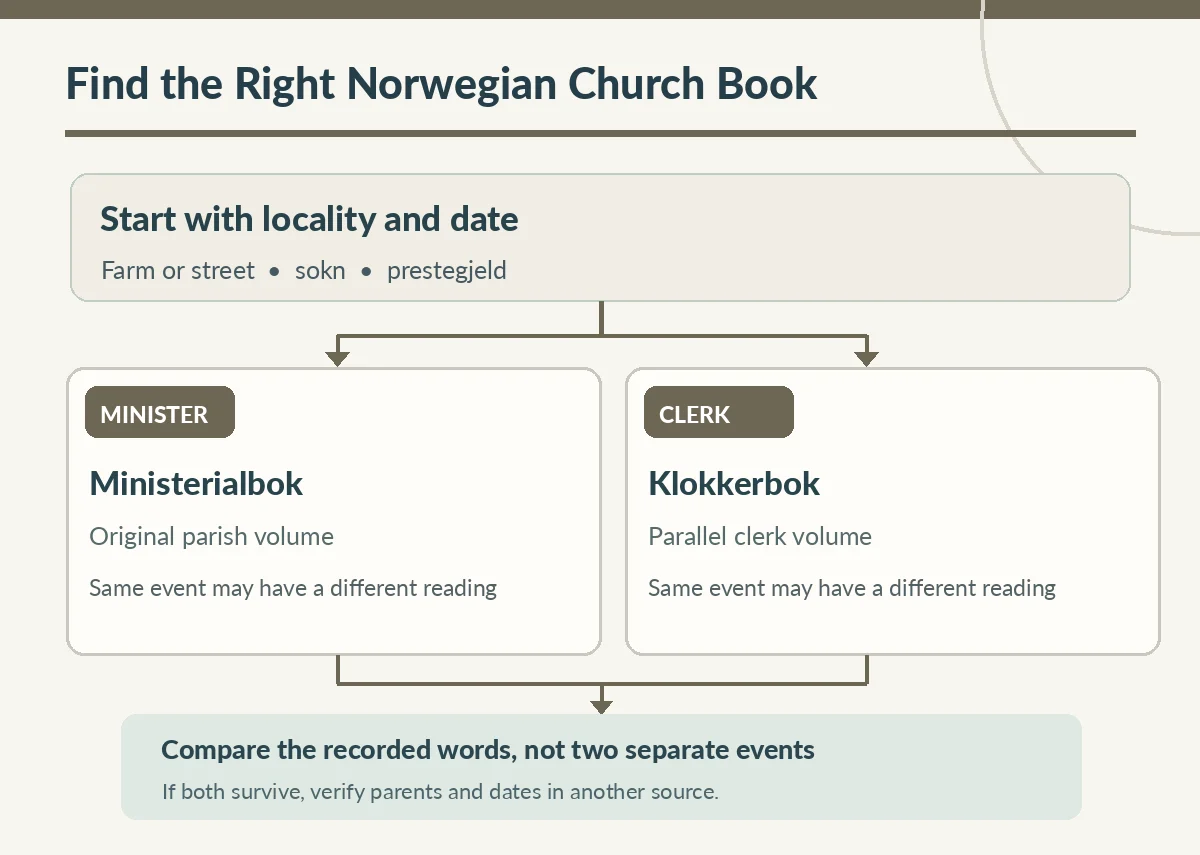
Compare ministerialbok and klokkerbok as separate witnesses
A ministerialbok is the parish register kept under the minister’s responsibility; a klokkerbok is a parallel book associated with the clerk. Their survival and dates vary by locality, and they should not be described as two independent events. For the same baptism, examine both when one entry is faint, damaged or appears inconsistent. Each volume is a distinct source: copy its title, years, section, page and permanent image reference rather than citing ‘Norway church records’ generically. For a related choice, see our guide “Polish Birth Records”.
Build a comparison sheet with left column for the minister’s recorded date and names, right for the clerk copy, and a third column for agreement or discrepancy. One copy may reproduce an error or omit detail; identical entries are not necessarily independently provided testimony. If one version spells a patronymic differently, keep both literal readings. Check related baptisms and the parents’ marriage before standardizing the family name. These books improve legibility, not magically prove identity.

| Source | What to capture | Caution |
|---|---|---|
| Ministerialbok | Parish, volume, section, image | May be faint or incomplete |
| Klokkerbok | Separate volume and wording | May copy an earlier mistake |
| Independent event | Census or marriage corroboration | Check same person, not only name |
Separate a child’s birth from the baptism ceremony
A book’s fødte og døpte section may report both a birth and a baptism, but which columns are available changes across years and parishes. Read the exact column heading. A baptism witnessed by a minister is strong evidence for the ceremony; a birth date within the entry can be informative but should be separately transcribed and corroborated when critical. Parents, residence or farm, witnesses and sponsors may appear. Do not treat every adult named as a parent or proof of a genetic relationship.
For a fictional Anne Olsdatter, distinguish a child’s patronymic from an adult surname and from the farm name attached to the residence. The child of an Ole may bear Olsdatter, but that patronymic alone cannot identify which Ole is the father. Look for a matching parent’s occupation, farm, siblings and later confirmation entry. If a scan is difficult to read, compare adjacent entries by the same clerk to learn letter forms without changing the literal transcript to fit an online tree.
Find the actual wedding rather than only a marriage intention
Select the viede (married) section and verify that the record documents a performed ceremony. Some books also have banns or other preliminary entries; a notice is not itself proof a wedding occurred. Transcribe both spouses, residences, occupations, witnesses and named fathers or prior marital status only if those columns are actually present. Expect the available details to change by period and register format, and record missing fields rather than inserting names from a secondary database.
If two couples share a common patronymic combination, trace the newlyweds in later household and baptism registers. A witness may be a relative, neighbor or community member, but witnessing is not automatic kinship. A banns date preceding the wedding date belongs in a separate timeline row. Where one parish only contains the announcement, search the relevant partner’s parish for the service before claiming a legal marriage. Keep uncertainty open if conflicting entries remain. Our guide “Danish Parish Registers” covers a related question.

Use confirmations, deaths and moving notes as checks
A confirmation record may add an approximate birth date, baptismal place, residence or parents, depending on the year. A burial entry can record the funeral event while the death happened earlier; do not turn one date into the other. Separate the categories konfirmerte (confirmations), døde (deaths) and begravede (burials) if they appear separately in the volume. Cross-reference ages cautiously: a death age could be rounded or copied from an informant.
If a marriage or census suggests the family moved, check any available moving-in or moving-out section and the receiving parish. A noted destination is evidence of an administrative statement, not by itself proof the person arrived or stayed. Record both departure and receiving entries when possible. Where sections are absent or no digital scans are accessible, the limitation may be a missing book or access restriction rather than evidence of no religious event. Ask the holding archive about the historical volume rather than guessing.
Search the scans when a name index shows no result
Digitalarkivet publishes scanned archival material and searchable transcriptions, which are not identical coverage sets. A source can be scanned without every entry being searchable by name. In the scanned-book navigation, choose parish, volume, event section and approximate year; then inspect neighboring pages if dates are out of sequence. Always save the persistent image reference and its source title. If a name is indexed, compare its extracted spelling to the manuscript, especially for patronymics, abbreviated farms and handwritten letters. Our guide to Norway’s 1865 census covers a related question.
The National Archives’ guidance also warns researchers to consider access restrictions and differing record availability. Do not publish information about living people or treat restricted books as an invitation to circumvent privacy. Check the current page’s rights and availability before downloading or reproducing images. If no year range survives, use an alternative period census, probate entry or independently dated record, but label it substitute evidence rather than an unlocated baptism.
More Records and Archives Guides
How We Research Norwegian Church Books
We checked the Norwegian National Archives’ kirkebøker guide, its Digitalarkivet research entry point and the agency’s explanation of scanned versus transcribed archival access. The comparison chart shows the logic of checking parallel books; it is not a reconstruction of a historical person’s register. The Anne Olsdatter case is imaginary. We kept any region- and period-dependent fields conditional because a national statement that every parish recorded the same details would be misleading.
The safest research trail records the parish hierarchy, book series, section heading and image, followed by a second dated source. We offer no affiliate endorsement of a paid register provider. See our affiliate disclosure; check the National Archives’ actual reproduction and privacy rules before sharing or reusing a scan.
A parish register kept under the minister; cite its specific parish, volume, section and page.
A parallel parish-clerk book where preserved. It can clarify writing but may repeat mistakes or omit details.
No. Fields vary across years and parishes; read the heading and transcribe birth and baptism dates separately.
No. It may represent the farm or residence at a particular time and can change as a person moves.
Not every scanned entry has a name transcription; try browsing the correct parish book and check volume survival and access.