
Cornwall parish registers can lead to baptisms, marriages and burials long before civil registration, but finding a name in a Cornwall Online Parish Clerks transcript is not the same as viewing a manuscript parish book. Start with a verified place, approximate date and denomination. Search the free volunteer transcription, identify the historical parish and the exact event, then check Kresen Kernow’s catalogue for the surviving original or copy. This method is especially important where neighboring Cornish parishes share surnames and where Methodist and other nonconformist families appear outside an Anglican parish register.
Find the correct parish rather than trusting a county-wide name hit
Cornwall is not a single parish register. Assemble a locality profile using a census residence, a marriage certificate, a will, or a documented farm or hamlet. Then identify neighboring parishes likely to have served that location; do not treat today’s postal address as proof of the historical ecclesiastical parish. A person could be baptized in one parish, marry in another, and be buried where relatives lived. In an OPC result, preserve the parish stated in the source and any chapel or place field. If the same name appears in two parishes a few miles apart, create separate candidates until a parent, witness, occupation, or dated household link distinguishes them. For a related choice, see our guide “Cambridgeshire Parish Registers”.
Use free OPC entries as discovery tools, not manuscripts
The Cornwall OPC Database describes its records as volunteer-donated transcriptions and explicitly advises consulting originals. Search the likely surname and variants, widen the date interval, and compare different event types without automatically attaching them into a family. Record exactly what the result displays: parish, baptism or burial date, parents when stated, register notes, and any source reference. Do not reproduce a third-party transcript as if it were an independent primary source. If the online entry has an unfamiliar abbreviation or unclear date, keep the ambiguity verbatim for later verification. The OPC search is free, but transcript coverage and completeness vary.
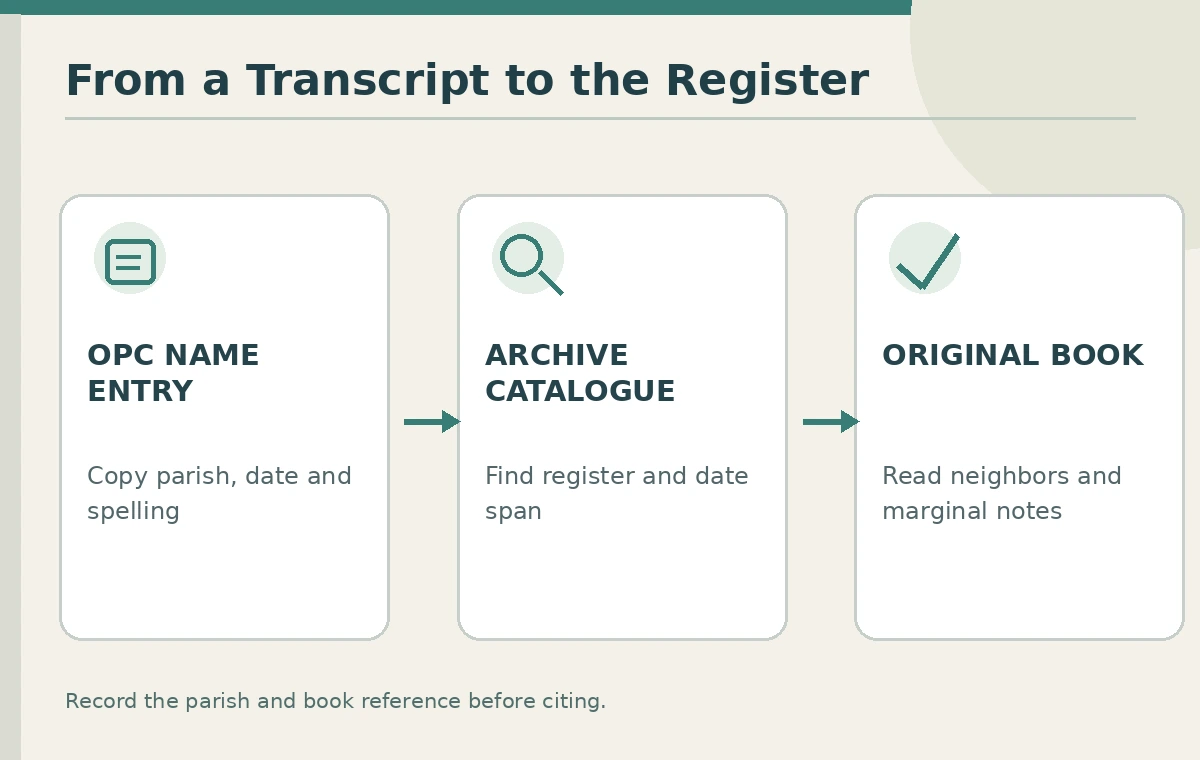
Locate the manuscript or microfiche at Kresen Kernow
The archive’s family-history guide says Kresen Kernow has registers from Cornwall’s 257 parishes and more than 500 registers from Methodist, Quaker, Congregational and Baptist traditions. This is an archive-wide statement, not a guarantee that every parish survived continuously from 1538. Search the archive catalogue by parish and record class; capture the exact collection and item reference, inclusive dates and viewing arrangement. The archive explains that parish registers can be viewed on microfiche in its reading room and transcripts are available. Ask about remote scans if travel is impossible; cost and availability depend on the item.
Keep Anglican and nonconformist books apart
A family’s denomination matters. An Anglican baptism entry, a Methodist chapel register, and a Quaker birth record may preserve different information and sit in different archival collections. Kresen Kernow identifies P for parish records and MR among its Methodist record collections; confirm the actual archival code on the catalogue item before citing it. Do not call a nonconformist baptism proof that an Anglican baptism is missing or that a child was born that day. Similarly, an Anglican burial can follow a nonconformist life and may reflect the local burial ground rather than the deceased person’s worship history. Search by documented church affiliation and locality, and broaden only when coverage calls for it. Our guide “Bedfordshire Parish Registers” covers a related question.
| Clue | First search | Verification source |
|---|---|---|
| Baptism before 1837 | Cornwall OPC surname and parish | Original parish or chapel register |
| Marriage after 1837 | Parish ceremony plus civil index | Original entry and civil certificate |
| A missing Anglican baptism | Neighboring parish and denomination | Methodist or other surviving book |
Read the original page in its neighboring register sequence
When the image or fiche is available, read the full heading, column labels, page number and adjacent entries. A copyist may silently expand abbreviated names, normalize a parish name or miss a marginal remark. Some early entries combine events on the same page; others were copied retrospectively. Check whether the entry is for baptism versus birth, marriage versus banns, or burial versus death. Dates before 1752 may use a calendar year beginning March 25; record the written date before modernizing it, and explain any dual-year conversion. Witnesses and sponsors can point to a cluster but do not, on their own, prove a specified relationship. To go further, our guide “Illogan Parish Registers” shows how to check Cornwall OPC entries against church originals.
Use 1837 as a change of record system, not an end date
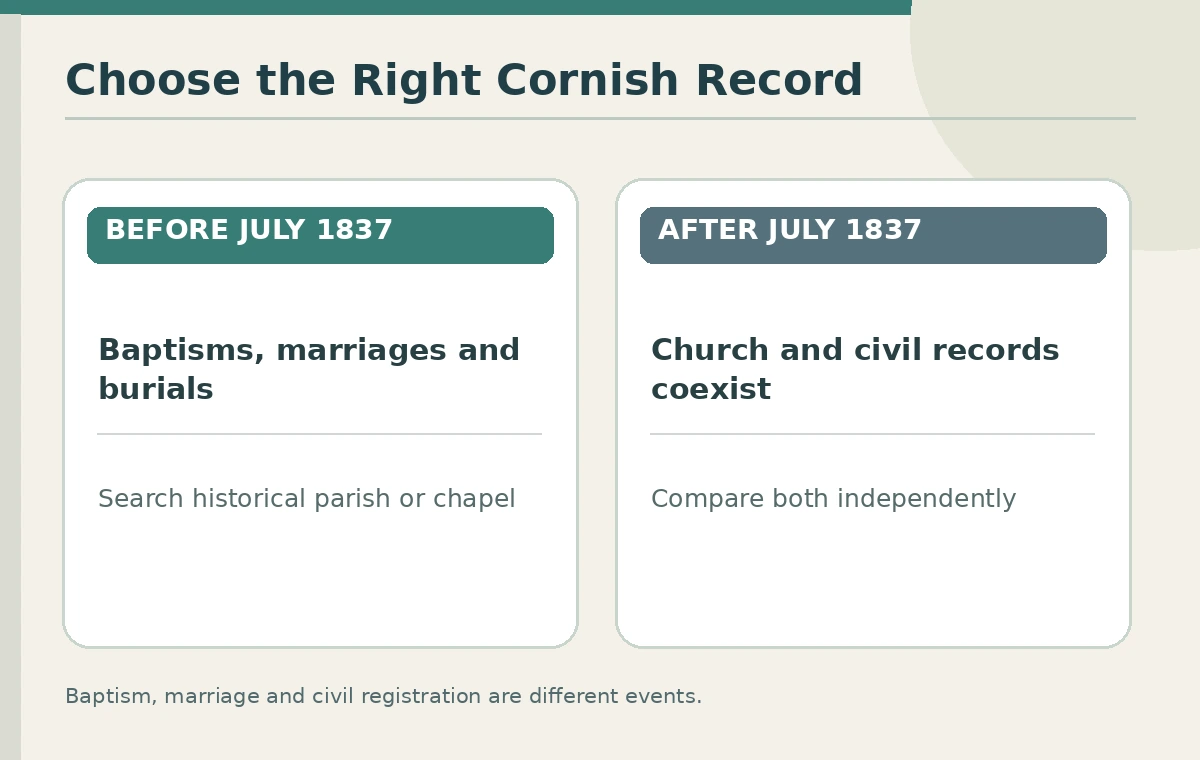
Cornwall Council’s family-history instructions explain that civil registration of births, marriages and deaths began in England and Wales on 1 July 1837. Parish registers continued afterward; the new system did not replace every church record with a civil register. For a post-1837 marriage, an Anglican register may provide witnesses and ceremony details while a civil registration entry can connect the event to legal registration. For a pre-1837 birth, the likely surviving church source is often a baptism, which can be separated from the actual birth date by days, weeks or years. Make this difference explicit in your conclusion.

Write a source trail that will survive a website redesign
Your research log should show the query, spelling variants, parish, record type, entry date, OPC transcript details, and the Kresen Kernow catalogue reference that leads to the original. If you only have the transcript, say so. A citation for an archived manuscript should identify the holding institution, collection, parish, register date span, page or folio and the entry; an online database citation should identify the database and retrieval date as well. When two same-name people remain possible, build a dated timeline with parents, spouses, witnesses, hamlet and occupation. An unresolved line is preferable to linking a stranger’s baptism to the wrong family.
How We Research Cornish Parish Books
Our research for this guide compared the dated and jurisdiction-specific statements on kresenkernow.org, www.cornwall-opc-database.org. We treated source descriptions, access conditions and missing-return notes as separate claims, cross-checked terminology against the original collection guide, and wrote visual steps only for information those sources support. All examples describe hypothetical comparison methods, not identified historical people. Recheck the linked institution before ordering a record or interpreting a changed access rule.
More Records and Archives Guides
Record Sources, Access Boundaries, and Disclosure
Primary source guides used here: Kresen Kernow original parish and nonconformist register holdings and research guidance.; Free volunteer transcript database, provenance and original-register verification caveat.; Cornwall parish records before 1837 and separate civil registration from July 1837.; Current archive catalogue route and item descriptions.. These links are informational references, not paid placements. This article makes no claim of a paid archival partnership; see our affiliate disclosure. If an archive limits access, never circumvent the rule or publish identifying details about a living person.
Yes. It is a free volunteer transcription resource, but does not replace viewing the original register.
Kresen Kernow holds historic registers from all 257 parishes, though survival and dates vary by parish and some current volumes remain in use.
No. A baptism date records a religious event; only an entry explicitly recording birth date supports that separate claim.
Sometimes, especially for burials or events involving a parish church, but search Methodist and other nonconformist collections separately.
Civil registration began in England and Wales; church registers continued and can still offer independent evidence.