
The Kilmoremoy Catholic parish registers, also cataloged under Ballina, do not form one uninterrupted image run. The National Library of Ireland (NLI) lists separate microfilms for births through baptism, marriages and certain death entries, with discontinuities and changes in coverage. Select the event type and year first, then open the appropriate film and cite the actual frame. A parish baptism can suggest a birth period but is not a statutory birth certificate, and a missing entry in a known gap is not evidence the person did not live in the parish.
Confirm Kilmoremoy, Ballina and the Diocese of Killala
The NLI parish catalogue labels the collection Kilmoremoy in the Diocese of Killala, County Mayo, and lists the variants Kilmore Moy, Killmore Moy and Ballina. These are catalog variants for the parish, not automatically separate searchable books for each name. Record the form used by a particular family document and the NLI’s normalized parish label. A couple described as married ‘at Ballina’ may have used this Catholic parish, a Church of Ireland parish, a registry office or another nearby religious institution. Religion and denomination must be established rather than assumed from a town name.
The microfilmed Catholic registers are from local parish custody, with images supplied by NLI. An index on a separate service may be a transcription of some entries rather than an independent original. Enter the parish, diocese and film number in your search log; otherwise a page or image number can be confused with another Irish parish collection. If a family migrated across the Mayo/Sligo boundary, check contemporaneous place forms before restricting your search to a modern county. The NLI’s catalogue is an aid to holdings, not proof that every resident appears.
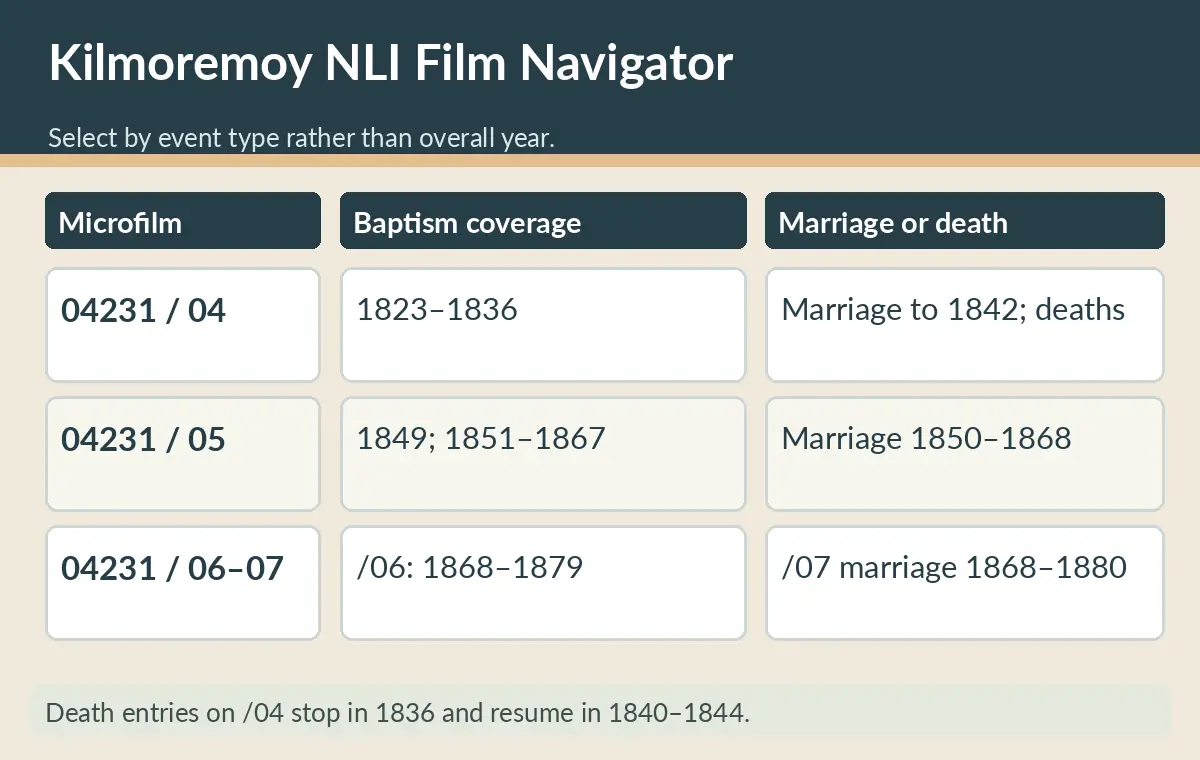
Choose film 04231/04 for early baptisms, marriages and deaths
Film 04231/04 is an unusually useful mixed-event source. NLI dates baptisms from 1 May 1823 to 14 October 1836, marriages from 15 May 1823 to 4 October 1842, and death entries from 29 April 1823 to 12 August 1836 plus 12 September 1840 to 3 May 1844. The two death ranges should be written separately; there is an intervening gap. Because the film includes different registers, a frame reached while searching marriages is not necessarily a baptism page, even if familiar surnames appear nearby. Read the heading and surrounding entries.
A death entry is not automatically a civil death certificate or a full burial record. Note the exact event label, written date, people named and whether the image contains place details. If the handwriting uses Latin abbreviations, transcribe literally first and expand cautiously later. The label of a death entry may not establish the death day if it refers to a burial or religious service. Be especially careful with a pre-1837 baptism: church practice and intervals between birth and baptism varied, so no exact birth date should be calculated without explicit evidence.
Bridge the mid-century discontinuities with film 04231/05
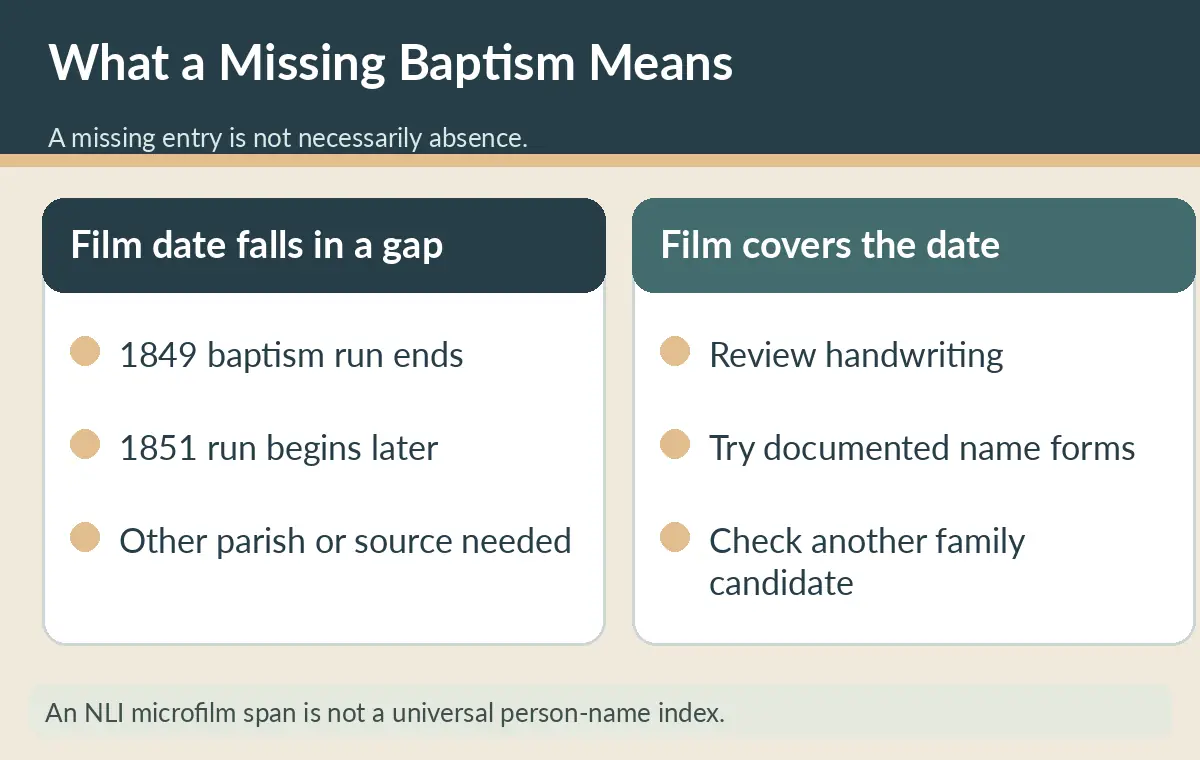
The NLI entry for film 04231/05 lists baptisms for 9 May to 16 July 1849 and again from 23 July 1851 to 8 September 1867. Marriages run from 22 October 1850 to 20 February 1868. Do not collapse the two baptism spans into ‘1849–1867 complete’: that shorthand conceals an important gap. Marriage coverage does not imply baptism coverage in the same interval. A child believed baptized in 1850 may not be locatable on this NLI film even when a marriage in that year is visible.
Search images near a relevant year rather than relying exclusively on an external name index. Look at headings, page breaks and the cleric’s layout to see whether a name was abbreviated or written phonetically. Record sponsors or witnesses, dates, residences if stated, and the exact frame reference, but do not assume a sponsor is a grandparent. If a person is absent from a covered range, search a wider period and neighboring parishes with explicit notes. If the presumed year falls in a catalogue gap, characterize the result as a coverage limitation, not a negative family-history finding.
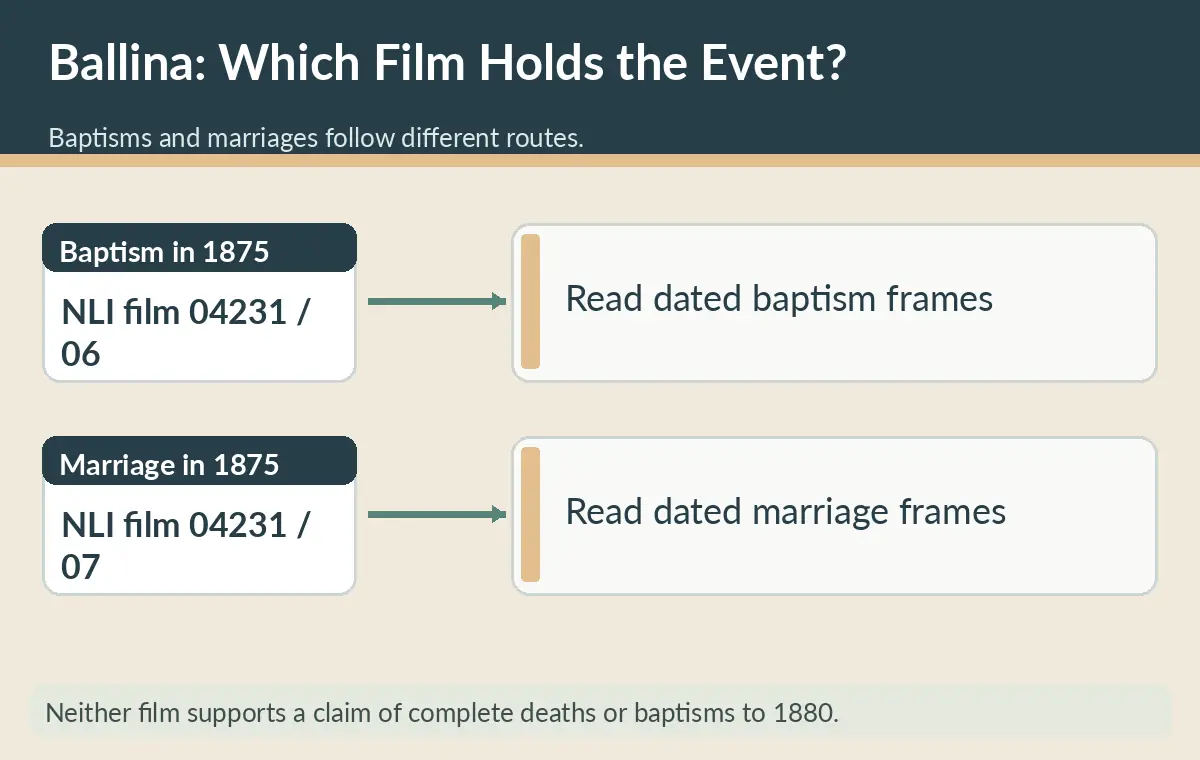
Avoid mistaking films 04231/06 and /07 for the same collection
Film 04231/06 carries baptisms from 2 February 1868 to 18 February 1879, according to its own NLI register description. Film 04231/07 carries marriages from 2 February 1868 to 31 December 1880. Although both start in the same month of 1868, they differ in record type and ending year. A researcher seeking a baptism in 1880 should not assume film /07 covers it merely because the film runs to that year. Conversely, a marriage in 1879 need not appear in film /06 even if the family name occurs there.
Make a matrix with the question in one column and the correct film in another: baptism 1875 leads to /06; marriage 1875 leads to /07; death 1841 leads to /04. This is a navigation rule, not a claim that every expected entry survives or is legible. Index page labels and image numbers can shift with interfaces; identify the original register heading and transcribe neighboring dated entries to confirm your place in the film. Cite the NLI film and image, not only the hosting site’s overall collection title.
Corroborate same-name couples and parent-child claims
A register may contain multiple Patrick O’Haras or Mary Gallaghers, and identical names are especially weak identifiers in a large parish. For baptisms, compare the named parents, date, sponsors and any residence literally shown. A maternal surname may appear in varying forms across entries; record variants before normalizing. For marriages, confirm the two spouses’ names, the stated date and witnesses, but remember that witnesses are not automatically siblings. A baptism that names two adults as parents does not prove that every similarly named adult in later census returns is one of them.
Use a fictional two-family worksheet: one baptism names Patrick and Bridget, another Patrick and Mary, with different dates. Do not fuse the entries into one household merely because the father and town coincide. Link the children only if a defensible chain of independent records supports them. Irish civil birth registration from 1864 can offer a separate comparison for later children, subject to the correct jurisdiction and record availability. Distinguish a name index from a frame you actually opened, and do not claim direct inspection if you only saw a transcript.
Cite the film, frame and research gap precisely
A useful citation reads: National Library of Ireland, Catholic Parish Registers, Kilmoremoy (Ballina), Diocese of Killala, microfilm 04231/05, baptism entry dated [the date actually seen], frame or image reference, access date. Add literal spellings and uncertain handwriting in the working note rather than correcting an original entry silently. If you need to reproduce an NLI image in a publication, consult the terms for reuse and credit the archive. Original editorial diagrams can describe the film route without republishing a protected facsimile or suggesting access to a private parish book.
When no entry is found, state the film, event type, dates covered and frames searched. For a range outside documented coverage, say the NLI films do not show that segment; do not claim the individual was absent from the parish. Look for local records, adjacent parishes or later civil documents, preserving every source’s event category. This is a research guide, not a paid transcript service; GenHis’s disclosure page explains any third-party referral policy.
More Records and Archives Guides
How We Research This Collection
We read the NLI parish catalogue and individual 04231/04, /05, /06 and /07 register descriptions rather than generalizing from a single year range. The graphic film matrix preserves event-specific discontinuities; it does not stand in for an image review of a particular ancestor. Evidence claims are restricted to source descriptions and careful methods, not fabricated entries.
The NLI catalogue lists Ballina, Kilmore Moy and Killmore Moy as variants for Kilmoremoy in Killala Diocese.
NLI microfilm 04231/06, covering baptisms from February 1868 to February 1879.
The NLI lists marriages from February 1868 through December 1880 on film 04231/07.
NLI film 04231/05 has a short 1849 baptism run and resumes in July 1851; the missing interval cannot be treated as complete coverage.
No. Test named parents, witnesses, date and place against independent sources and competing same-name entries.