
To locate someone in Manukau Memorial Gardens near Auckland, use Auckland Council’s official cemetery page and linked burial-or-cremation search. Search by a documented name or death date, then read the remains type and event field before interpreting a map. An ashes record may report a cremation rather than a grave burial. The cemetery was established in 1932 and formerly known as Papatoetoe Cemetery; older family descriptions may use that historic name. Do not assign a family relationship based on proximity or surname.
Recognize Manukau, the former Papatoetoe Cemetery
Auckland Council locates Manukau Memorial Gardens at 361 Puhinui Road, Wiri, and describes its earlier name as Papatoetoe Cemetery. A death notice or family letter may use the old label, the contemporary cemetery name, or simply ‘South Auckland.’ Save the exact historic wording but use the present council name when choosing a cemetery database filter. Check the date carefully: the council states the site was established in 1932, so an alleged interment there well before that year calls for another place or a later memorial. A cemetery name in a modern directory is not retrospective evidence of where a person died.
The site’s public information distinguishes burial plots, reopened plots, cremated remains, a crematorium and memorial facilities. A person can be connected to the cemetery through different events. Decide what you need to prove: an actual burial, a cremation, disposition of ashes, ownership of a plot, or a commemorative marker. Do not start with a map pin and retroactively assign an event to it. Ask whether the original family source refers to a funeral service, a grave visit or a memorial inscription, since those phrases support different hypotheses.

Search the council burial-or-cremation database with variants
The cemetery page points to the council’s searchable burial and cremation records and says a name or date of death is needed for a search. Begin with a full name as recorded in an independent civil or family document, and try well-documented spelling, initials or surname changes where appropriate. Preserve each search and its filters, including the cemetery and date range. A result in another Auckland council cemetery should remain a separate candidate rather than being silently reassigned to Manukau. A missing result can reflect naming, transcription or the scope of the search, not proof that a family tradition is false.
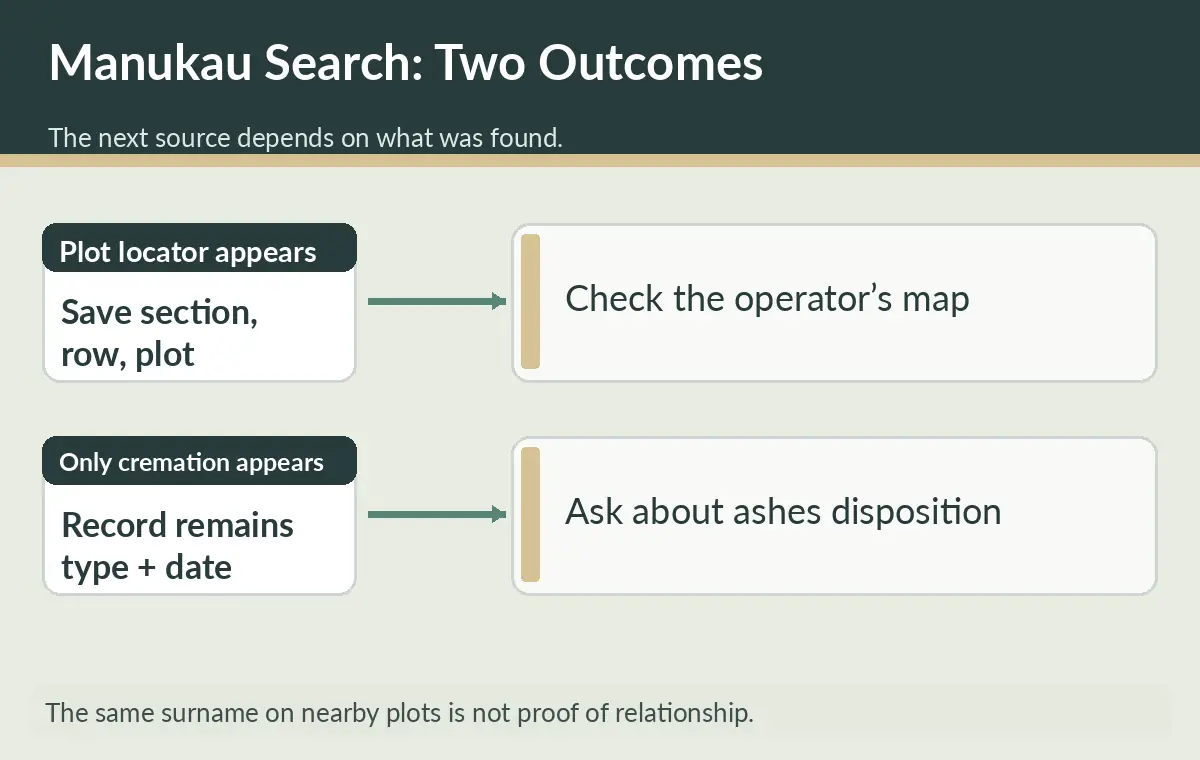
On opening a candidate, record the exact cemetery name, stated death date, any age, remains type, burial date, cremation date and plot location if present. Not all fields are populated. One publicly displayed council example lists remains type ‘Ash’ and a date of cremation without any plot position, while another lists ‘Body,’ a burial date and a section-row-plot location. The records illustrate how database fields differ; neither is a template that licenses inventing absent fields. Treat unknown birth dates as unknown rather than computing them from rounded ages.
Use remains type before interpreting the cemetery map
A site map is for wayfinding, not for determining a person’s identity. If a database entry gives a named section, row and plot, transcribe the entire locator before comparing it with the council map; omitting a section name may produce a wrong location. Where an ashes record has no plot locator, do not manufacture a grave number. Cremation and the subsequent fate of ashes can be separate events, potentially at different sites. Contact the cemetery when the operator result is ambiguous rather than assuming an ash record identifies a burial plot.
A gravestone or plaque is not a complete ledger of everyone commemorated or interred there. A person might be named on a family monument without physically lying in that grave. Conversely, an official interment may lack a visible headstone. Preserve the precise cemetery section and map edition when possible, especially if areas have been renamed or upgraded. If you photograph a marker, separately cite what is physically legible, what was supplied by the council, and what is merely a family interpretation.

Compare candidates without presuming family relationships
Consider two historic John Smith entries found in the Auckland council search. One has a matching approximate age but a cremation record; another has a burial in a mapped Manukau section. Neither becomes the ancestor automatically. Prepare a two-candidate matrix with known occupation, residence, spouse, newspaper death notice, death registration, event dates and literal name variants. Identify which details came from each source, and do not use the database’s age to guess an exact birth date without recording uncertainty. Similar names can occur in different districts and generations.
If a candidate is documented as buried beside another person of the same surname, that spatial association is worth investigating but does not prove parentage or marriage. A plot purchase or contact person may be an unrelated administrator, friend or funeral arranger. Use independent certificates, contemporaneous notices or dated household sources to test actual relationships. Keep an unresolved status when the evidence cannot distinguish the people. A cemetery match that is accurate at the interment level may still be the wrong identity for a particular family tree.
Request a correction with evidence, not a speculative tree
Auckland Council’s public record pages provide a correction path tied to the council’s regional contacts. For a Manukau entry, preserve the record URL and the displayed region; the example records direct South-region changes to the appropriate southern cemeteries address. State the exact field believed wrong and attach reliable supporting evidence instead of demanding a broad rewrite of family information. Separate transcription defects from historic disagreement: an error in a modern index may be corrected, whereas two historical sources can legitimately record different names or dates.
When requesting help, identify whether you need a burial-location clarification, an original administrative source or an amendment to displayed details. Do not assume that all records or private contact information are publicly accessible. Avoid including living relatives’ private data in an open request or publicly shared family-history post. A concise reference number, deceased person’s recorded name and specific question are usually more useful than a large speculative pedigree. Follow the current council instructions because staff contacts and interface labels can change.
Cite the cemetery claim and the identity claim separately
For an operator search citation, write ‘Auckland Council cemetery database,’ the exact recorded name, remains type, event date, location or section if shown, stable URL and access date. Cite any downloaded map by its council source and edition or retrieval date. If the family identity comes from a civil record or funeral notice, that document needs a separate citation. Never write ‘buried in Plot X’ when the operator displays only cremation; make the narrow statement the data supports. A no-result search should list what filters and spellings were tried.
Close the case only after the person-level identity and event type both satisfy the research question. Valid outcomes include confirmed interment with independent identity support, verified cremation but unknown ashes disposition, or an unresolved same-name possibility. Historic Papatoetoe references require explicit source comparison rather than automatic normalization. The council search is the recommended official starting point, not a paid partnership. Our disclosure policy provides information on third-party referrals.
More Records and Archives Guides
How We Research This Collection
We compared Auckland Council’s Manukau Memorial Gardens page with two public operator record examples, specifically contrasting ‘Ash’ with ‘Body’ and the presence or absence of plot information. The examples establish field types, not family relationships. Our maps are schematic and do not recreate the council’s protected map or imply an actual location.
Auckland Council says the cemetery, established in 1932, was originally known as Papatoetoe Cemetery.
Yes. The official council cemetery page links to a burial-or-cremation database searchable with name or death date.
No. Read the remains type and dates; a cremation record does not by itself locate ashes or a coffin grave.
Open the operator result and transcribe its cemetery and section-row-plot fields, if present, before checking the official map.
Use the record’s correction instructions and provide the record link, affected field and supporting evidence.