
To research Ararat Cemetery in Victoria, identify the cemetery first: the Victorian Government lists Ararat Cemetery Trust at Nott Road, Ararat. Ask the trust for an interment or grave reference, then compare historical burial-register listings and a documented memorial inscription. The Public Record Office Victoria explains that many burial records remain with cemetery trusts and some have transferred to archives. A name on a photographed stone is a useful lead, but it does not alone prove the person was physically buried beneath it.
Confirm Ararat Cemetery and the Correct Custodian
Victoria’s official cemetery-search listing places Ararat Cemetery on Nott Road in Ararat, postcode 3377, and names Ararat Cemetery Trust as administrator. This identification matters because other burial grounds, older churchyards and memorial sites can appear under similar place names in local histories. When you have only an obituary stating a death in Ararat, do not automatically assign the burial to this public cemetery. Record the exact wording, funeral service location, reported cemetery and date. Then contact the named trust to ask whether an interment is documented.
The Government’s current listing distinguishes adult burial positions, lawn and monumental sections, and cremated-remains arrangements, including graves and memorial sites. These are current service categories, not historical dates of introduction. Do not use a present-day fee list to claim which option an ancestor received in the nineteenth century. Instead request the actual burial or interment record and note its wording. An operator may need a surname and approximate year to conduct a historic lookup; ask for its available date coverage before assuming that all older entries have been indexed.
Locate a Historical Burial Register Before Relying on a Name List
An independent Victorian genealogy directory points to a FamilySearch catalog entry for Ararat burial registers and an index reportedly spanning 1863–1982. Treat that range as a catalog lead to verify against the item description and actual reels or images, not a promise of continuous records or online name access. When locating a likely volume, write down its dates, title, institution, item or film reference and whether viewing is permitted online or at a library. A later index may be arranged differently from the original burial register.
Public Record Office Victoria’s burial guide instructs researchers to search by the specific cemetery trust and browse the records held for that trust. It also warns that many current and historical registers are still with local trusts. A failure to find an Ararat series through PROV does not show that no register survived or that no person was buried. Record which custodian you contacted and precisely what material they reported. Some institutional copies may be incomplete; ask whether a parallel index or older administrative book is available.
Compare Interment, Plot Right, and Memorial Wording
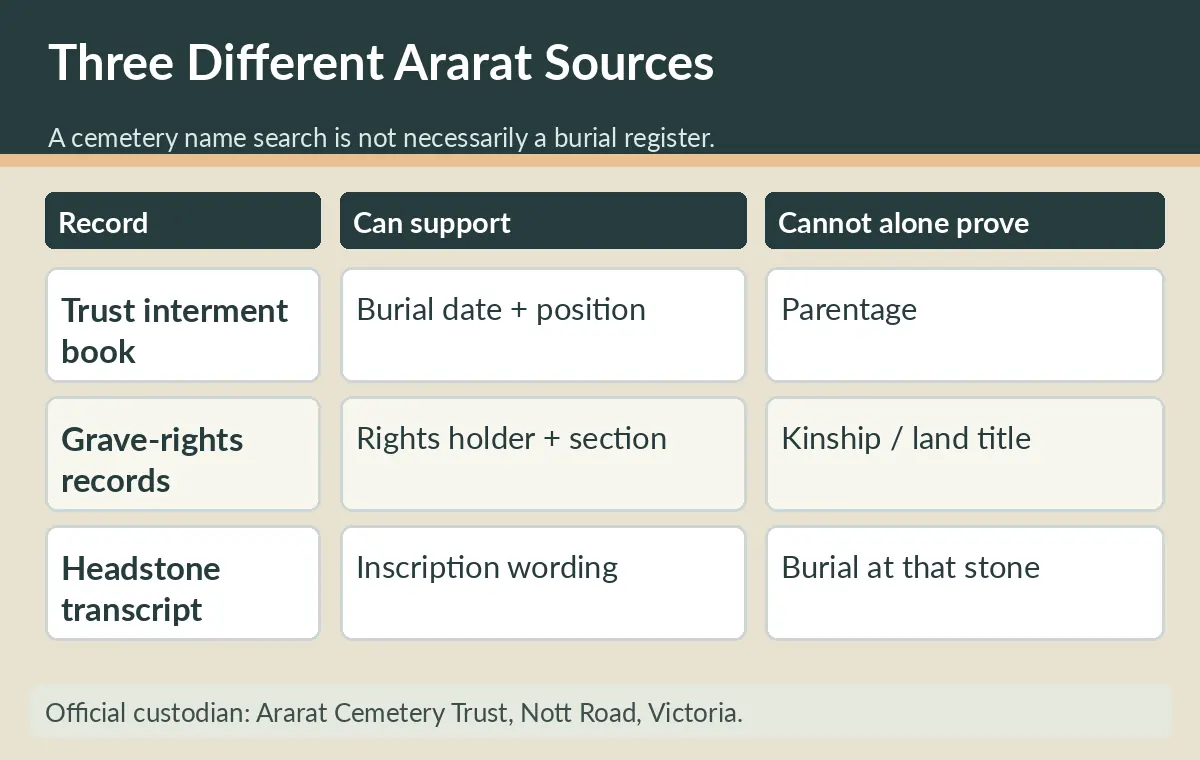
A burial register can substantiate that a person’s body or remains were interred, often with a date and location identifier. A grave-rights or trust administrative record may identify the responsible payer or holder of rights, but that person is not necessarily a spouse or descendant. A gravestone shows what was inscribed, sometimes long after death. These records answer three distinct questions. Even when two names appear on a single stone, one person may be commemorated rather than buried there. Do not infer family relationships merely from proximity or repeated surname.
For a strong result, gather the deceased’s exact name, separately labeled death and burial dates, cemetery and section, plot number if supplied, trust reference and the words of any monument. Compare a civil death registration or funeral notice for independent identity anchors. If a map supplies only a modern grave position, check whether its numbering corresponds to the historic register. A plot reference cannot be converted into a genealogical relationship or ownership of cemetery land without a supporting administrative record.

Use Headstone Transcriptions as Carefully Attributed Clues
The independent Ararat memorial listing credits volunteer photography and transcription of inscriptions visible in the cemetery. It is not presented as the original cemetery trust’s complete burial register. Note the transcription author’s attribution, the text and the available photo, then compare actual lettering if possible. A worn date, abbreviation or name may have been misread, and a monument can disappear or be replaced. If no surname appears on the transcription page, that does not prove there was no burial or that a particular family lacked a stone.
A cemetery visit can supply a marker photograph, neighboring landscape references and the state of an inscription. Do not alter or clean historic stone in an attempt to read it; use respectful noninvasive observation and appropriate photography. Record the date of your observation because lettering and site layout can change. A memorial may mention a person who died overseas or was buried elsewhere, while an unmarked grave can be documented in office records. The original trust register should remain the principal line of inquiry for physical interment.
Know When to Ask PROV or the Trust for a Copy
The Victorian Department of Health emphasizes that cemetery trusts have legal record-keeping obligations and that their records are public records, subject to relevant privacy and access rules. For a historical request, provide the exact cemetery, surname variants, death window and any earlier plot or funeral details. Ask whether an interment register entry, grave plan or rights record exists and how it can be cited. Avoid inventing a register number merely because a website displays a memorial code. If an item is transferred to PROV, use its own collection and series reference when visiting a reading room.
A custodian may reply that an older volume has gaps, that the likely spelling is unclear, or that the item must be inspected in person. Preserve such replies as evidence about search coverage, not proof that a historical event did not occur. If the record lies under a different cemetery trust, use the health department’s official trust locator to identify that custodian. Fees, appointment rules and availability can change. Neither a general genealogy website nor an unverified downloaded table should be represented as the trust’s primary register.

Resolve Same-Name Burials Without Inventing Kinship
Suppose two people named Mary Sullivan have similar death years. Build a side-by-side table of reported age, residence, date, funeral notice, register identifier and grave location for each. If one matches an independent family address but the other matches a remembered burial date, neither should be attached to your pedigree automatically. Look for other supporting records, such as spouse or informant details on a civil death registration, contemporary newspaper notice, or inscription whose wording explicitly identifies a relationship. Mark uncertainty clearly when fields conflict.
Your final citation should state exactly whether you saw a trust interment entry, an archival copy, a modern burial search record, or a memorial transcript. The illustrations here are conceptual and do not reproduce the Ararat cemetery map or any person’s headstone. Record negative searches with dates, coverage and custodian, not as claims that the deceased was never present. Read the GenHis affiliate disclosure for transparency; no partnership or paid cemetery-search endorsement is asserted.
More Records and Archives Guides
How We Research Ararat Cemetery Evidence
We verified Ararat Cemetery’s current custodian and address against the Victorian Government listing, compared PROV’s custody guidance with the Department of Health’s trust record rules, and treated third-party memorial transcriptions and catalog coverage as separate secondary leads. We did not assume that a photograph, grave-rights entry or index name establishes a burial or kinship.
The Victorian Government lists it on Nott Road in Ararat, Victoria, managed by Ararat Cemetery Trust.
No such complete online access is established. Check the trust and exact archival catalog item.
It can report memorial wording, subject to reading errors, but does not independently establish an interment.
No. Rights administration and biological relationships are different claims.
The specific trust register or archival item, grave reference when given, and any separate memorial source actually consulted.