
For Antrim Cemetery records in Northern Ireland, start with Antrim and Newtownabbey Borough Council and select Antrim Cemetery in its linked burial search. The cemetery is on Moylena Road; other council grounds include Ballyclare, Belmont and Sixmile, so a result for the borough is not automatically an Antrim Cemetery burial. Search surname and date variants, copy the exact cemetery and plot reference, and verify questionable entries with the council. Its portal explicitly warns that historical transcription errors remain under review.
Select Antrim Cemetery Rather Than the Wider Borough
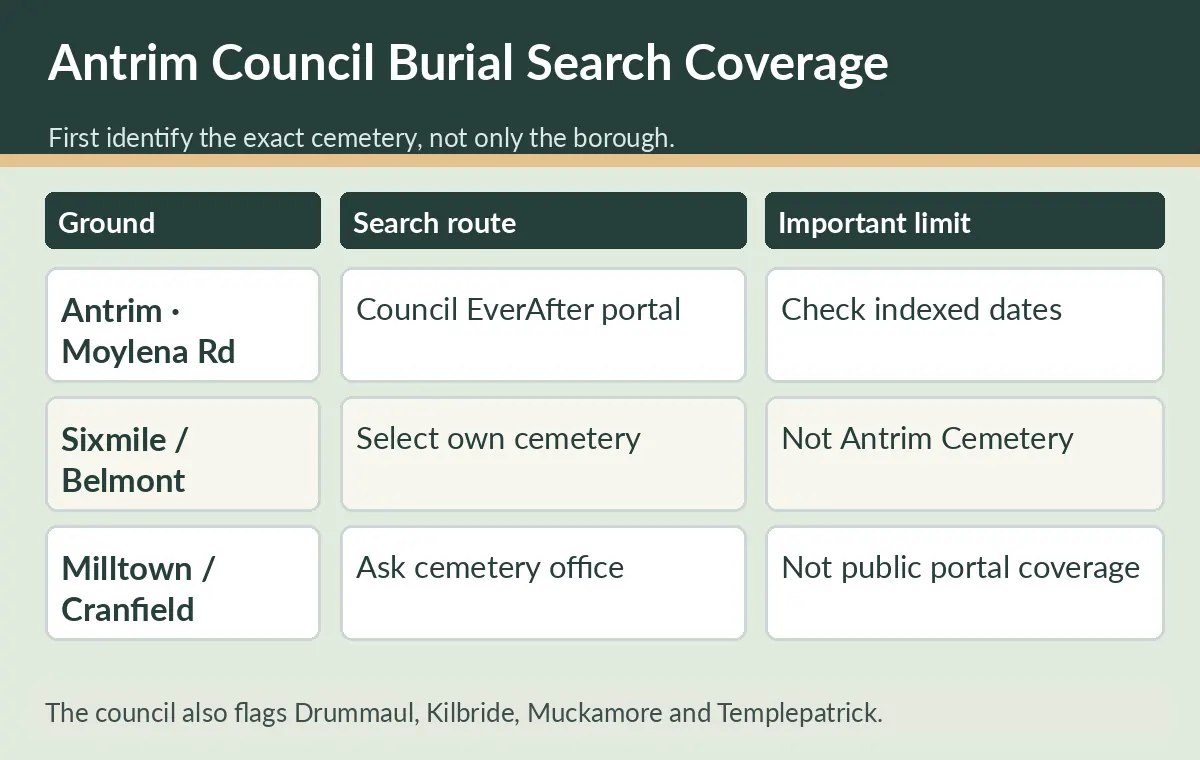
The council manages several burial grounds around Antrim and Newtownabbey and publishes a list of their locations. Antrim Cemetery is specifically on Moylena Road. Sixmile Cemetery and Belmont Cemetery are separate sites, although both are also in Antrim. When a death notice merely says ‘Antrim,’ it may name the town, death location or district rather than the actual burial place. Use the place reported in a funeral notice or family document as a hypothesis, then check the operator’s named cemetery field rather than automatically accepting a search hit.
The Discover EverAfter portal begins with a name field and a cemetery selector. Choose the named ground whenever evidence points there; if not, first search the council’s available cemeteries but record which facilities were included. The current portal has a broader displayed list than the council’s short published list of searchable sites. A visible selection option is not proof that a complete historic burial register is indexed for that ground. Save the exact displayed site label with every candidate.
Build a Search Using the Fields the Council Describes
The council says users can search by surname, date of death, or forename together with surname and date of death, with results displayed in reverse date order. Begin with the known surname and a time bracket supported by an obituary or civil record. If the name is common, narrow by forename or date only after observing the initial result count. Preserve spelling variants from historical evidence; do not silently change a name to make the result fit a theory. Copy the search date and filters so a reader can reproduce your findings later.
For each possible match, capture the name as indexed, displayed cemetery, death and burial dates if provided, any plot identifier and a stable record URL or reference. A matching death date supports investigation; it does not prove that the person is your relative. Where dates differ, distinguish the death event from funeral, burial and memorial inscription dates. Cemetery office records often come from administrative systems with their own conventions, so avoid inventing a burial date if only a death date is shown in the search display.
Understand Which Grounds Lack Online Register Coverage
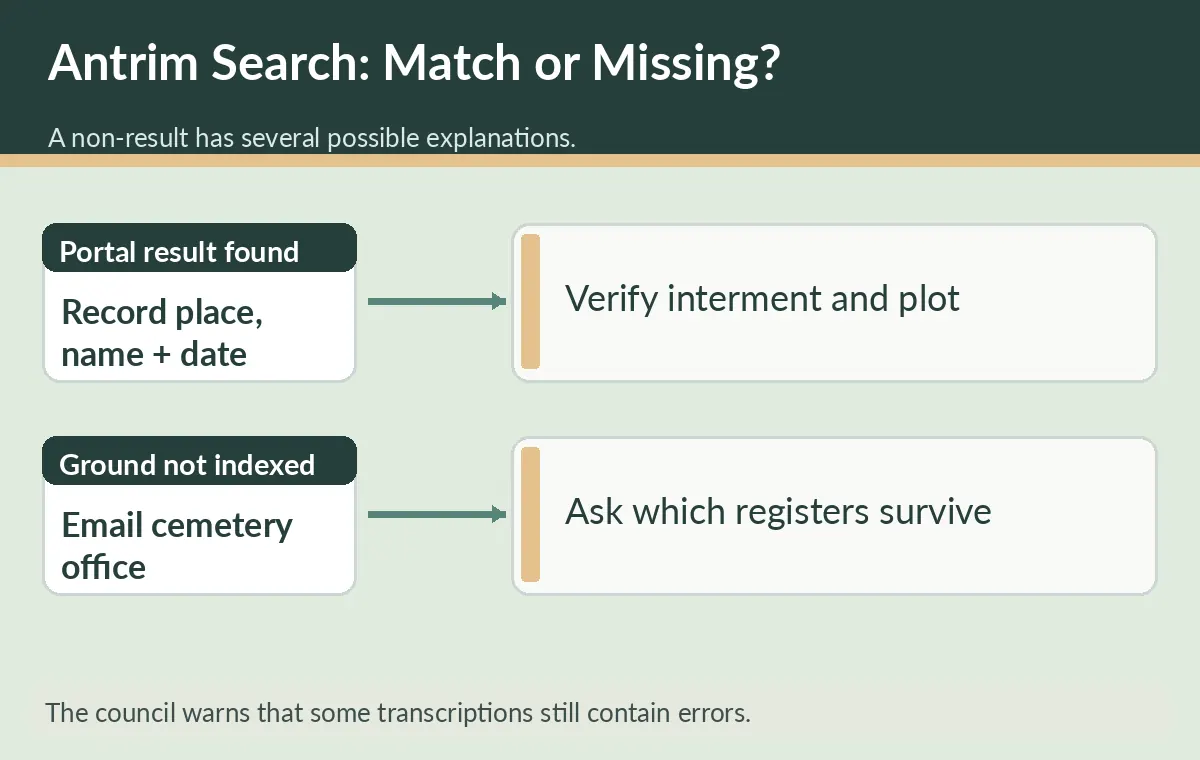
The council’s public guidance expressly excludes Cranfield, Drummaul, Kilbride, Milltown, Muckamore and Templepatrick from its online burial search because available information is limited. A search returning no record for one of those cemeteries cannot be treated as evidence that no interment occurred. For a family lead tied to an excluded site, write to the council’s Cemeteries Office with the deceased’s full name, approximate death or burial year and the suspected ground. Ask staff which surviving material is searchable rather than requesting that a missing web result be ‘corrected.’
Do not confuse Milltown Cemetery in Antrim with the cemetery bearing the same name in Belfast, and do not assume the online portal includes every churchyard in County Antrim. Burial grounds administered by religious organizations or other authorities require separate inquiries. Keep a jurisdiction column in your notes: operator, exact cemetery name, street or locality, index availability, and known catalog limitations. A negative search of one council database does not establish that the person was not buried elsewhere in the county.
Read a Plot Record Without Claiming Family Relationships
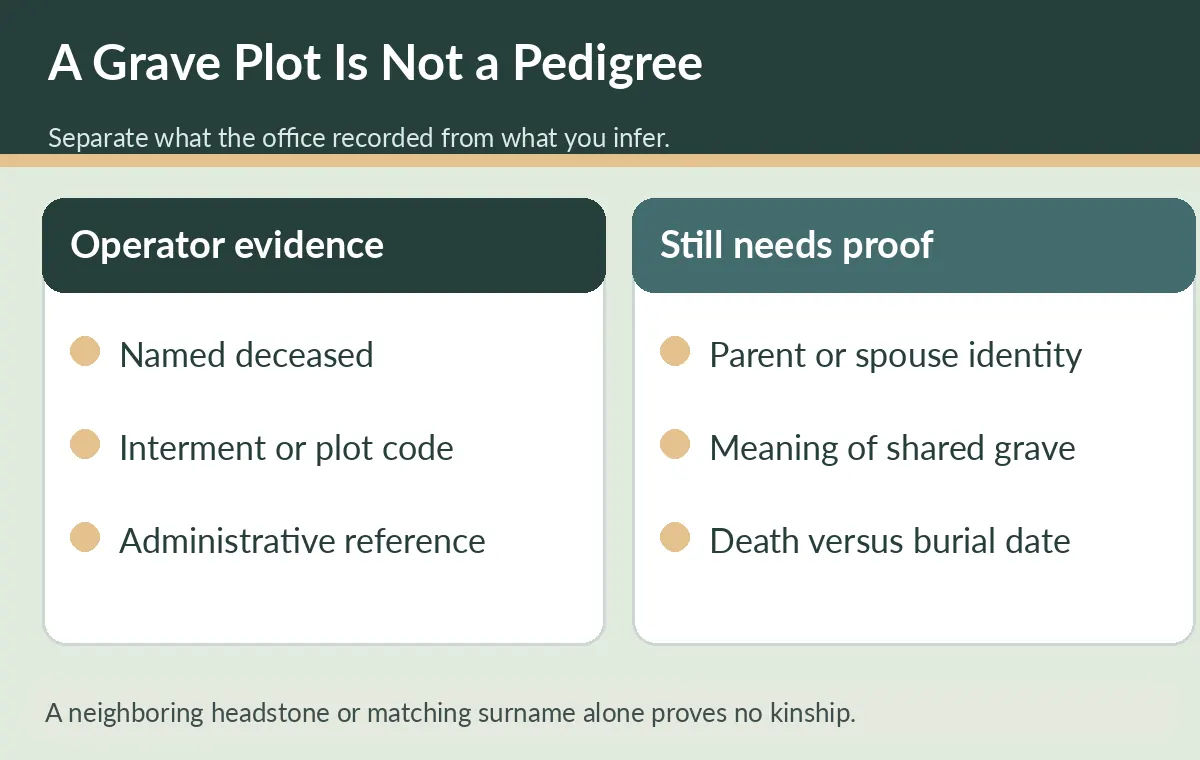
A plot record may show a location and names associated with that position. It does not automatically show every burial or explain biological relationships among occupants. A burial register entry identifies an administrative event and may be more direct evidence of interment than an inscription photographed decades later. Rights to a grave or a purchase recorded in someone else’s name are a separate legal and administrative issue. Do not write that a purchaser was a spouse, parent, or child until an independent source establishes the link.Compare a cemetery record with a dated funeral notice, civil death entry, household evidence and any accessible memorial photograph. A gravestone may name someone commemorated at the site but buried elsewhere. Likewise, a common surname and adjacent grave do not prove shared ancestry. If a plot contains multiple entries, construct a candidate matrix listing literal evidence for each name and the source you examined, not a ready-made pedigree. State clearly when burial is confirmed but the person’s identity or family relationship remains unresolved.
Correct Errors Through the Published Council Route
The council warns that data transcription errors may exist and says its quality audit is ongoing. The portal provides a ‘Suggest an Edit’ option within plot records, while the council also publishes the cemetery office email for corrections. If an entry conflicts with a certificate or an original inscription, first transcribe both exactly. Submit the relevant record reference and evidence without disclosing unnecessary details about living people. Do not quietly rewrite the public index in your private tree as though the operator had already accepted the correction.
If the online item is incomplete, ask what kind of underlying register or office system was consulted and whether the relevant name, interment date, or grave reference can be confirmed. Avoid assuming staff hold a particular original volume or public plot plan until the operator confirms it. An answer from the cemetery office should be cited with date, respondent or department and the specific claim supported. Note any access or privacy restrictions conveyed by the custodian rather than seeking ways around them.
Document Your Search and Explain the Evidence Limit
Finish with a search ledger identifying each ground checked, spelling used, date filters, result and follow-up action. Keep a section for conflicting candidates with similar names. For a site visit, use the location and cemetery administration rules supplied by the council, photograph memorial inscriptions respectfully and avoid disturbing any burial area. A mapped plot might not have a marker; a photographed stone cannot substitute for a documented burial entry. Treat the council’s information as a source that can be corrected when original evidence disagrees.
The diagrams in this guide are explanatory layouts rather than reproductions of cemetery maps or real family plots. A defensible final statement says which record shows an interment, which evidence places it in a particular plot, and what is still unknown about family relationships. Useful record-access policies should be verified directly before a visit. GenHis explains any commercial relationships in its affiliate disclosure; this is independent source-based guidance.
More Records and Archives Guides
How We Research Antrim Cemetery Sources
We read the council’s current cemetery inventory and portal warning, separated the named Antrim site from other district grounds, and checked the explicitly excluded cemetery list before designing a negative-result route. We do not assume that a portal option guarantees coverage or that a plot entry proves kinship. Example plots in the diagrams are conceptual, not real graves.
The council lists it on Moylena Road in Antrim, Northern Ireland.
No. The council identifies several grounds whose limited historic information requires a direct office inquiry.
One may be a date of death while the other is a burial or later memorial date.
Use Suggest an Edit in the plot result or contact the council cemetery office with documented evidence.
No. Confirm any relationship with independent family or civil records.