
For a historical burial at New Monkland Cemetery near Airdrie, first locate the official cemetery and distinguish its named areas. North Lanarkshire Council describes the Joint area as used for interments from about 1842, the Rydenmains area from 1935, and the Landward area from 1938. North Lanarkshire Archives identifies surviving cemetery registers among its family-history resources. Request the documented interment and lair reference before using a map or memorial as evidence; a lair right is not freehold land ownership or proof of kinship.
Identify New Monkland and Its Three Areas
The council places New Monkland Cemetery on Condorrat Road, Airdrie, ML6 0NS. Its page describes a Joint area dating from about 1842, Rydenmains opening in 1935, and Landward opening in 1938. These are dated subareas within a cemetery, not three automatically separate people-search databases. They are helpful clues for interpreting a grave locator after an interment is confirmed, but the year on a death notice alone cannot identify a lair. An older family plot might receive a later burial, so a 1950 death should not be assigned to Rydenmains without a recorded location.
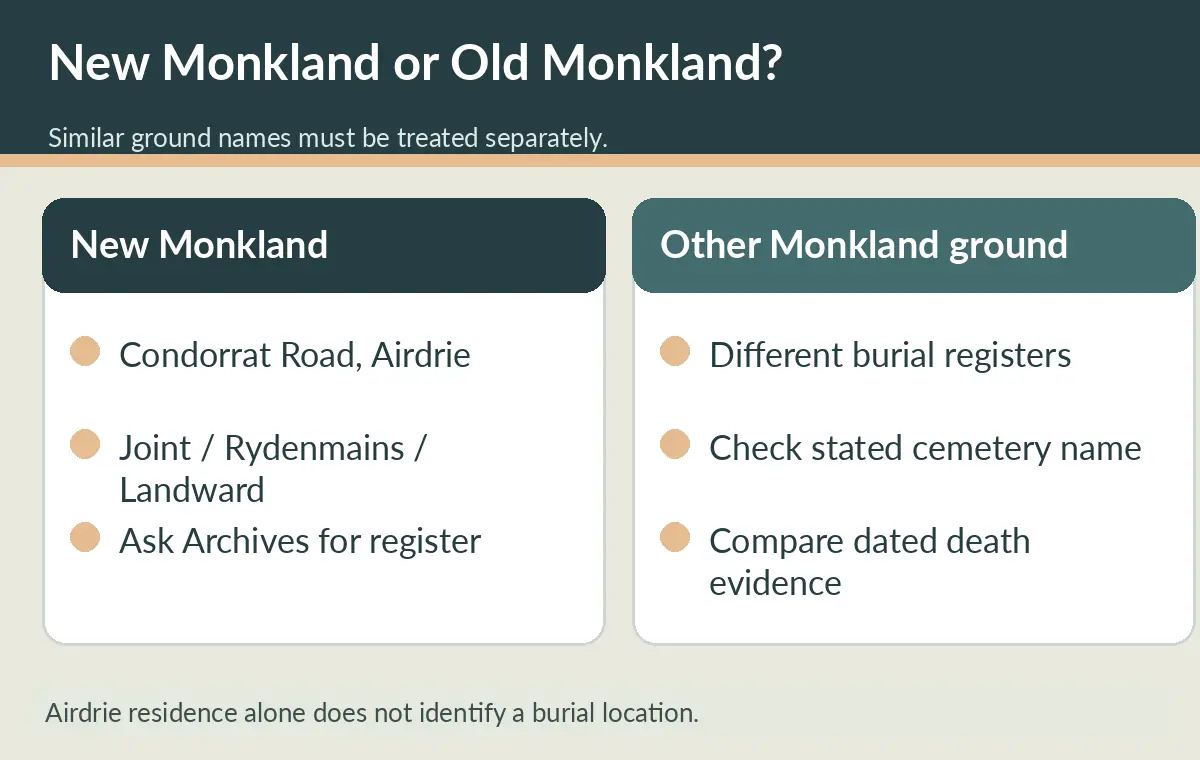
The county has other grounds with similar names: Old Monkland, Clarkston and St Joseph’s, for example, appear alongside New Monkland in North Lanarkshire’s archives list. A residence labeled Monkland or Airdrie may not specify which cemetery contains a burial. Transcribe the exact ground named in the source, confirm the authority and postal location, and compare cemetery identity with a dated obituary or church burial record. Avoid automatically treating the name of the parish as the name of a burial ground.

Follow the Archives Register Route Before a Web Name Search
North Lanarkshire Culture explains that registers for most local cemeteries are held by North Lanarkshire Archives and may be inspected in the public search room; its list includes New Monkland (Glenmavis), Airdrie. The archive can offer research help where a visit is not possible, and fees may apply. The source describes physical and serviced archival access, not a guaranteed complete online search-by-name database. Enter your request with the person’s names and variants, approximate death or interment window, religion or residence if documented, and the exact cemetery.
Ask whether the reply comes from an interment register, a separate lair or right-of-burial record, or an index to these materials. Keep a copy of the correspondence and its coverage limitations. Some historic records may remain with a cemetery administration office rather than the archives, so the correct custodian can depend on both the source class and the date. Do not invent an original entry number merely because an online local-history site has a similar name.
Use a Lair Reference to Find a Location
If an archival response provides a section, lair number or plot designation, transcribe the exact syntax. Request guidance on the corresponding official section plan and on whether historic numbering has been revised. A lair reference describes an administrative location; a marker might have been installed years later or removed. Without an official locator, a photograph of an appealing family stone is not proof of the intended grave. Carefully distinguish Joint, Rydenmains and Landward in notes, because the first is older but not necessarily the only area with later interments.
An on-site check should document the date of your visit, visible inscriptions, condition, section and directions used. Respect site rules and never disturb a grave. A name on a memorial can commemorate someone who was buried elsewhere; a marker missing from an otherwise verified interment does not negate the register. A shared surname or an adjacent lair should initiate research into possible connections, not settle biological or legal relationships.
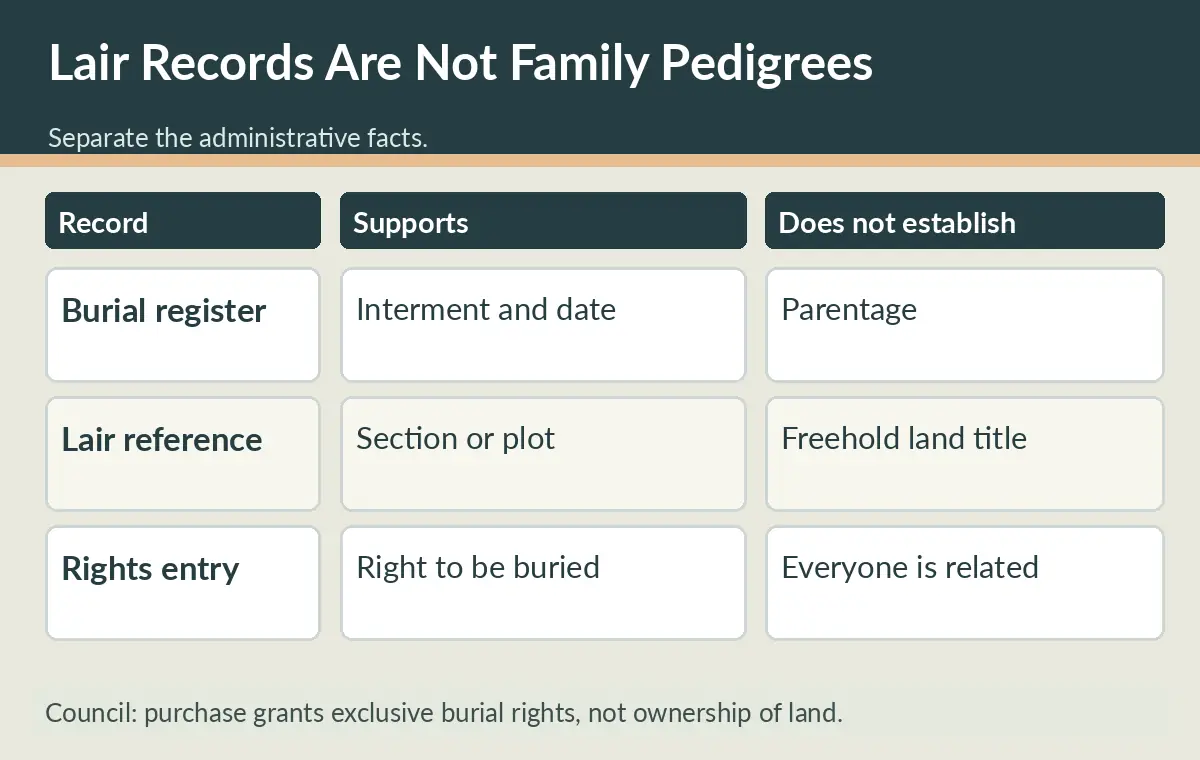
Separate the Exclusive Right to Burial From Ownership
The council’s cemetery explanation says purchasing a lair grants an exclusive right to burial, not a transfer of land ownership. This legal and practical distinction matters when reconstructing family history. An applicant or purchaser might be a spouse, child, executor, neighbor or another party; a right recorded under a particular surname does not automatically establish that every interment was in that person’s nuclear family. Do not describe a cemetery lair as a house lot or deeded freehold property.
Keep separate columns for the deceased named in the burial entry, the holder of rights where disclosed, the grave or lair locator, and any memorial inscription. These can come from different files or dates and can disagree without one being fraudulent. For an early burial, the right-holder information may not have survived or may have been transferred later. A modern rights record cannot by itself establish nineteenth-century family structure.
Check Death Dates and Historical Coverage Against Other Records
A Scottish statutory death entry from 1855 onward may support a death date and identity, while earlier church burial records and newspapers can provide alternatives. These sources answer different questions. A council burial entry records a burial; a statutory death record describes a death; a gravestone reports what someone chose to commemorate. If the two dates conflict, retain both and test whether the difference concerns event timing, transcription, or two people with the same name. Ages at death should not be mechanically converted into exact birth years.
For a hypothetical Alexander Thomson with a name match in both New Monkland and Old Monkland records, compare residence, occupational records, spouse and reported age before choosing a candidate. A late nineteenth-century person may have moved within Lanarkshire and attended a church outside the burial ground’s nearest parish. The cemetery name is not a reliable substitute for civil parish, registration district, or religious affiliation. Put each locality at the correct point on the person’s dated timeline.
Prepare a Traceable Burial Conclusion
Your research log should show the date of the request, service or archive consulted, exact cemetery, variants searched, result fields, record class and subsequent corroboration. If the register gives a burial but no recoverable lair, report ‘recorded burial established, physical plot unconfirmed.’ If a memorial is photographed but the burial register was not found, describe a memorial lead rather than a confirmed interment. An honest inconclusive result protects against accidental merging of same-name residents. Cite the actual archive response and original page or volume where available.
This article’s diagrams use interpretive layouts, not the council’s official map. They show the three named areas, what different record types establish, and a careful path from an index or archive reference to a record. No claim is made about the identities or relationships of actual living descendants. Any cost for a record search depends on the archive’s policy and should be verified with that office. The site affiliate disclosure explains the general editorial framework; this guide contains no paid cemetery arrangement.
More Records and Archives Guides
How We Research This Collection
We checked the council’s current site entry for Condorrat Road, its approximately 1842 Joint area and 1935/1938 later areas, and compared those descriptions with North Lanarkshire Culture’s archive register inventory and research service. We separately checked the council’s statement that lair purchase grants an exclusive burial right rather than ownership of the cemetery land. Sample identity cases are illustrative only.
The council says the Joint area opened for interments around 1842.
They are named cemetery areas opened in 1935 and 1938, respectively.
North Lanarkshire Archives lists New Monkland among cemetery registers available through its search room or research service.
No. The council describes an exclusive right of burial, not ownership of the ground.
No. Confirm any relationship with separate marriage, birth, or other contemporary sources.