
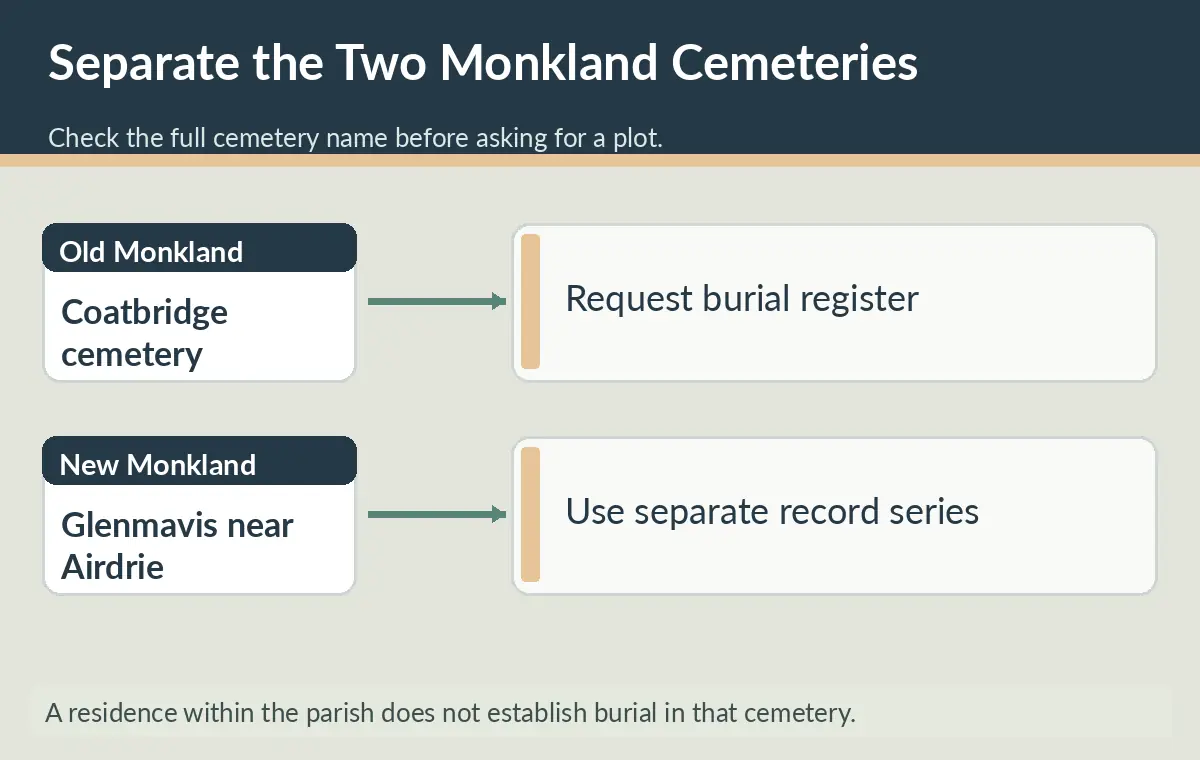
Old Monkland Cemetery in Coatbridge has its own burial-register search route; it must not be confused with New Monkland Cemetery near Airdrie. North Lanarkshire Archives lists Old Monkland among cemeteries whose registers are available for public search-room inspection. If your relative lived in the Old Monkland parish, the parish microfilm and kirk-session sources provide a separate line of inquiry, not substitutes for proof of burial in a particular grave. The North Lanarkshire family-history inventory is the starting point for identifying the correct record class, custodian and access route.
Identify Old Monkland, Not New Monkland, on the Record
Two neighboring names are the principal hazard in this search. North Lanarkshire lists ‘Old Monkland, Coatbridge’ and ‘New Monkland (Glenmavis), Airdrie’ separately in its burial holdings. A person living in Coatbridge may have been buried in a different cemetery, and a death location does not establish where a burial took place. Before filing an archive request, copy the cemetery name from a funeral notice, inscription, certificate or family document and check whether it specifically says Old Monkland. If it only says ‘Monkland’, maintain both locations as candidates until clarified.
Do not merge a church parish name with a cemetery property name. An Old Monkland Church of Scotland baptism identifies a sacramental record under a historical congregation; it is not a reservation or interment record for the cemetery. Parish boundaries, civic districts and burial grounds can differ over time. The Canmore site entry identifies a historical Coatbridge church and churchyard association, helping locate the place while offering no automatic proof about a named ancestor’s interment. Keep the date, local place and precise record wording.

Locate the Council Burial Register at the Archive
North Lanarkshire Culture reports that registers for most local cemeteries, explicitly including Old Monkland, are held at North Lanarkshire Archives and may be inspected in the public search room. A research service may be available when a personal visit is impractical, with possible charges; check current access rules rather than assuming the entire register is publicly searchable online. Provide the deceased’s name variants, a plausible death or funeral interval, the cemetery’s full name and any section or lair reference. A narrowly framed request is more practical than asking staff to prove a whole family history.
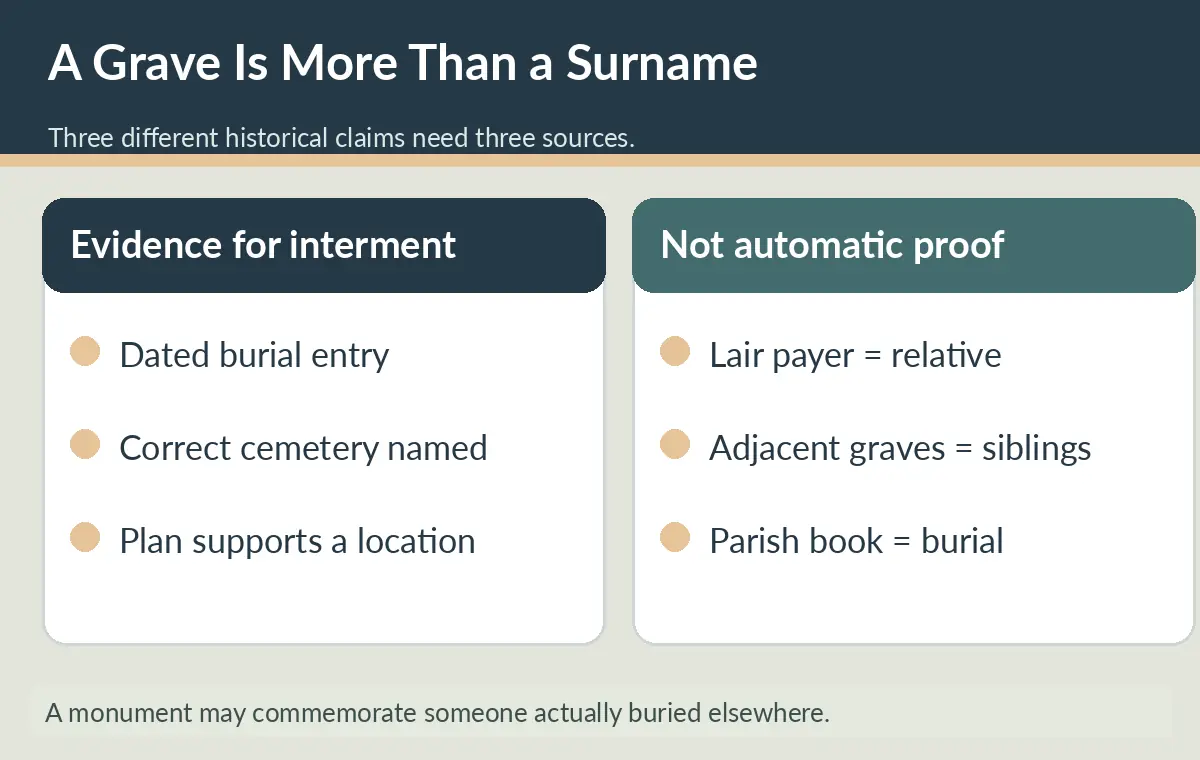
When a register entry is obtained, record the exact description of interment, date, grave or lair reference if present, and the archival identifier. Do not infer kinship from neighboring entries or a shared surname. A plot owner, person arranging a funeral and deceased may be three different individuals. A single register may not explain legal rights to the lair. If a full plot plan or grant document exists, ask the custodian separately and cite it independently. Physical grave markers can be absent, moved, illegible or commemorative rather than proof of interment.
Separate Parish Register Dates From Cemetery Dates
North Lanarkshire’s local studies listings include Old Monkland parish registers on microfilm beginning in 1695 and continuing through 1854, as well as older census microfilms for the district. Those church books are useful for baptisms, marriage proclamations and occasionally death or burial references. Their span does not mean a comprehensive cemetery register exists for all those years or that a baptized person was later buried locally. In Scotland statutory registration began in 1855, so post-1854 civil death records provide a different potential source of death date, parents and informant reports.
The Airdrie Local Studies guide describes local copies of Old Monkland parish registers and census returns. A family documented in an Old Monkland 1841 household might have relocated or switched burial ground by death decades later. Use the birth and household records to build a person profile, then ask independently where the actual funeral or interment occurred. Record the source title and whether the item was a contemporary entry or a later transcript. Do not let a chronological resemblance become unsupported proof of identity.
Use Kirk-Session Records for Context, Not a Grave Locator
Scotland’s People lists Old Monkland Church of Scotland kirk-session minutes, accounts, communion rolls, heritors’ material and other series. These can illuminate parish administration, assistance, discipline or funeral-related costs when the specific volume supports it. They are not a complete register of every death in the parish, and names can appear for reasons unrelated to burial. Choose a series by its title and date coverage; transcribe the exact context in which a person was mentioned. A record of a payment is not necessarily evidence of a grave location.
Kirk sessions are distinct from municipal cemetery records. A fictional reference to an A. Campbell in an 1830 account cannot be treated as the burial of an Alexander Campbell who died in 1868 without separate corroboration. Historic spellings and parish descriptions can be similar across generations. Test ages, occupation, addresses, spouse or children and independent documentary continuity. If a family tradition uses ‘Old Monkland’, identify whether it means parish, church, village or cemetery before attaching a particular record to the claim.
Check Section, Lair, Memorial and Rights Separately
A register may include a burial entry or lair number, while a cemetery plan locates a physical site and a rights document records an authority to bury. These are different claims. Where a later map has been renumbered or a memorial moved, record both identifiers and the date of each source. A modern management rule about a lair cannot be projected backwards without checking the original grant terms. Likewise, several people sharing one lair do not establish their biological relationship. Funeral applications or death registrations are stronger sources for immediate identity details than plot adjacency alone.
Photograph a stone respectfully when access and cemetery rules permit; preserve the inscription exactly and mark illegible characters as uncertain. Do not clean or disturb historic stone to force a reading. If a marker names someone buried elsewhere, its commemoration is an independent historical fact but not a confirmed interment. Cross-check a burial-register date against an official death registration or contemporaneous notice. Where sources disagree, preserve both and ask which informant had direct knowledge. Record any relocation or reinterment rather than collapsing all events into one grave date.
Prepare a Custodian-Specific Request and Honest Citation
An effective question for North Lanarkshire Archives states the full cemetery name, the name exactly as known, alternate spellings and the death or funeral window, followed by one requested item: the underlying burial register entry or a map reference. Ask staff about access, costs and whether the series is available as a scan before assuming a web search exists. If your hypothesis involves pre-1855 Old Monkland people, request parish register assistance under the separate microfilm series. If it involves poor-relief records, use the archive’s independent poor-law holdings rather than labeling those records cemetery material.
The GenHis affiliate disclosure is available; no partnership with the archive or a commercial grave website is claimed. Cite cemetery, register title, date, page or lair identifier, and holding office. A parish citation should instead include congregation, event type, microfilm and page; a civil death record has a third citation structure. Finish by saying which source proves a burial, which only names an Old Monkland resident, and which claims such as kinship or plot ownership remain open for testing.
More Records and Archives Guides
How We Research This Collection
We compared North Lanarkshire Culture’s named cemetery inventory with its Airdrie local studies coverage, Scotland’s People Old Monkland kirk-session catalog and the historic Canmore churchyard entry. This route keeps Old Monkland Cemetery in Coatbridge distinct from New Monkland (Glenmavis), parish baptismal microfilms, kirk-session accounts and statutory death registration.
No. North Lanarkshire lists Old Monkland in Coatbridge and New Monkland in Glenmavis/Airdrie as separate burial grounds.
North Lanarkshire Archives lists them among registers accessible for search-room inspection, with an enquiry service.
Local studies lists Old Monkland parish microfilm beginning in 1695, but this does not imply continuous cemetery burial coverage.
No. They provide church-administration evidence; seek a burial-register entry and map for an interment claim.
Burial rights and land title differ; inspect the specific grant and current cemetery terms instead of inferring land ownership.