
The Steve Morse One-Step ED Finder helps identify where to browse a census; it does not tell you that your ancestor lived in the resulting household. It combines geographic tools for U.S. censuses from 1870 through 1950. A name search that fails while a contemporary address is known can be rerouted through state, county, city and, for supported urban locations, street or cross-street data. The Unified Census ED Finder reports candidate enumeration districts. Those geographic candidates must be checked against official ED descriptions, maps and the original household pages.
Decide Whether You Know an Address or Only a Community
First establish the person’s location at approximately the date of the census you want, citing a directory, draft registration, letter or other document with its own date. A 1948 address is a useful candidate for 1950, but an intervening move remains possible. Enter the census year first, then state, county and city or town in One-Step. For many supported large cities you can enter street names or intersections. A small community may require using a town or rural ED description rather than a precise numbered street. These starting points are different searches, not a single guaranteed lookup.
The ED is a geographic enumeration area, not a stable family identifier. Boundaries and numbering changed from census to census. Never paste an ED number from 1930 into a 1950 citation as though the same code followed the family. One-Step includes cross-decade conversion aids, but a translated candidate must be verified for the desired census year. Record the address source, the year to which it applies, and the exact ED options returned, including geographic boundaries that were used to include or exclude them.

Use Historical Street Names and Cross Streets
For a large city, enter the address and boundary streets as the tool allows. If the street name has changed or the house number was renumbered, an apparently missing address may still fall within a tract described under its former name. Use a period city directory, Sanborn map or locally held street-renaming list to establish the historical label. A modern map can help identify a physical intersection, but it should not be treated as a faithful 1920 or 1950 street map. Note every modern-to-historical equivalence as a sourced inference.
The One-Step FAQ cautions that street descriptions were transcribed from National Archives microfilm and may have typographical or source errors. Some areas use rivers, wards or other boundaries instead of all internal streets. When more than one ED survives the street filters, examine the official descriptions and map rather than choosing the lowest numbered district. Cross streets can narrow a candidate but do not establish the listed house was present or occupied at census time.
Check the Original ED Description and Map
NARA’s 1950 census finding-aids guide points to One-Step and to official descriptions and maps. Open the relevant map in the National Archives Catalog or the corresponding original description image when available. For 1940 and 1950, the One-Step team worked with microfilm descriptions, including T1224, as explained in its documentation. Take care with the geographic prefix of a district identifier; large-city map labels may show only the local portion while the full census designation has an additional component.
Write a map citation independently from the census-page citation. The map can show that an address would fall within a particular district as understood at the time; it does not list occupants by name. Some original descriptions are damaged or use alternative street names, and transcription projects can include additional annotations beyond the photograph. Treat the original film as a check on the transcription, not the other way around. If a boundary follows a canal or an old ward line, a historical map may be needed to resolve which side included your target.
Browse Candidate Census Pages and Identify the Household
After identifying a plausible district, open the original census schedules for that year and browse households in a logical sequence. Locate the street heading or house number if recorded on those pages. Some enumerators wrote changing street names at the edge; others may include gaps or abbreviations. A household matching only the street number is not necessarily your ancestor’s household. Compare first names, ages, occupation, birthplace and nearby associates with independent records. In an institutional or large-building ED, several entries may share one physical address without being a single family.
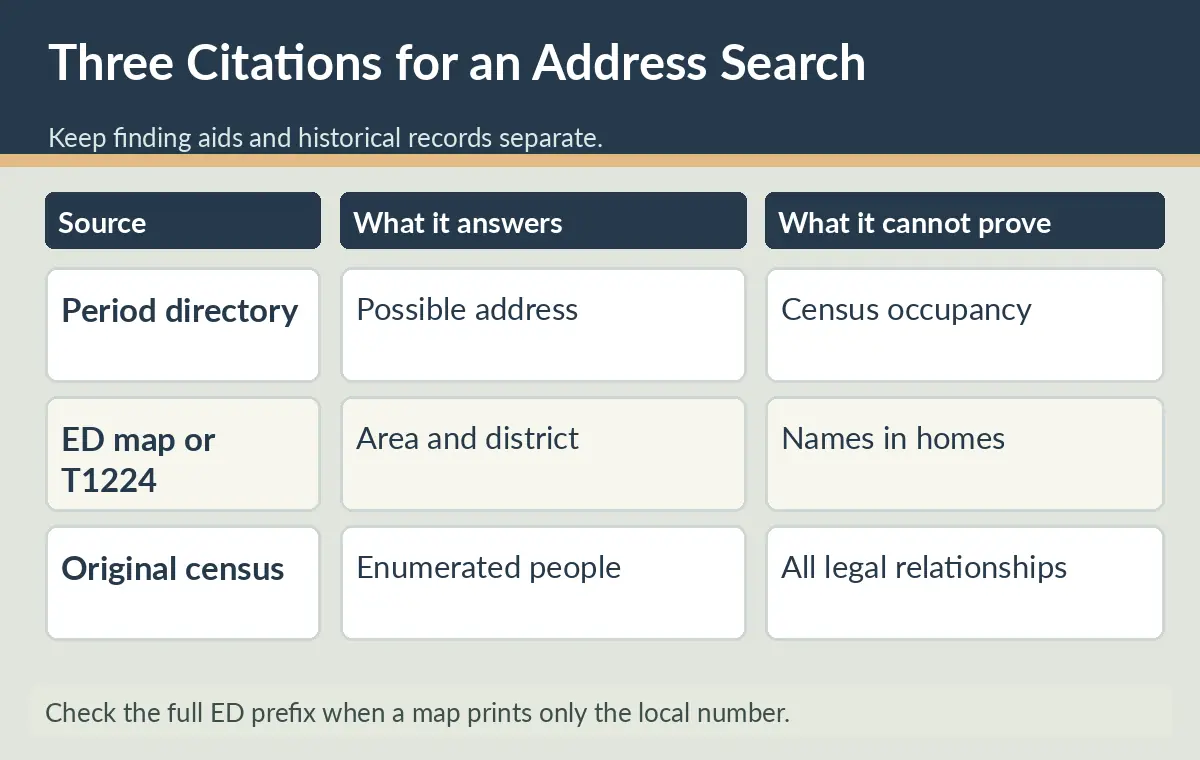
The census itself is the evidence of what an enumerator recorded. The One-Step result is a geographic finding aid, and a commercial name index is another finding aid. Keep all three citations separate. A fictional family named Garcia at 218 Pine Street should not be joined to a candidate census family merely because the ED finder points to the same neighborhood. Check the numbered dwelling, all household members, dates and competing addresses before identifying the person. If the census household is absent, preserve the negative browse scope and test an alternative ED.
Resolve Rural Communities and Changing ED Prefixes
For smaller communities, select the relevant state and county and use the locality description functions where street-by-street searching is not offered. The Unified tool allows a city or town to be typed in an ‘Other’ field in appropriate workflows. Rural enumeration often depended on township, precinct or landscape rather than named streets. Confirm that the historical county and township match the person’s contemporary record; present-day municipal limits may be different. A locality name can recur within a state, so read the complete ED text before interpreting it.
A district code is meaningful only together with its census year, state and local context. When a map legend provides a prefix, copy it rather than truncating the code printed within the mapped district. The One-Step historical tool combines several conversion and browsing utilities; it may direct you to scans, text descriptions or external census providers. Access to a tool does not prove the underlying census frame was checked. If a resource is unavailable, document the blockage and seek official NARA copies or a library provider instead of inventing a household match.

Cite the Address Source, ED Evidence and Census Return
Build a three-line citation set: the document providing the historic address; the ED map or description establishing the candidate district; and the census sheet showing the enumerated household. Save complete geographic identifiers and page/image references. This evidence chain makes it possible for another researcher to distinguish a valid geographic search from an accidental namesake. If the census disagrees with the directory, preserve both dated observations and investigate a move or error rather than silently discarding one.
The GenHis affiliate disclosure is available; no affiliate relationship with the One-Step site or a census provider is asserted. One-Step is useful precisely because it turns a vague unsuccessful name search into an address-led route. Its result remains a hypothesis about an enumeration district until verified against official geographical descriptions and actual schedules. Note the tool used and its retrieval date, then write one next action such as browsing the adjacent district after checking the ward boundary.
More Records and Archives Guides
How We Research This Collection
We read the Unified ED Finder interface, its 1950 FAQ and the National Archives census finding-aid guide. We treat the One-Step site as a finding aid rather than an archive of people, separate historic from modern streets, and require original ED evidence plus census pages before establishing a household identity. The Garcia example is illustrative, not a historical search result.
No. It provides geographic lookup tools that point to EDs and related images; the household must be checked separately.
The named Unified tool describes location-based ED finding for 1870 through 1950, with different functions by year.
You can start with it, but historic renaming, renumbering and boundary changes must be checked.
Inspect each original ED description and relevant map, then browse the underlying census pages.
No. Cite the historical address, original ED evidence and the population schedule separately.