
A Victorian trade-directory hit is a clue about a business or reported address, not proof of legal ownership or family relationship. The University of Leicester’s Historical Directories collection contains 689 digitized trade and local directories from the 1760s to the 1910s. It includes publications by Kelly’s, Pigot’s and regional firms, with name, place and occupation searching as well as county browsing. The best practice is to identify a particular edition first and then inspect the actual page and its section heading, because the same volume may classify tradespeople, residents and advertisements quite differently.
Find the Relevant County, Publisher and Edition
Start with a documented town and the decade when the ancestor supposedly worked there. In Leicester’s Special Collections Online, browse the appropriate county as well as querying surname or trade. County coverage is not uniform by year or town: a digitized collection of 689 books is not an annual census. Save a volume’s exact title, publisher, stated edition year, region and identifier before searching inside it. For a market-town baker, a county directory may be more useful than a city-only title whose boundaries excluded the village in question.
Different publishers used different headings and selection rules. Kelly’s, Pigot’s and Post Office directories need not include identical residents or list them in the same order. When a person fails to appear, try the occupation, an employer or a village spelling on other pages. OCR may overlook worn or ornate type, so page browsing is a necessary fallback. A search hit that gives an abbreviated first name is a candidate until tied to an independently documented spouse, address or business. Never silently expand initials into a preferred ancestor.

Distinguish Trade, Street, Private Resident and Advertisement Lists
A trade classification such as ‘blacksmiths’ may gather businesses across a district, while an alphabetical section may identify private residents and a street section arrange reported addresses. An advertisement is a purchased message and does not independently verify every claim it makes. Transcribe the exact heading above the entry. A name appearing under ‘Grocers’ describes a commercial association in that edition; it does not automatically establish the person lived at the shop, owned the premises, or was employed there all year. Compare occupational terms only within their printed context.
For a fictional Elizabeth Morris in a bootmaking list, capture the spelling, trade heading, town, street and page. A second Elizabeth Morris in the residential pages need not be the same woman. The National Archives business and trades guide emphasizes that local archives hold most surviving business records. Use those sources to test whether a directory label represents owner, manager, firm, partnership or a family member whose surname was used by the business.
Interpret Publication Dates and Missing Names Cautiously
An edition printed in 1895 is a snapshot prepared for a commercial purpose; the date of canvassing may precede publication. It is not a government enumeration taken on a uniform census night. A shop may change hands between editorial collection and distribution. Avoid converting one listing into a precise migration date: if an ancestor appears in 1892 and disappears in 1896, the evidence supports two observations, not a certified departure year. Compare adjacent editions and report the interval honestly. An address renumbering can also create a false move.
Directory compilers did not aim to include everyone. The State Library of South Australia’s guide notes that many women and girls, servants and boarders were absent. Women do appear in some trade listings, so do not assume an omission proves unemployment. An unsuccessful full-text search may reflect OCR failure, different trade terminology, edition gaps or a name printed as a partnership. Record exactly which pages or searches you checked; a negative web query is weaker than a documented browse of the relevant section.

Use a Street Address to Resolve Two Same-Name Traders
Suppose two fictional men called Thomas Allen are listed in a city’s 1901 trade volume, one a tailor and the other a warehouse merchant. A family-tree claim that one is your ancestor needs more than a surname, city and approximate age. Compare the street in census returns, business advertisements, trade partnerships and civil records. If a 1901 census lists the ancestor as a railway porter, treat that conflict seriously instead of presuming a secret tailoring business. The publisher’s date and the census reference date can explain some differences but do not remove the need for evidence.
A reproducible candidate matrix has a line per entry with source edition, page, exact printed occupation, address, independent evidence and remaining contradictions. Street-level context can be especially useful when a renamed street or civic renumbering makes later addresses hard to align. Historic maps may show the shop footprint, but a building on a map is not proof of tenancy. Deeds may show the freehold owner, who could be entirely different from the person who operated a business on the property.
Cite the Scanned Page and Verify the Source Type
Include publisher, volume title, edition year, town or county, section heading, page and Leicester image or collection URL. A searchable text snippet is not a substitute for the scanned page, especially where punctuation, initials and street numbers matter. For an advertisement, identify it specifically as an advertisement. For a trade listing, preserve the printed category and do not change it to a modern occupation without marking the interpretation. Where online scanning cuts off a column, try a neighboring image or another holding institution before creating a corrected transcription.
The Leicester collection is a digitized body of historical books, not a live registry of present-day tradespeople. Cite the repository as the image provider, distinguish the original publisher as creator, and preserve any later correction notices. Compare a second directory or a census only after identifying its own exact edition and geographic coverage. If a surname is rare, it is still possible that two people in the same town share it; confidence requires corroborating fields. No directory entry proves a parent-child relationship by itself.
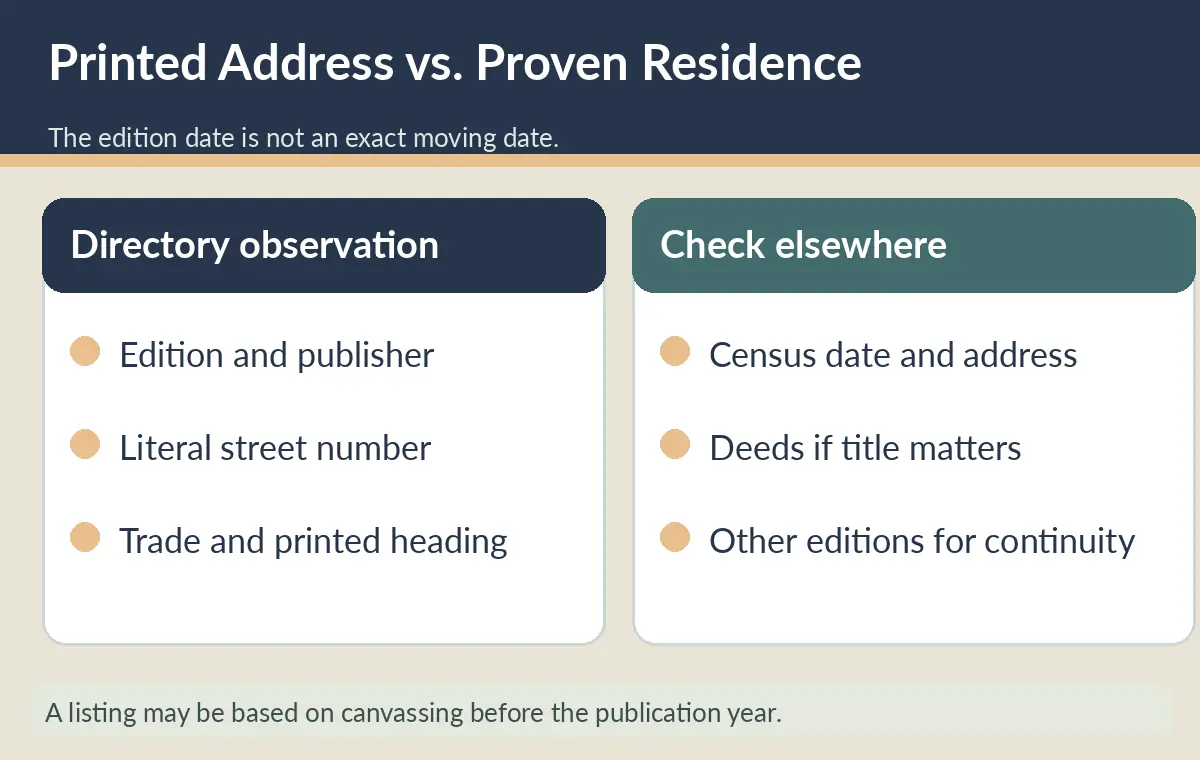
Turn a Directory Search Into a Specific Local Archive Request
The next archive search might seek rate books, licensing records, leases, company or partnership files, newspaper advertising or a dated photograph of a named shop. Ask a local record office for the town and trade, the exact edition year and address, and the claim you want to test. A local shopkeeper’s lease might establish occupancy rights without establishing freehold. A surviving wage ledger might record an employee not named in the trade directory. Treat each new source according to its creation, informant and time.
The GenHis affiliate disclosure explains general site relationships; this article assumes no commercial partner or required subscription. The free University of Leicester collection is the starting point, while library-held subscription databases are optional supplementary access routes. End with a focused question—such as whether the tailor on page 214 is the person on a nearby census schedule—plus a list of documents able to answer it. That is more useful than exporting every OCR hit with no identity test.
More Records and Archives Guides
How We Research This Collection
We checked the University of Leicester collection inventory and search options against guidance from The National Archives and the State Library of South Australia. The analysis separates a trade listing, a resident list and an advertisement, and prevents publication dates from becoming exact occupancy dates. All named comparison cases are explicitly fictional.
The University of Leicester describes 689 trade and local directories covering England and Wales from the 1760s to the 1910s.
No. Coverage favors businesses, selected residents and institutions; servants, boarders and many women were often omitted.
No. A directory is not a deed, lease or title register.
Browse by county, edition and section; try trade terms and variant spellings because OCR and coverage are imperfect.
Include publisher, volume and edition, county, section, printed page, and the digital image locator.