
Start With the Mark, Number and Product Class
The National Archives holds original visual representations of trade marks registered with the Patent Office from 1876 to 1938. Most are in BT 82, while a separate Manchester record series, BT 244, concerns cotton marks. These are records of symbols and registrations, not inventories of every product a firm manufactured. A design resembling a family coat of arms is not genealogical evidence without a real connection between the mark’s proprietor and a documented family.
The National Archives trade marks guide explains that each representation was assigned a registration number and one of fifty goods classes. The mark could be a logo, distinctive lettering, a common word in a commercial context or another graphic. Document the visual form, exact number, class and date before trying to connect the trade mark to a modern business with a similar name.
An early registration number is a useful locator, not proof of a firm’s duration. The same printed brand could be reused, assigned or altered, while a business might operate for years without a surviving owner register at The National Archives. Create three separate claims: what the representation shows, who was recorded as the proprietor, and what contemporary commercial documents demonstrate about the business.
Choose BT 82 or the Manchester Cotton Route
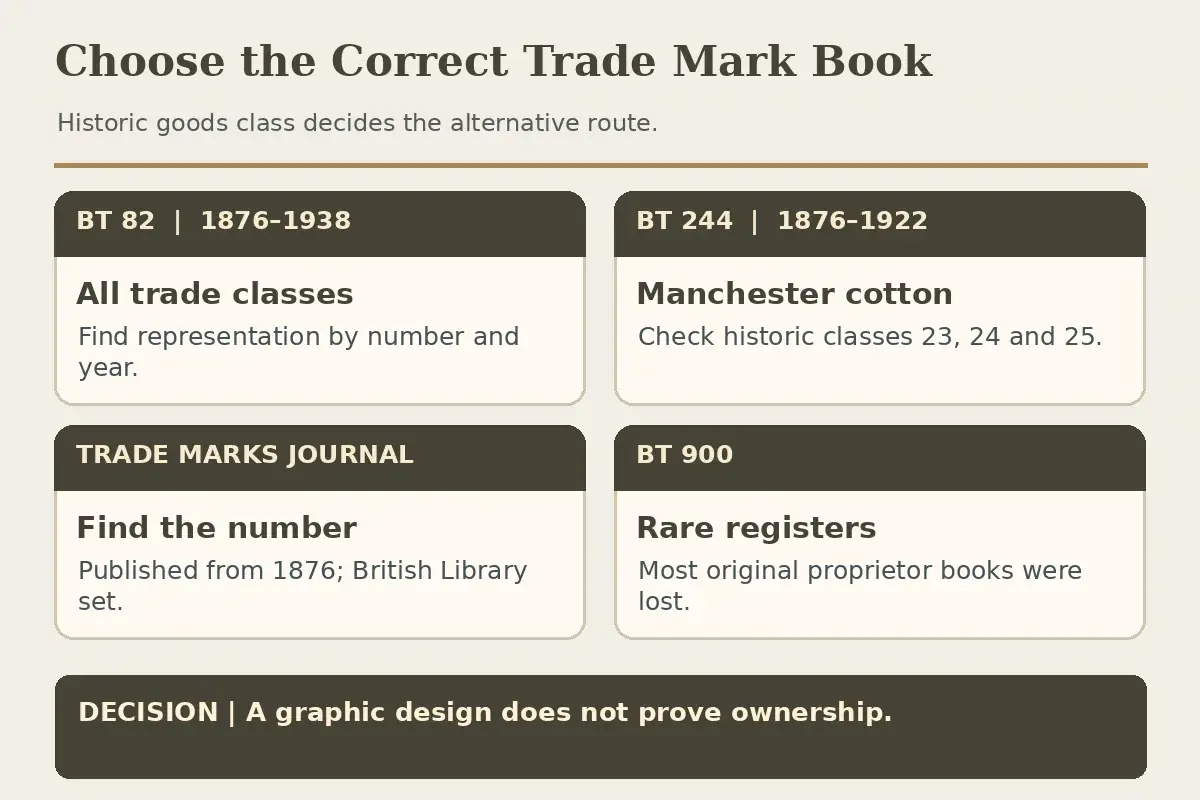
Most records from this Patent Office period can be located by searching BT 82 using a date range and registration number. When the subject is cotton yarn, cotton piece goods or related cotton goods, check the historic material classes 23, 24 and 25 and consider BT 244 as well. The Manchester office was established in October 1876 for cotton marks. BT 82 still includes some cotton marks, so the two series are potential alternatives rather than a mandatory chronological sequence.
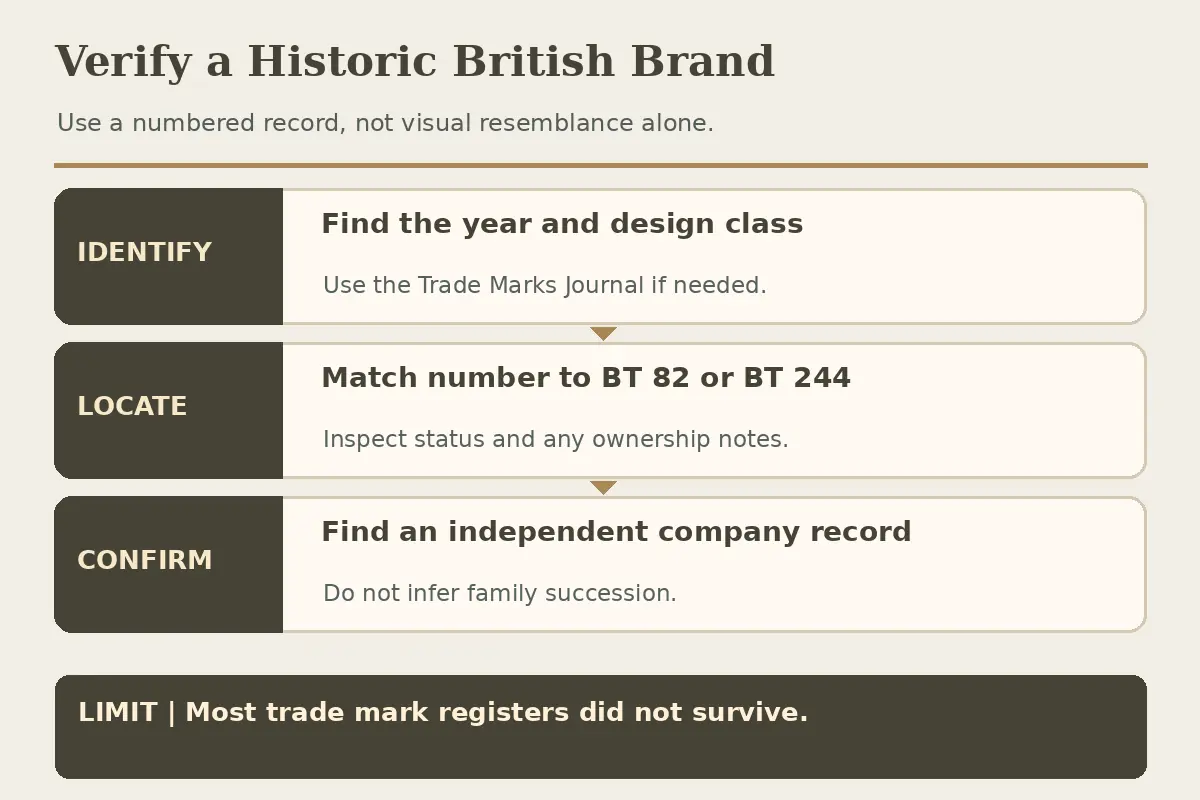
A name alone is often insufficient because the catalogue commonly describes books by number range, not by every proprietor. The Trade Marks Journal, first issued in 1876, is a route to an applicant name, number, product class and published representation. The National Archives guide says the British Library holds a complete microfilm set. Once a number is identified, find the right BT 82 book by number range and year, or the BT 244 category where appropriate.
A special caution applies to Manchester registrations: an M number was used internally for applications, while official numbers and classes may appear in the published record. Do not treat a number stamped on a design as a personal registration, tax identifier or evidence that the named agent founded the company. Compare the design and the class as well as the number. Where the catalogue gives only a book description, arrange to inspect the entry itself.
Know Why Ownership Evidence Is Missing
Design representations sometimes contain an owner, manufacturer or agent’s name and address; others contain no such detail. They may also show later amendments or that a request was accepted or refused. The meaning of each notation depends on its date and wording. In particular, a printed representation does not by itself prove a mark was accepted; some proposed marks were refused and their images have survived.
Most registration books from 1876–1938 were destroyed under the Public Records Act 1958. Only four specimen registers and two associated indexes survive in BT 900, as the official guide states. This is a central proof limit: absence from those surviving specimens does not show that a company never registered its mark. A clear name and address found on the representation may be valuable, but verify which role the name actually describes.
Our evidence matrix separates a BT 82 or BT 244 representation, a surviving BT 900 register and an independent trade directory or company file. A representation can support the mark’s visual design and assigned number; a register may give the proprietor or a later renewal; a company file can establish a separate business event. A proprietor’s commercial address need not be a private home, and a mark’s appearance cannot establish someone’s parentage.

Test a Brand Story With Independent Records
Suppose a ceramic jar carries a familiar logo and a seller attributes it to an ancestor’s business. First determine whether the mark is actually a trade mark rather than an ornamental registered design, maker’s mark or later reproduction. Then retrieve its registration number and product class. If a design registration diamond appears instead, the distinct BT 43 and BT 44 process may be relevant; using the trade mark series would be the wrong route.
Next compare the exact registration to the brand name and applicant reported in a contemporary Trade Marks Journal. Inspect the representation’s own annotations. If a name appears, distinguish the manufacturer, agent and recorded owner and record any assignment or renewal date. An address can establish an official correspondence point at one moment, not the physical site of a factory or household. Historical maps and directories may test whether a business occupied the site.
Finally build a small chronology: mark application, accepted registration if shown, later transfer if found, and dated independent evidence of trade. A mark reproduced in a much later advertisement may reflect continuity of branding rather than continuity of family ownership. Do not invent a seamless succession of proprietors to bridge gaps left by the lost registration volumes. The unresolved interval is itself a meaningful conclusion.
More Records and Archives Guides
How We Research Historical British Trade Marks
We begin with the object or published brand and distinguish trade marks from registered ornamental designs. We then use the National Archives material-class classification and the Trade Marks Journal to reach BT 82 or BT 244. Diagram arrows describe conditional searches, not assumed transfers of ownership. The historic motifs on our cover are newly drawn illustrations and must not be mistaken for genuine registered company marks.
The National Archives guide documents both record availability and substantial destruction of original register volumes. Every article claim is therefore matched to the surviving level of evidence: a representation, a manuscript annotation, a rare register or an independent business record. For a company or family assertion, we require a named and dated link, not visual similarity, a shared surname or an unverified modern website.
Our affiliate disclosure covers commercial transparency; a product purchase or paid database is unnecessary to understand the archival method. Save the entire BT reference, design number, class, page and date, and describe exactly what you viewed. The useful result is a carefully attributed mark and a transparent list of ownership questions still needing evidence.
Representations of British registered trade marks, 1876–1938, arranged mainly by registration number, date and goods class.
For historical Manchester cotton trade marks, especially classes 23, 24 and 25, alongside a search of BT 82.
No. Only four specimen registers and two indexes survive; most historic registers were destroyed.
Not always. Some refused applications survive; check status and any dated annotations.
No. Commercial and personal addresses must be established separately.