
BT 19 is a Board of Trade index-to-papers route that may point researchers toward apprenticeship-related correspondence from 1846–1895. It is not interchangeable with a named apprenticeship indenture; first locate the indexed paper and determine exactly what kind of administrative transaction it describes.
If you are looking for a specific Merchant Navy apprentice, BT 150 indexes and sampled BT 151–152 indentures may be the right route. Use BT 19 when the evidence points to a Board of Trade paper, dispute, administrative policy or related correspondence. The National Archives identifies Board of Trade paper indexes from 1846 to 1895 as a place to look for apprenticeship references in BT 19; this does not mean that every indenture or complaint for those years survives.
Define the apprenticeship question before searching
An apprenticeship research problem might concern a person signing an indenture, a dispute before a government department, a port authority question or changes to administrative policy. The National Archives directs readers to BT 19 for references to Board of Trade papers dealing with apprenticeship matters during 1846–1895. That is a different kind of evidence from the original agreement signed by apprentice and master.
Write a one-line question identifying which kind of answer you need. If it asks whether an apprentice entered into a specific contract, begin with an indenture index. If it asks how the Board of Trade handled a dispute or regulated an aspect of apprenticeship, a paper index may be more productive.

Use the correct index for the record type
The National Archives names BT 150 as the index to Merchant Navy apprentices, with selected original indentures in BT 151 and BT 152. Those collections are arranged differently from BT 19. A person who searches only one series can mistake an index gap or sample-survival rule for evidence that an apprenticeship did not occur.
For a BT 19 route, inspect the archival catalogue description and follow any paper reference to the correspondence indicated by the index. Do not guess the receiving series or invent a departmental file number from a partial reference. Preserve the exact form of the number and ask the archive how its index connects to the surviving papers.
Interpret a paper reference as a locator
An index may summarize a subject, person, vessel or complaint without telling you whether a request succeeded. Treat it as a finding aid until you read the original paper or a reliable copy. Copy the title, dates and reference alongside the reference to the index itself, so the finding can be reproduced without relying on a search snippet.
Discovery searches catalog descriptions rather than the complete text of every item. A name absent from catalogue results can appear in correspondence whose description mentions only a department or subject. Broaden the question to the relevant heading and years when a name-first strategy fails.
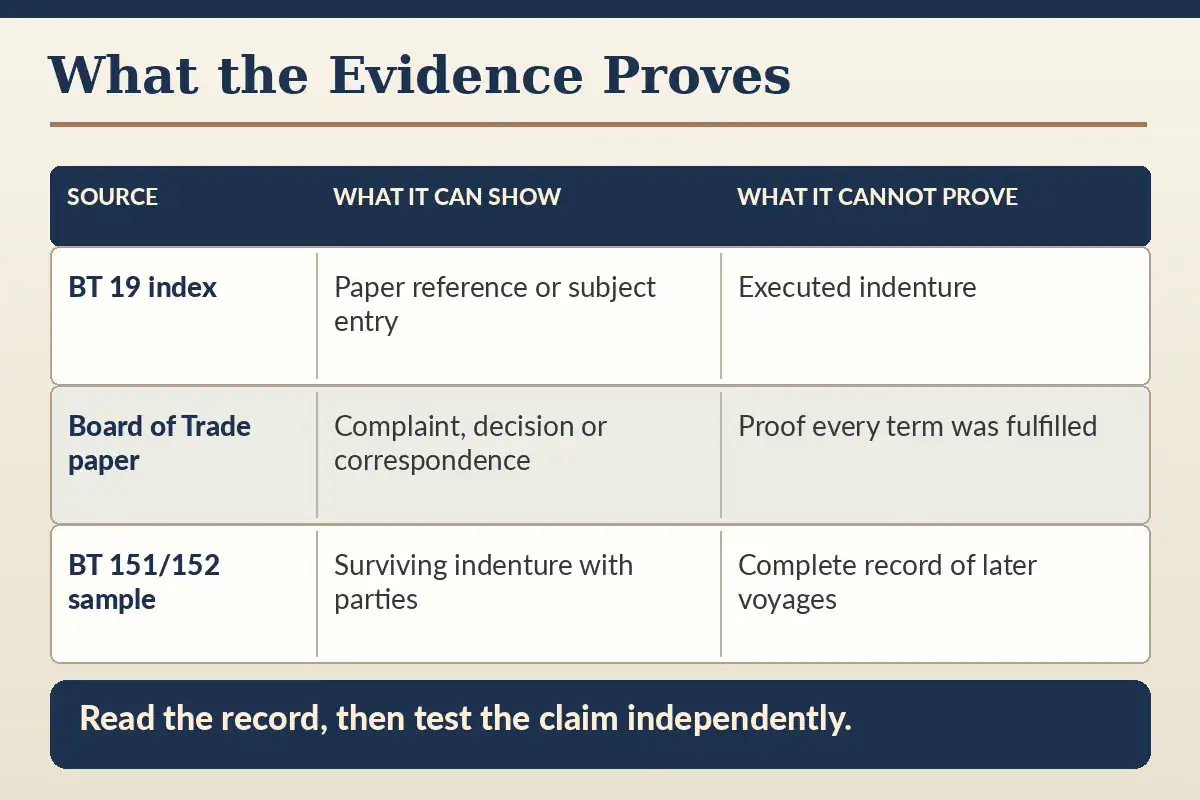
Keep a complaint separate from a final decision
A dispute about treatment, pay, assignment or the terms of an apprenticeship can pass through several administrative stages. A complaint is evidence that someone made a representation, not that it was accepted. A reply can acknowledge a claim without determining its truth, and a procedural instruction does not itself prove what happened aboard a vessel.
Use a three-column ledger for the allegation, the answer, and independent action. If a file contains only the initial correspondence, leave the outcome open. Where a named apprentice is involved, compare the person’s age, master, port and period against the indenture index before attaching the case to a family tree.
Respect the indenture sample and missing evidence
The archive explains that the Merchant Navy’s original indentures were preserved selectively, as a two-month sample every five years for much of the relevant period. A BT 150 index may therefore point to an apprenticeship even when the signed BT 151 or BT 152 document has not survived. Keep an explicit column for document survival.
When the index entry is all that survives, it may still support a claim about recorded apprenticeship registration, subject to reading the fields correctly. It cannot support a fabricated signature or complete voyage history. Look for ship agreements, later service documentation or other sources appropriate to the dates.

Document the finding so it survives review
Write the precise BT 19 entry and describe what it indexed, not what you hoped it represented. Link each archival citation to a single factual statement and label interpretation as interpretation. If the file has several people with similar names, use corroborating place, age, trade and master information to avoid conflation.
An inconclusive result is not a failure. A clear account of the index searched, series checked, surviving papers inspected and missing contracts is a reliable starting point for a later researcher who may gain access to a new item or a local archive collection.
Build an archive-ready research worksheet
Make a worksheet with columns for the research question, record creator, date covered, original reference, verbatim role or transaction, date of the alleged event, and independent confirmation. Begin with this subject-specific gate: Named merchant apprentice and indenture: BT 150–152; apprenticeship correspondence or Board of Trade paper reference: BT 19 and its catalogued related papers. In the first positive entry, record what the document actually establishes. Do not replace uncertainty with a stronger event or identity claim just because the finding aid has an attractive title.
Put BT 19 paper index and BT 150 name index to merchant apprentices on separate lines when comparing sources. The first may show subject or case reference to correspondence, but it does not itself establish a signed indenture by itself. If the research requires a firm conclusion, seek original indenture in bt 151/152 if preserved or independent service evidence. Log negative searches by reference, years and access method; a catalogue search is not a complete examination of undigitized records.
More Records and Archives Guides
How We Research and Verify the Evidence
We checked the official National Archives research guidance on 2026-11-03. TNA explicitly directs apprenticeship researchers to BT 19 Board of Trade paper indexes for 1846–1895 and explains sampled BT 151 and BT 152 indentures. The guidance establishes the series route; it does not independently verify an unnamed ancestor or a specific undocumented case.
We checked the official National Archives research guidance on 2026-11-03. TNA describes the BT 150 name indexes to merchant apprentices and the limits of surviving original indentures. The guidance establishes the series route; it does not independently verify an unnamed ancestor or a specific undocumented case.
The practical method in this guide distinguishes archive descriptions, original records and independent confirmation. We do not claim that online Discovery searches inspect every word of undigitized documents. For transparency, read the GenHis affiliate disclosure; our source evaluations do not imply a commercial relationship with an archive or record provider.
No. It is a Board of Trade papers index that may contain references to apprenticeship matters.
BT 150 is an index of merchant apprentices; selected original indentures survive in BT 151 or BT 152.
The National Archives guide points to Board of Trade paper indexes for 1846–1895.
No. It documents a claim or issue; a dated resolution and independent records are needed to establish the result.
The National Archives preserved only a sample of many merchant apprenticeship indentures, so absence of the contract is not proof of no apprenticeship.