
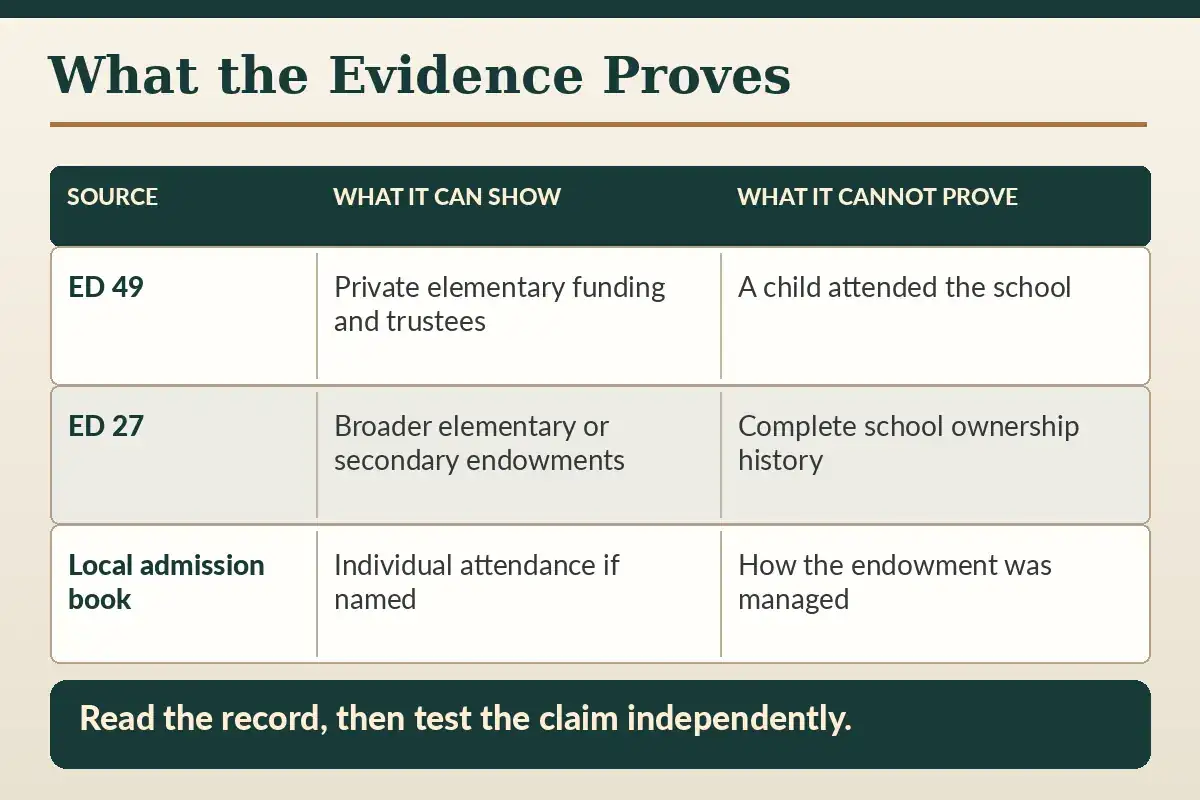
ED 49 concerns private endowments for elementary schools, with records dated 1853–1945. It is useful for tracing historical funding and administration of a school, not for locating a student’s admission or proving that a named child attended.
Verify the institution’s historical name, locality and type of school before using the ED 49 route. If the question is a secondary-school or broader educational endowment, ED 27 may be the more appropriate starting point. The National Archives describes ED 49 as private elementary-school endowment files for 1853–1945; ED 27 also covers elementary and secondary education endowments during 1850–1945. Dates describe archival groups rather than an individual school’s whole existence.
Start from a school rather than an ancestor’s surname
A funding record is organized around the institution and its administration. Begin with the school’s name as used during the relevant decade, parish, county, denomination if known and whether it was elementary or secondary. Historical school names may differ from their current names; enter all variants in the research log.
Only then ask whether the school drew on a private endowment, public grant, voluntary subscription or another funding mechanism. Do not infer an endowment merely because the institution was old or charitable. The National Archives identifies ED 49 for private elementary-school endowments and ED 27 for a wider group of endowment files.

Choose ED 49 or ED 27 by the funding question
ED 49 is the direct route when the subject is a private endowment for an elementary school. If the question concerns both elementary and secondary schools, or a more broadly described charitable provision, the archive also identifies ED 27. These are alternatives chosen by document and institutional type, not mandatory stages in chronological order.
A search that finds nothing in ED 49 does not show that a school had no financial support. It may have received a different sort of grant or been documented in local trust papers, parish archives or school correspondence. Record the scope of the negative search and revise the hypothesis rather than declaring the institution unfunded.
Read a trustee or donor role literally
Endowment material can put the names of benefactors, trustees, officers or property interests near the school. A person named as a trustee is not necessarily a pupil, teacher, founder or personal owner of the land. Preserve the title and capacity recorded by the source. When land is involved, separate the trust arrangement from private freehold.
To establish a particular property right, inspect the legal instrument or associated deed and the date of the relevant transfer. For a family-history claim, an independently documented relationship is necessary; two individuals with the same surname in an endowment file do not automatically belong to one lineage.
Follow the school through administrative changes
School funding and governance may have changed when an institution moved, amalgamated, adopted a different name or entered a new education authority structure. Build a chronology with separate columns for naming, premises, trustee status and administrative funding. Avoid giving the same date to all events simply because one file was created in that year.
For additional institutional context, the archive identifies ED 21 school files and other centrally held records. These can help trace correspondence about premises, trusts and organization, but they are not interchangeable with a local admission book. A line about the number of places is not a roll of identified children.
Find pupils in the correct repository
The National Archives states that it is not generally the best repository for individual pupil records. If the question concerns a child’s attendance, research local school registers, log books or records held by the school, local authority or a related charity. Check the repository and surviving date span before sending a request.
A school’s continued funding is evidence of an administrative relationship, not that a particular ancestor was enrolled or was present on a particular day. Test individual attendance against a named register entry and independently establish that the child matches the person in your family tree.

Produce a funding claim that can be repeated
In the final research note, separate the school’s existence, its recorded endowment, named officials, property references and individual attendance into distinct claims. Each needs its own source citation and date. An index reference to a file is useful, but does not establish every statement attributed to the original.
List missing items explicitly: no trust instrument viewed, no grant amount confirmed, or no pupil register examined. That honesty makes the ED 49 record a reliable part of local history even when the exact value of the endowment or the next generation of trustees remains unresolved.
Build an archive-ready research worksheet
Make a worksheet with columns for the research question, record creator, date covered, original reference, verbatim role or transaction, date of the alleged event, and independent confirmation. Begin with this subject-specific gate: Elementary-school private endowment: check ED 49; broader elementary or secondary endowment: consider ED 27; individual pupil: look for local school registers, not a central funding file. In the first positive entry, record what the document actually establishes. Do not replace uncertainty with a stronger event or identity claim just because the finding aid has an attractive title.
Put ED 49 endowment file and ED 27 broader education endowments on separate lines when comparing sources. The first may show school financial administration or trust context, but it does not itself establish pupil enrollment or direct descent. If the research requires a firm conclusion, seek ed 21 institution correspondence or local trust and school records. Log negative searches by reference, years and access method; a catalogue search is not a complete examination of undigitized records.
More House and Local History Guides
How We Research and Verify the Evidence
We checked the official National Archives research guidance on 2026-11-03. TNA lists ED 49 private endowments for elementary schools (1853–1945) and ED 27 for wider endowments. The guidance establishes the series route; it does not independently verify an unnamed ancestor or a specific undocumented case.
We checked the official National Archives research guidance on 2026-11-03. TNA explains that central education files are mainly administrative and pupil records usually remain with schools and local repositories. The guidance establishes the series route; it does not independently verify an unnamed ancestor or a specific undocumented case.
The practical method in this guide distinguishes archive descriptions, original records and independent confirmation. We do not claim that online Discovery searches inspect every word of undigitized documents. For transparency, read the GenHis affiliate disclosure; our source evaluations do not imply a commercial relationship with an archive or record provider.
It is an endowment and administration record group, not a standard pupil register.
The archive describes private elementary endowments dated 1853–1945; check the specific file dates.
Use ED 27 for a wider elementary or secondary education endowment question.
No. Read the actual legal instrument and its capacity wording before concluding ownership.
Where they survive, look at the school, local archives, or the responsible organization rather than assuming central files contain them.