
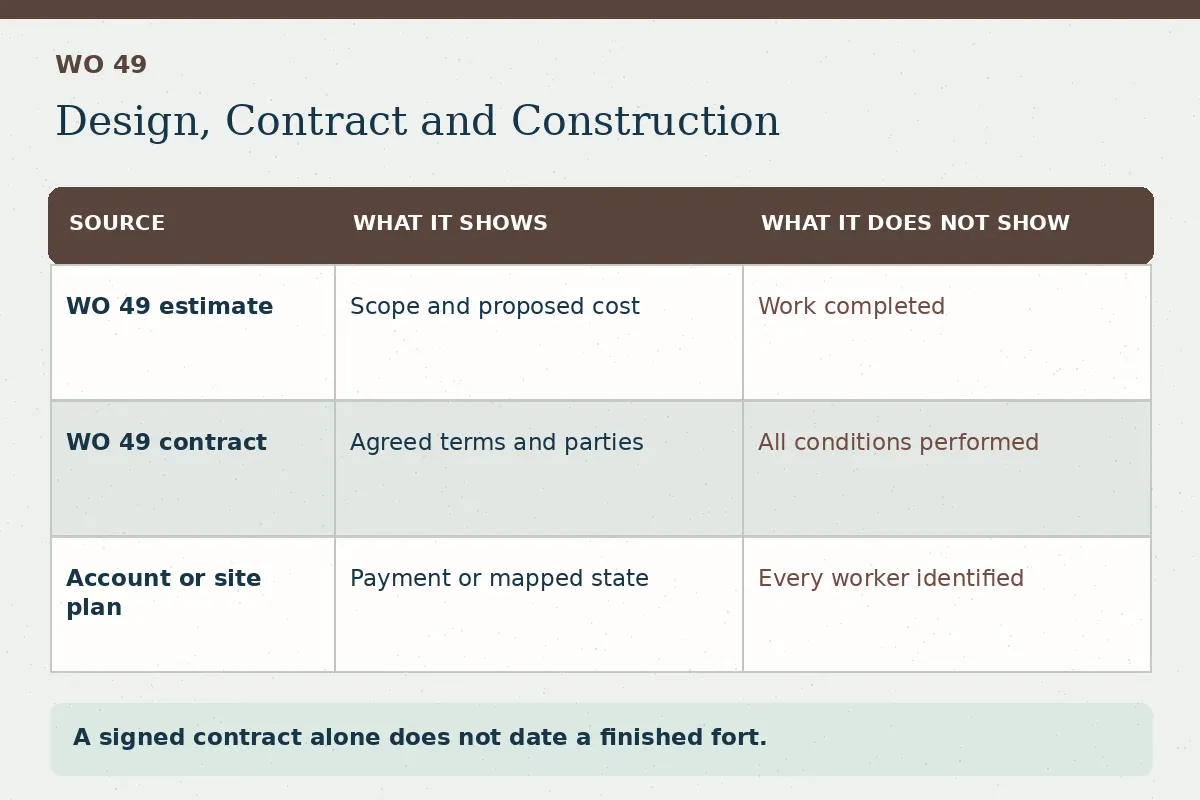
WO 49 can show how Britain’s Board of Ordnance contracted for fortifications and other military works, but the parts of the series answer different questions. The National Archives identifies original contracts in WO 49/1–16, chiefly 1783–1835; estimates in WO 49/110–206B, mainly for fortifications and works from 1639 to 1850; and other financial material elsewhere in the series. A cost estimate is not proof that a wall was built. Start by naming the site, the type of document and the event you need to establish.
Choose Contracts, Estimates or Accounts Before Searching
Separate the question into “what was proposed,” “what was contracted,” “what was paid,” and “what survives at the site.” Those are different historical stages. WO 49/1–16 holds original contracts from 1783–1835, chiefly concerning fortifications. WO 49/110–206B covers estimates mostly for fortifications and works from 1639 to 1850. The Board of Ordnance guide also identifies WO 49/17–109 as debenture books and WO 49/207–293 as assorted accounts and financial papers.
Those date spans and piece ranges are selection aids, not proof that every place or year has a surviving contract. Search the archive catalog for a site, garrison, fort, construction type and known contractors, but browse by the relevant run of documents when titles are generic. Record your original search terms. If no named-place hit appears, the work might have been entered under an office, engineer or broader military district.
The Board of Ordnance and an individual army unit are not equivalent. Administrative records can name engineers, contractors, suppliers or officials rather than the soldiers who later served at a fort. A surname on a contract is a specific documentary role; never turn it into proof of residency, garrison service or ownership of the land.

Read the Contract Scope Without Assuming Performance
For an original contract, transcribe parties, place, date, work described, measurement or quantity, specified materials, price and any schedule or conditions. A document can establish what a party agreed to supply if it was executed as such; it does not show that all terms were performed. Check signatures, dates, amendments and endorsements, including the possibility that a paper is a draft or copy.
For an estimate, preserve the conditional language. An estimate can be a planning calculation, a revised cost or a comparison of alternatives. If the estimate has a total for a battery or barracks, do not repeat it as final expenditure. Even an approved budget can remain unspent. The next evidence type may be a progress report, measured account, debenture, payment or inspection, depending on what survives.
Historic engineering vocabulary deserves care. A “work” may refer to a planned defense, a repair, a survey or material procurement rather than an entirely new building. Terms such as enlargement, refacing and rebuilding can describe different physical interventions. Quote the scope closely enough to distinguish a repaired existing wall from a newly erected one. Do not invent a precise modern site boundary from a name alone.
Reconcile Financial Papers and Construction Evidence
Make an evidence ledger with one row for the contract or estimate, another for a later account, and a third for physical or cartographic evidence. WO 49 includes accounts, but an account needs its own transaction date, payee and purpose. A payment to a contractor may cover supplies or stages of work and does not enumerate each laborer. Where a deduction or dispute is recorded, keep the final status unresolved until the relevant decision or settlement can be found.
Cross-check Board minute books in WO 47 or correspondence when a work was approved, questioned or altered. The Board of Ordnance guide explains that WO 47 contains minutes and that older minute books vary in indexing. An order for a survey, request for an estimate, and authorization to commence works are different actions. The date of one does not substitute for the others.
For the physical fort, compare an appropriately dated plan in a military map collection such as WO 78, a later engineering survey, or surviving building evidence. A drawing can depict a proposed bastion rather than one already constructed. Look for status legends, actual dimensions, annotation dates and independent references. A modern ruin or restored structure cannot be assigned wholesale to an eighteenth-century contract without a chain of dated evidence.
Separate a Named Contractor From Workers and Residents
A family tradition might say that an ancestor “built the battery” because their surname appears on a contractor account. This is too broad. A company owner or master contractor may have agreed to provide stone, timber, carriage or labor; the named person need not have worked on the site. Determine whether the paper names a principal, agent, witness, clerk or recipient of money, and seek wages or household evidence before identifying the actual workforce.
A hypothetical 1805 estimate for an earthen battery followed by an 1810 map showing a similar outline would be a useful lead, but it is not automatically proof of execution. The map could show a projected arrangement or a revised work. The historian would need a dated construction report or verified physical sequence. Those dates are illustrative; no actual case is claimed here.
Negative searches should be recorded by piece range and method. A missing contract does not prove that a fort was never altered: work may have been done through another office, described at district level, or documented in accounts rather than formal contracts. Write an explicit remaining question instead of a definitive conclusion unsupported by survival and coverage.

More House and Local History Guides
How We Research Fortification Contracts and Estimates
We use The National Archives Board of Ordnance guide to route WO 49 by original contracts, estimates, debenture books and financial papers. We check the broader British Army research-and-development guide for the distinction between earlier Ordnance contracts and later production agencies. Each proposed construction claim is tested against independent works, plans and payment evidence, with precise piece citations.
Our worksheet preserves documentary role, scope, date, payer and payee, conditional language, and the next independent test. Neither a cost estimate nor a map necessarily proves completed construction or lists the labor force. For transparency see the affiliate disclosure; no commercial relationship is assumed.
The National Archives identifies original contracts, fortification estimates, debenture books and other financial papers in distinct piece ranges.
No. Compare contracts, progress records, payments and later plans or physical evidence.
The Board of Ordnance guide lists WO 49/1–16 contracts chiefly for fortifications from 1783–1835.
WO 47 includes Board minute books; references in correspondence may provide additional routes.
Not necessarily. Contractor, supplier, witness and individual laborer are different documentary roles.