
CAB 21 is a route into the Cabinet Secretariat’s registered files about British domestic and foreign policy, not a shortcut to a final Cabinet verdict. A registered file may collect background correspondence, a draft, comments, or administrative steps; a contemporaneous minute or signed instrument is a different kind of evidence. The National Archives identifies CAB 21 as beginning in 1916, with related registered files continuing in CAB 164 and CAB 165 from 1966. Choose a dated policy question first and classify each record by what it actually records.
Decide Whether You Need a Secretariat File or Cabinet Minutes
Write the exact claim before you search. “A department considered closing a facility,” “the Cabinet approved closure,” and “the facility closed” are three propositions. CAB 21 is useful for reconstructing consideration and administrative context, but one file’s subject heading does not prove all three. Decide whether you need a proposal, the ministerial decision, a legal authorization, or evidence of practical implementation. This makes the search narrower and prevents a catalog keyword from becoming a historical conclusion.
The Cabinet and committees research guide places registered Cabinet Secretariat papers in CAB 21 and lists post-1966 continuation series CAB 164 and CAB 165. It separately identifies formal Cabinet minutes and memoranda: for the earlier War Cabinet, CAB 23 and CAB 24; for the postwar Cabinet, CAB 128 and CAB 129. A researcher who finds a policy topic in CAB 21 should therefore not label that file a Cabinet conclusion unless its actual contents justify that description.
Build a date-and-record matrix. In the first column record the year of the problem; in the second, the body that could have considered it; in the third, the applicable minute or paper series; in the fourth, the department responsible for any action. If a file straddles the post-1966 changeover, test the later series instead of treating the disappearance of CAB 21 results as the end of the issue.

Follow a Registry Description Without Assuming It Is the File
Use Discovery’s advanced search to combine a distinctive term, an approximate year, and the CAB 21 reference. Search the full vocabulary of the time. “Emergency housing,” for example, may appear under reconstruction, local government, labor, supply, or a particular ministry. Search alternate spellings and synonyms, but keep a log of exactly which date span and filters produced each result.
Read a Discovery result as a record description. Its title, date span and reference tell you how the archive arranged an item; they are not necessarily a transcript of every internal paper. Identify a piece reference and access conditions before writing about its contents. If the item is not online, say that you have located a candidate file, not that you have seen the discussion. Historical confidentiality and current access restrictions are not interchangeable concepts.
When you can inspect the original, preserve document dates separately. A covering note may have been written after a memorandum it encloses, and an old file may contain later correspondence. Record author, recipient, document date, enclosure date, and any circulation marks individually. A statement that a matter was “for consideration” is not the same as a record that members agreed to take a particular action.
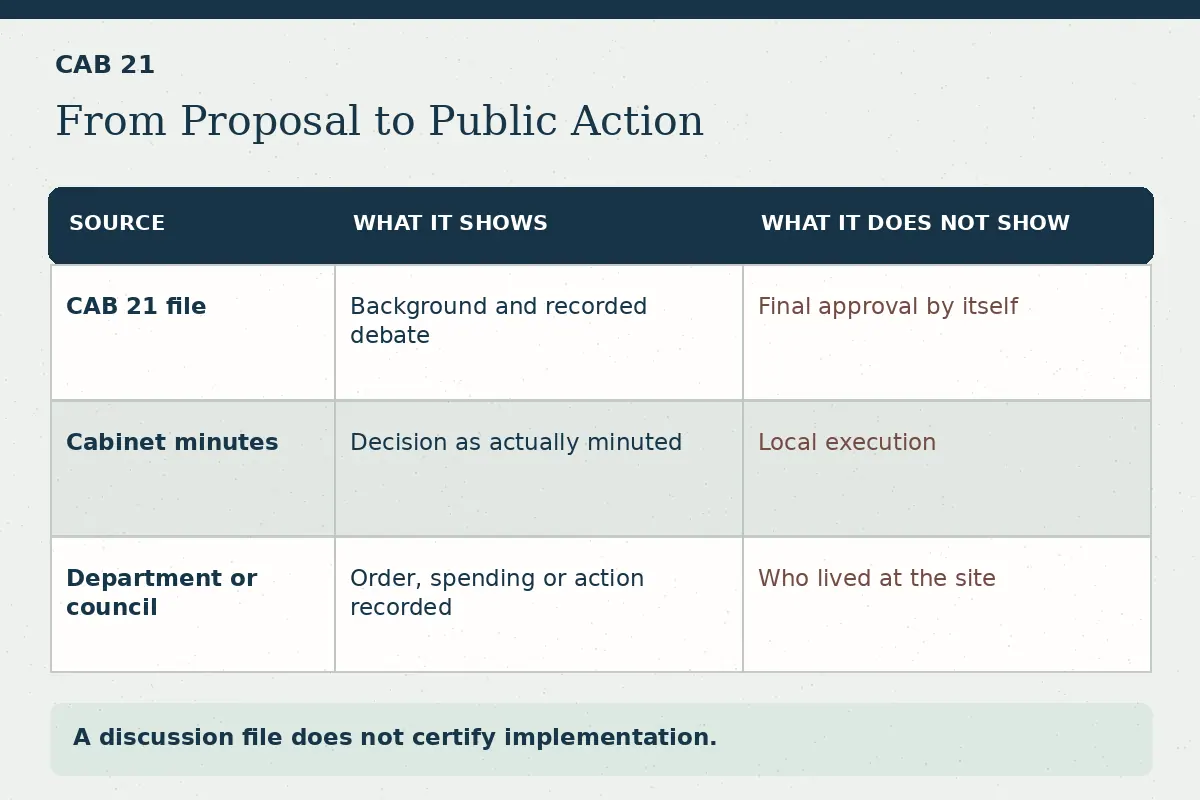
Build a Claim-by-Claim Policy Evidence Ledger
For each proposed action enter four fields: the literal words, the source reference, the decision stage, and a missing test. “An option circulated” belongs in the discussion column. “The Cabinet concluded” should be supported by minutes or another authoritative decision document. “The works opened” needs an operational report, local authority record, government notice, or similarly direct evidence. Never use a horizontal arrow in a diagram to imply that all three steps necessarily occurred.
A ministry may have prepared several competing recommendations. Record amendments, objections, and withdrawals rather than quietly selecting the proposal that best fits the story you expected. A later Cabinet minute might modify an earlier proposal, delegate a question, or simply note a report. Quote only the operative wording necessary to classify the action and keep the complete original reference for a reader who wants to check.
Official implementation may be documented outside CAB. Depending on the question, look for a departmental registered file, statutory instrument, parliamentary proceedings, financial approval, or a local record. Each source resolves a different uncertainty. An order authorizing expenditure does not prove the money was spent; a ministry instruction does not by itself prove local execution; a proposal to move a family does not identify the people who eventually moved.
Use the File to Test Local and Family Histories Carefully
Cabinet Secretariat files often illuminate a historical setting without naming ordinary residents. If a family narrative says someone was displaced by a government policy, first establish the policy’s relevant place and dates. Then look for individual-level evidence in an address directory, property file, tenancy record, or local register, observing access restrictions. Do not import a person’s name into a national government file simply because they lived nearby.
Try a hypothetical example: a file cataloged under postwar housing debates contains a plan for temporary buildings. Place that as “proposal.” A later minute authorizes an inquiry, not construction; the status remains unresolved. A municipal building register from the appropriate district might eventually show the structures erected. None of those documents alone names the families housed there. This worked sequence illustrates the evidence logic, not an actual case reconstructed from CAB 21.
Keep unsuccessful searches proportionate. A missing result in an online catalog is not evidence that ministers never considered an issue: records may be retained under another office, described only in broad terms, subject to restrictions, or absent. Document the titles, years and alternate terms you tried before changing the research question or reaching a cautious negative conclusion.
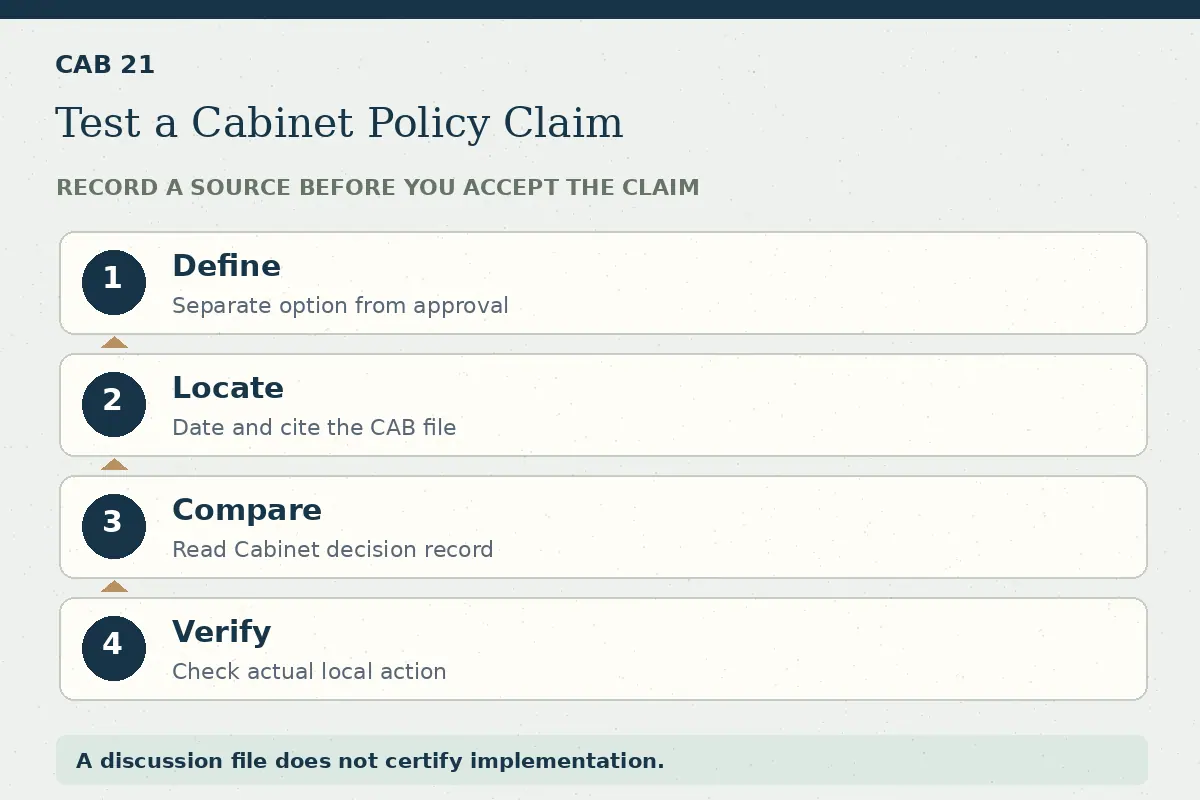
More Research Method Guides
How We Research Cabinet Secretariat Policy Records
We begin with The National Archives Cabinet and committees guide, which maps CAB 21 against other Cabinet series. We then use the Discovery searching guide to locate a precise item and record whether it was actually consulted. Formal decisions, legislation and departmental execution are investigated separately. We never convert an archival subject heading or a proposed recommendation into proof of an adopted measure.
Our verification worksheet preserves the issue date, original wording, full CAB reference, the decision-stage classification and a clearly named independent source still needed. This workflow is a research method, not a claim that any fictional illustrative example occurred. For transparency, see our affiliate disclosure; access routes may differ by document and do not imply commercial affiliation.
Not necessarily. CAB 21 is a Secretariat registered-file series; check formal minutes and the exact operative wording before making an approval claim.
Use the period-appropriate Cabinet minutes or memoranda, including CAB 23/24 for earlier War Cabinet records and CAB 128/129 for postwar records.
The National Archives guides researchers to CAB 164 and CAB 165 for registered files continuing from 1966.
They can explain policy context but generally require separate named local or personal records to prove an individual experience.
Cite it as a catalog reference only, and do not assert the contents of an uninspected piece.