
Read the Conclusion as a Recorded Decision
CAB 128 contains minutes and conclusions of postwar British Cabinet meetings, covering 1945–2002 in The National Archives series guide. The conclusions summarize discussion and decisions; they are not verbatim transcripts of everything said by every minister. A recorded agreement is evidence of Cabinet-level decision making, not automatic proof that a policy was immediately enacted or applied uniformly across the country.
Begin by writing one exact question: what did Cabinet authorize, defer, request or merely discuss at a named meeting? Record the meeting code, date and item number and quote the operative action precisely. The words “noted,” “invited,” “approved” and “agreed to consider” have materially different implications. A proposal mentioned in discussion should never be described as a binding Cabinet decision.
The National Archives notes that postwar minutes and conclusions may use CM or CC codes associated with changes of administration. Do not treat the code as an individual minister’s initials or a departmental file number. Preserve the full citation with the CAB 128 piece reference, then inspect the actual meeting paper to confirm the item’s text and its position in the sequence.
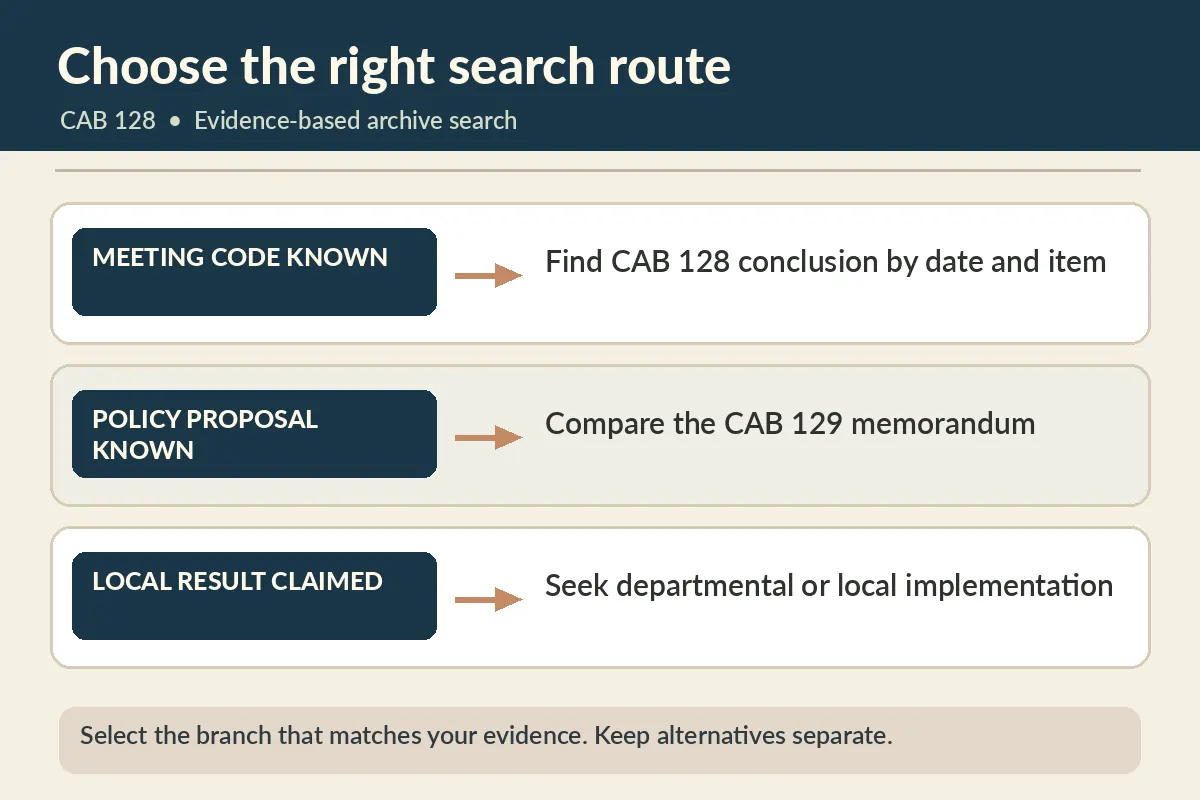
Choose Conclusions or Memoranda by the Question
The companion CAB 129 series holds Cabinet memoranda from the postwar period. Memoranda were circulated as background or proposals for discussion; they are different from the summary conclusions kept in CAB 128. A memorandum advocating an option cannot show that Cabinet adopted it. Conversely, a conclusion may record a decision without reproducing all arguments behind it.
If you know a policy topic but not a meeting date, search both series using contemporary subject terms and available reference codes. Catalogue descriptions may list an agenda subject or the title of a memorandum rather than every person or institution mentioned in the full paper. Try departmental vocabulary, historical acronyms and date intervals, then browse adjacent meetings when a single keyword search fails.
For a documented decision, cross-reference the cited memorandum and Cabinet conclusion when both are available. Set out the proposal, the meeting’s response and any further action requested as separate rows. A change between the draft and the conclusion can be the most important part of the story. Do not fill silence in CAB 128 with the wording of CAB 129.

Keep Confidential Annexes and Gaps Visible
The National Archives warns that sensitive matters could be recorded in confidential annexes rather than in the ordinary run of conclusions. For 1939–1948 there are separate annual volumes in CAB 65 and CAB 128, and for 1949 to September 1951 confidential annexes are identified in CAB 128/21. Those examples show why a short public-facing catalogue description may not capture the whole archival context.
Check the date and file status before concluding that an item was never raised. A title may omit the names of attendees, officials or affected localities even when the original record contains them. Conversely, a subject heading that sounds like a public decision may conceal a report received for information. The item’s actual words, not the headline in Discovery, determine the supportable statement.
Do not infer that every annex is available online or open. Follow the current catalogue access statement for the exact piece and use the repository’s rules for restricted or untransferred material. In a research log, distinguish “catalogue description found,” “original seen,” “restricted” and “not yet searched.” Those statuses give readers a more truthful accounting than the label “no records.”
Follow a Decision Into Implementation Records
The usual next step after CAB 128 is to find the administrative department tasked with the decision. A Cabinet conclusion may direct a minister or committee to prepare a plan, but implementation could require legislation, subordinate rules, funding, local agreements or later reconsideration. Look for a departmental file, parliamentary proceedings or a subsequent Cabinet item that records what actually happened.
For a local-history claim, separate policy authorization from effects at a named street, school, workplace or property. Even a national decision with a clear date cannot demonstrate that a particular resident received a payment or that a structure was demolished. The appropriate next source may be a ministry case file, local authority minute, property plan or contemporary report tied to the specific place.
Use an action ledger with columns for meeting reference, operative verb, responsible body, expected follow-up and verification source. Mark later implementation as confirmed only where dated documents describe that action. If a later minister altered the plan, show that change rather than projecting the first decision forward as an unbroken policy.

Cite the Meeting and Preserve Alternatives
A useful CAB 128 citation contains the series and piece number, meeting code and date, agenda or item number, and the key language in context. Cite the associated CAB 129 memorandum separately. The National Archives guide describes the catalogue’s limited keyword access, so preserve search terms and browsing ranges when a relevant meeting was difficult to locate.
When Cabinet recorded several options without a clear final choice, leave the outcome open. A minister’s expressed preference is not itself a government decision; a decision to request another paper is not approval of that paper’s eventual contents. Represent these distinctions explicitly in your article or family history narrative rather than smoothing them into an easy chronology.
The final conclusion can be short and defensible: “At meeting X, Cabinet agreed to ask department Y for a further report.” If later correspondence documents action, add that as a second sentence supported by its own record. By keeping Cabinet discussion, recorded decision and actual implementation separate, a researcher avoids false claims built from a compelling but incomplete archival summary.
More Research Method Guides
How We Research and Verify the Archival Record
For this guide we checked the official series and research descriptions for CAB 128 against the document categories, chronological boundaries and access limitations specified by the custodians. We separate series-wide statements from claims about a particular piece: the former establish a search route, while the latter require the piece itself. Our principal source descriptions are Cabinet And Committees Searching For Records Using Discovery Understanding Your Search Results. These sources support reference names and evidence limits; they do not certify an uninspected record as proof of an individual event.
Our verification worksheet records the claim, exact CAB 128 reference, creation date, nature of the entry, names and roles actually written, independent source used for comparison, and any unresolved alternative. The illustrated search routes are teaching reconstructions, not facsimiles of original records. Consult the affiliate disclosure for the site editorial and commercial policy. This article does not depend on an unverified paid provider or a claim of access to closed material.
No. Cabinet conclusions summarize deliberations and decisions rather than providing a full word-for-word transcript.
The National Archives identifies 1945–2002 for postwar minutes and conclusions in CAB 128.
CAB 129 contains memoranda circulated as papers for discussion, not the minutes or conclusions of the meeting.
No. Follow subsequent departmental, statutory or local records to establish what was actually done.
Discovery searches descriptions and titles rather than every word of every archival document; try codes and chronological browsing.