
RAIL 463 contains records of the Manchester, Sheffield and Lincolnshire Railway, including surviving staff material described in The National Archives’ railway-workers guide. The guide directs researchers to specific RAIL 463 pieces such as 174, 176–177, 210–250 and 305–315. Staff or salary books can name an occupation, appointment or work location, but a single line does not prove that a person stayed at one station for life or transferred to another. Begin with the correct historical company and then read the purpose of the particular ledger.
Prove the Historical Employer Before Searching a Name
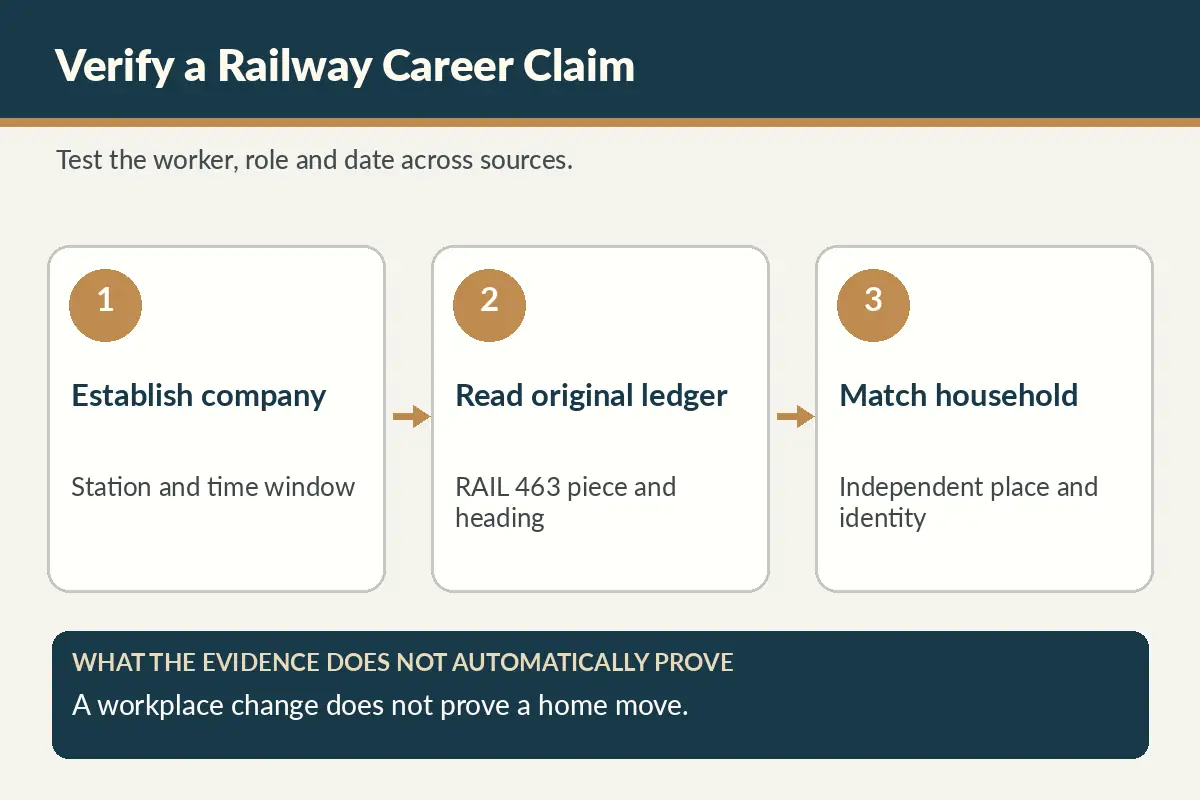
The same railway line could pass through changes in ownership and administration. Before searching RAIL 463, establish whether the relative worked for the Manchester, Sheffield and Lincolnshire Railway, another railway operating over the same tracks or a later successor. The National Archives’ guide advises checking pre-grouping railway maps and company information. Station geography is a starting clue, not proof of the employing company.
Create a small employment window from census occupation reports, home addresses, trade directories or family documents. Write occupation as recorded: porter, driver, clerk, fireman, fitter or another trade. A generic “railway worker” can refer to many departments and contracting arrangements. The guide warns that relatively few records survive for construction workers and casual laborers, so absence from formal personnel books may reflect the kind of work performed.
RAIL 463 catalogue coverage includes records from a long corporate history, and date ranges can refer to the oldest individual mentioned or the administrative life of a volume. Do not assume the first and last years in a series description are the first and last years of an individual’s employment. Each person’s entry must be dated on its own terms.

Select the Staff Book by Department and Station
The National Archives’ railway-workers guide identifies RAIL 463/174, 176–177, 210–250 and 305–315 as important ranges for the company’s staff records. The same guide describes how staff books can be arranged by office, station, occupation or staff number. An alphabetically indexed volume is only one possible form; browsing a relevant station section may be necessary when a name search fails.
Use the department vocabulary in the guide. Traffic and coaching records can include porters, guards and signalmen; locomotive or carriage records can include engine crews, fitters and workshop workers. Office staff may appear in salary registers, while goods-handling staff can be in commercial categories. Search the actual occupation and likely administrative heading, preserving older job terms as written.
A staff ledger might have a line recording name, work location, pay rate, appointment date or change of grade. Copy the column heading before interpreting any number. A wage amount might be an annual salary, weekly wage or an administrative adjustment; an unexplained sum is not automatically a bonus or pension. Compare neighboring lines and the form’s instructions.

Test Each Appointment and Transfer Date
A date alongside a station may refer to entering the company, appointment to a position, or movement to a specific workplace. Read the entire heading and later annotations. If a person appears at two stations, check whether the book directly records a transfer or whether the entries merely occur in different years. Two locations alone do not identify the reason for movement.
Make a timeline with columns for person, source date, recorded department, station, status and interpretation. Mark which entries use explicit words such as “transferred,” “advanced,” “left” or “retired.” Do not translate a missing later entry into dismissal or death. A register may end for an administrative reason while employment continued in another book.
Employment histories can also include accident, discipline, sickness or superannuation records, but the presence of such records varies by company and department. A note about a fine is not a criminal conviction; a recorded sick absence is not a clinical diagnosis. Preserve categories as payroll or personnel facts, then seek separate evidence for health, legal or family claims.
Distinguish Namesakes and Household Residence
Railway companies employed many people with common English and Welsh surnames. Match a candidate through work department, station, age, dates and independent address evidence. If a staff record lacks age or birthplace, do not invent them from a different same-name employee found in a census. A surname-only hit should remain a candidate until two or more dated clues align.
A person employed at a station did not necessarily reside in the parish where the station stood. Railway workers commuted, were assigned to regional depots or lodged near work temporarily. Keep workplace and residence in separate fields. A census entry provides a reported home on the census date; a staff book describes an employment relationship at its own reporting date.
Comparing a pay change with a birth, marriage or migration event can be useful, but coincidence does not establish causation. If the staff entry indicates a transfer, identify the origin, destination and date exactly. If the same person appears under two department names, ask whether that reflects a real career move or a reorganized accounting category.
Where to Go When RAIL 463 Is Incomplete
The National Archives emphasizes that there is no central name index for all railway employees. Some railway staff records are searchable through a commercial database, but the original holdings and arrangement still control what can be verified. A failure in a commercial search is not proof that a paper register contains no entry. Check catalogued pieces, access restrictions and the original form.
Consult surviving company histories, employee magazines, retirement notices and local archives when an employment period lies outside the known RAIL 463 section. The National Railway Museum and county repositories hold material different from central government collections. Always check who holds a source before making a copy request. Never invent an internal GenHis page as a citation or substitute for a repository reference.
The strongest result states the employee’s exact recorded role, station and date, with RAIL 463 piece and folio or page if visible. A broader career summary needs several connected records, with uncertain intervals marked openly. If two plausible workers remain, explain the alternatives rather than forcing them into one fabricated employment history.
More Records and Archives Guides
How We Research Historical Railway Staff Records
We follow The National Archives railway-workers guide for the documented RAIL 463 piece ranges, occupation terms and limitations of name indexing. We cross-check the general railways guide for company boundaries and the distinction between original private-company records and later nationalized railway administration. These guides establish a path to records; they cannot identify an individual without his or her entry.
Our audit records the employer, department, original ledger heading, date, staff number if shown, pay or grade wording, location and independent identity sources. We keep payroll events distinct from household relationships, employment claims distinct from criminal or health conclusions, and station movements distinct from proved residential migration.
Authoritative repository guidance used for this article: The National Archives: Railway Workers. The National Archives: Railways. Confirm current piece-level access restrictions and ordering routes in Discovery before making a research visit or requesting a copy. The original record—not a search hit or a printed summary—must support every contested detail.
For our editorial and affiliate-policy statement, see the affiliate disclosure. This research plan does not require paid services; archive and document-copy costs depend on the repository and the material requested.
The Manchester, Sheffield and Lincolnshire Railway Company and its staff-related records.
No. The National Archives warns there is no complete central railway staff name index.
The official guide lists 174, 176–177, 210–250 and 305–315 among the relevant pieces.
No. A workplace entry and a residential address are different evidence.
No. It records the period and purpose of that particular book, not necessarily every job.