
Great Western Railway staff registers in RAIL 264 can document clerks and other railway employees across changing departments and stations. However, a successful name-level catalogue result is not necessarily a full employment file or proof of every residence. The National Archives offers name-searchable summaries for GWR clerks and directs researchers to original registers and commercial images for fuller details. The distinctive task here is to build an employment chronology from the actual register pages while separating grade, assigned station, salary, domestic address and later railway reorganizations.
Confirm the Company and Job Before Searching
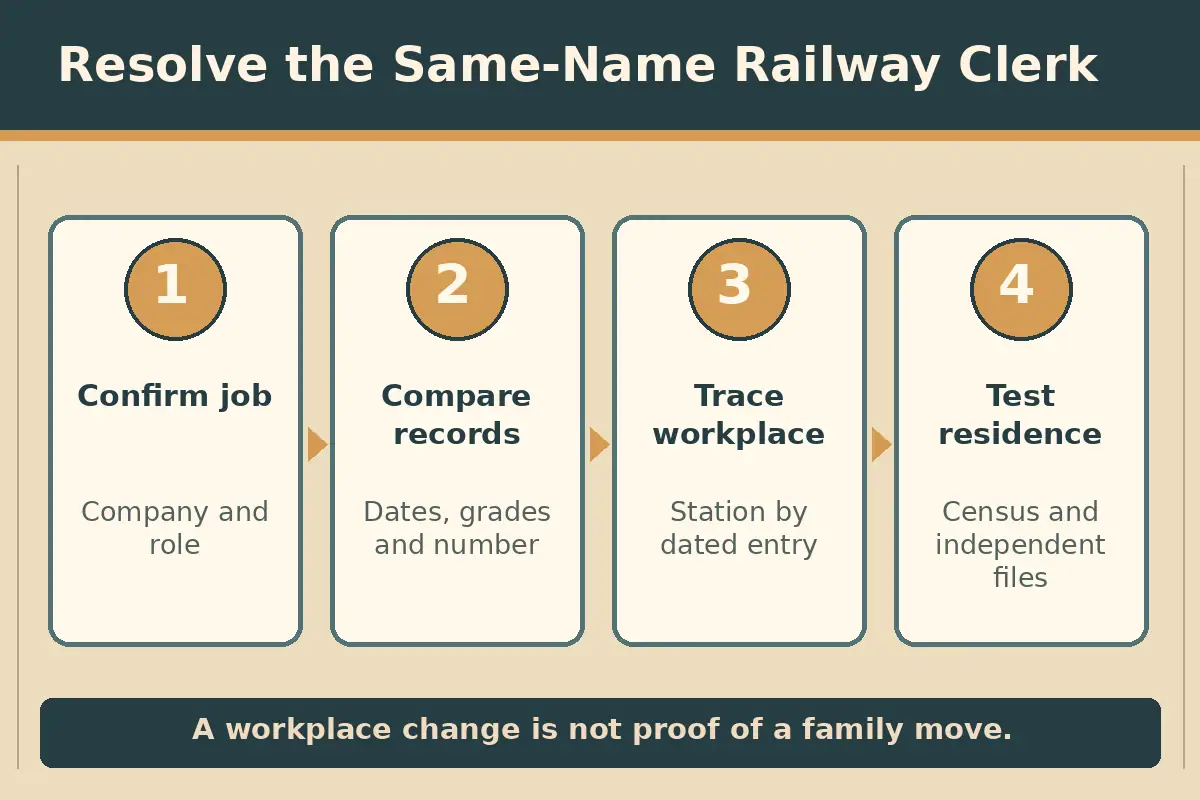
Start with a person’s occupation wording in a dated census, marriage certificate, employment letter, staff magazine or obituary. “Railway clerk” does not automatically identify the Great Western Railway; several companies operated in neighboring towns, and a station might change ownership or operation over time. The National Archives’ railway workers guide recommends establishing employer, kind of work and location before searching company holdings. Record the phrase as written, together with the evidence for the company identification, rather than silently assigning the nearest railway network.
A railway job title can be administrative, commercial or traffic-related. The guide explains that salary registers often focus on clerical staff, while operative staff may have different books and classification terms. Avoid confusing a railway passenger booking with a clerk’s office duty. If a person moved between companies, the later record may be in a predecessor or successor company’s series rather than RAIL 264. Build a company-and-date worksheet before assuming that every subsequent mention belongs to the Great Western Railway. This is especially important for common surnames.
Use the Name-Level RAIL 264 Discovery Summaries
The National Archives identifies service registers of Great Western Railway clerks in RAIL 264 with catalogue summaries searchable by name, covering a historical period described as 1835–1962. RAIL 264 itself contains other staff records, and the series is not a uniform alphabetic roster of everyone employed by the railway. Begin in Discovery with the person’s surname and forename, narrow to RAIL 264, then test spelling variants or initials. A positive summary can point to a book or entry but does not supply every field from the original handwritten register.
Save the Discovery URL or reference, employment type, date span and whether it was a name-level description or a register image. If a catalogue description names an occupation or workplace, treat that wording as a lead pending verification of the source. The archive’s guide says that an original can be viewed at Kew or accessed via an image arrangement where available. Do not represent paid access as automatically free or assume that all volumes have the same degree of indexing. A missing catalogue hit needs further browsing, not a definitive career conclusion.

Read the Register’s Financial and Career Fields
Railway staff registers often record name, occupation and place of work, while salary registers can trace rates, increments, allowances, bonuses, fines or absences. The actual fields vary by book and time. For a GWR clerk, transcribe each dated posting, department, grade, staff number and wage or salary figure that appears. An increase in pay may reflect a general scale adjustment, promotion or changed duties; its meaning should be confirmed from the corresponding heading. A fine is an administrative record and should not be exaggerated into a criminal conviction.
Do not expect a modern personal dossier with an uninterrupted career summary. The National Archives notes that registers were primarily financial or administrative, and that some record classes provide very little personal detail apart from a birth date. Compare an earlier entry, later annotated lines and the neighboring page before assuming a new date represents a complete change of employment. Record when a field is not present rather than leaving a blank that readers may mistake for “none.” A second person’s similar salary does not establish family connection or shared identity.

Distinguish a Posting from a Home Address
A staff register may name a station, depot, office or railway district: these are employment locations, not necessarily domestic addresses. A clerk might work at a station while living in another parish. Build two parallel columns—WORKPLACE FROM REGISTER and HOME FROM INDEPENDENT RECORDS—then place census and directory evidence in the second column only. If the person changes stations in two consecutive pay entries, do not invent a household move date between them. Note whether the dates are effective dates, bookkeeping periods or handwritten later annotations.
Railway reorganizations complicate long careers. The large 1923 company grouping and later nationalization alter the corporate record context, even though a person might remain at the same desk or station. The National Archives warns that post-1947 personnel cards were not consistently retained centrally. A late career may need regional record offices rather than simply a later volume in RAIL 264. Treat the series dates as archival coverage, not a promise that every member’s job history extends until 1962. Where a volume is missing or unindexed, record a coverage gap.
Corroborate a Clerk with Other Documents
Once a register entry is identified, compare approximate date of birth, place of work, department, initials and service number against other contemporary sources. A matching census occupation and residence may strengthen identification but does not by itself establish the same person if more than one clerk shared the name. Directory publication dates may lag the actual canvass, and obituary recollections may compress multiple roles. If a clerk later became a stationmaster, corroborate the transition rather than rewriting the earlier occupation to match the prestigious later title.
Check where the original record was held and whether another railway’s staff books are more appropriate. The railway guide lists different series for the Midland, London and North Western and other companies; those records are not subdivisions of RAIL 264. When an absence is reported, specify the years, books and spelling variants actually searched. A person might have worked for the Great Western Railway without leaving a surviving person-level register entry. A negative name search is a statement about search coverage, not a verdict about employment.
More Records and Archives Guides
How We Research GWR Employment Records
We begin with independently sourced employer and occupation, select RAIL 264 by company and date, and keep catalogue summaries separate from original images. Our ledger records the volume, page or entry number, staff name, grade, station, dated salary changes and exact transcription. We cross-check household address only against census, directories or vital records, and we separately mark corporate changes in 1923 and 1948. Each employment conclusion identifies whether it rests on an original register or an index entry.
The National Archives’ railway workers guide and railways overview provide the reliable company-routing and access framework. They do not prove a particular clerk’s identity without the underlying sources. We preserve unresolved namesakes, missing volumes and uncertainty about the reason for pay changes. Our editorial disclosure appears at GenHis affiliate disclosure. A named subscription provider is not an endorsement or evidence of any affiliate relationship.
No. Some clerks have name-level catalogue summaries, but the wider series includes other arrangements and incomplete coverage.
No. A station is normally an employment location. Test residence with independent sources.
No. Pay changes can reflect grades, scales, allowances or other administrative causes.
Survival is inconsistent. Regional archives may hold later cards or successor-company material.
Try variants, relevant volumes and neighboring company archives; absence from one index is not proof of non-employment.