
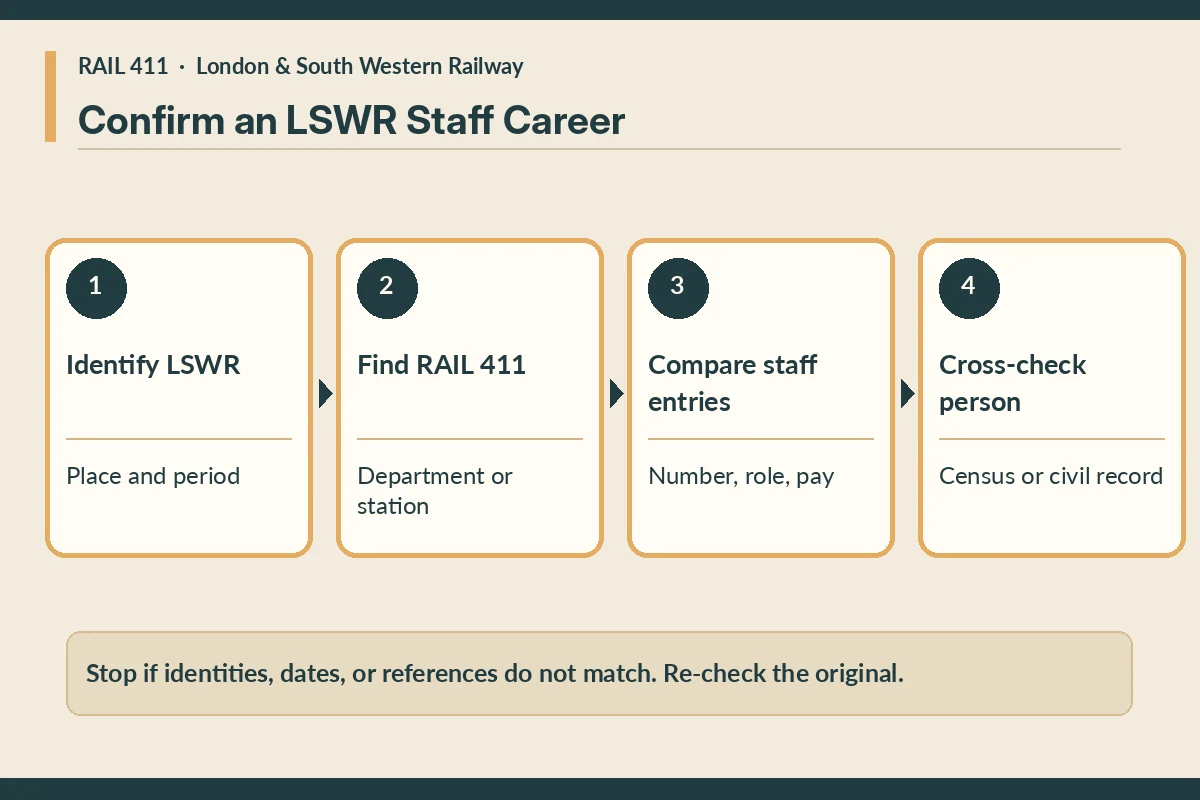
London and South Western Railway RAIL 411: Verify a Worker’s Job and Pay is an evidence-first guide to RAIL 411 staff registers, not a promise that one archival item can reconstruct a complete biography. Start with the archive’s stated scope, record the exact entry and date, and separate the administrative act from the larger historical conclusion. The National Archives series guidance establishes the first search route; a related official research guide explains the next evidentiary checks. Use the route below to find what a record actually says before inferring a person, voyage, estate, or event.
Confirm the Company Before Selecting RAIL 411
The London and South Western Railway employed staff across stations, goods depots, locomotive departments and offices. Its records are preserved in RAIL 411, but knowing that an ancestor “worked on the railway” is not enough to place that person in this company. Begin with a station, route, job or census entry and check which operator existed at the relevant date.
The National Archives railway-workers guide explains that company history is essential, particularly where mergers or later grouping changed the record-keeping body. For an employee whose career continued after 1923, investigate both earlier LSWR material and the appropriate successor records. Keep the documented employer name for each date rather than backdating a later railway brand.
Route the Search by Station and Department
RAIL 411 includes material for different functions, and survival is uneven. The National Archives advises searching by company, occupation, place of work and period, rather than expecting a single comprehensive surname index. Someone described in a census as a railway porter may appear in traffic or coaching material; a goods clerk may be filed under commercial or goods handling.
Make a short table of possible station names, the department most likely to employ the person, the years in question and variant job descriptions. Search Discovery with RAIL 411 as a series restriction, refining by location or department. Record every piece reference even if an online index gives only a name and date.

Compare Staff Registers and Wages Books
A staff register may provide the name, position, location, appointment, pay changes and sometimes illness or a disciplinary note. A wage book is organized primarily around payments, deductions and staff accounted for during a particular period. It may show a different slice of employment from a chronological service register. A blank period in one volume need not indicate the person left the railway.
Read the column headings and continuation pages. Watch for later corrections, marginal notes and re-used staff numbers. If a pay rate appears, keep its period and basis—weekly, annual or another measure—rather than converting it into a modern salary without qualification. A payroll item does not automatically establish gross earnings from every source.

Use Character and Discipline Records with Care
Some RAIL 411 material includes company reports on conduct, fines, cautions or commendations. Those records can illuminate workplace expectations and specific administrative events. They also reflect an employer’s perspective, often without the employee’s own explanation. A character book is not a neutral biographical evaluation and an accusation is not necessarily a proven offense.
For each negative or positive notation, record the date, reporting official, stated action and any later amendment. If a dismissal or transfer is claimed, seek the actual departure, appointment or personnel record rather than treating a marginal comment as a complete employment outcome. Distinguish a caution from a penalty and a complaint from its disposition.
Separate Similar Employees and Number Systems
Railway families often reused first names, and railway housing could place relatives at one address. Two entries at the same station with the same surname might be father and son, unrelated colleagues or an indexing duplicate. Compare occupation, age, department, address, staff number and dates. Numbers may be assigned within a register or department rather than throughout the railway.
Link staff evidence to census households, civil certificates or other independently dated records. If you know only a surname and station, report a possible match until you can connect a personal attribute. Do not infer a promotion merely because a higher paid employee with the same name appears in another book.
Understand What Survived and What Did Not
The railway-workers guide cautions that coverage varies greatly by company and occupation. Casual staff, construction laborers and workers outside well-organized personnel departments may leave few records. RAIL 411 is useful precisely because different types of staff registers survive, not because it captures every person ever paid by the railway.
If the desired volume is missing, use local newspapers, railway magazines, census records, trade directories or local archives as alternatives, describing their evidentiary limits. A newspaper report of a retirement may supply a clue but may exaggerate service length; a census occupation says what the household reported, not the contents of an employer file.
Test a Station Clerk Against Two Registers
Imagine a wage book listing a clerk at Exeter and a later staff register recording a clerk of the same name at a different station. Do not describe a promotion or transfer until the employment number, age, appointment dates or a separate source links the records. The name alone may belong to two employees. Keep the pay period and station exactly as the source gives them.
If a disciplinary record appears between the two entries, note its author and action. It may explain a change in pay but does not necessarily show a dismissal. Compare the record with a formal appointment or departure entry and the nearest census. Where a discrepancy remains, present a range of interpretations rather than choosing a single career narrative.
More Records and Archives Guides
How We Research a Railway Employment Claim
We begin with the company identification, then note every relevant RAIL 411 piece and whether it is a wage, staff or disciplinary source. We transcribe the actual name, station, occupation, amount and date, keeping any uncertainty visible. We do not write that an employee worked continuously between two entries unless the records support that interval.
When the record supports only an appointment or a deduction, our conclusion names that limited event. We confirm a longer career through multiple chronological sources and cross-check the worker’s identity outside railway paperwork. Read our affiliate disclosure for how linked resources are presented to readers.
RAIL 411 is the London and South Western Railway Company collection; its surviving staff records include multiple departments and piece ranges.
Sometimes a digital index helps, but station, job, department and dates often make a stronger catalogue route; there is no universal index for all railway employees.
Not necessarily. One book can cover only a station, department or period. A pay entry may not show an appointment, a transfer or a retirement.
They show a company’s recorded assessment or complaint, not an impartial finding about a worker’s whole character.
The 1923 Grouping changed railway company structures. Investigate successor-company staff holdings as well as the earlier LSWR records when chronology requires it.