
Medieval deeds can name land, witnesses, sellers, grantees and religious houses long before modern title registration. Yet a deed in E 40, E 41 or E 42 does not automatically provide a continuous ownership chain or prove a modern person’s ancestry. These “Ancient Deeds” series were assembled by later archival arrangements, sometimes separating records from the litigation or office where they once belonged. The useful method begins with a historical place, checks several related series and interprets the deed’s actual parties and transaction before drawing any family conclusion.
Understand Why Deeds Appear in Artificial Series
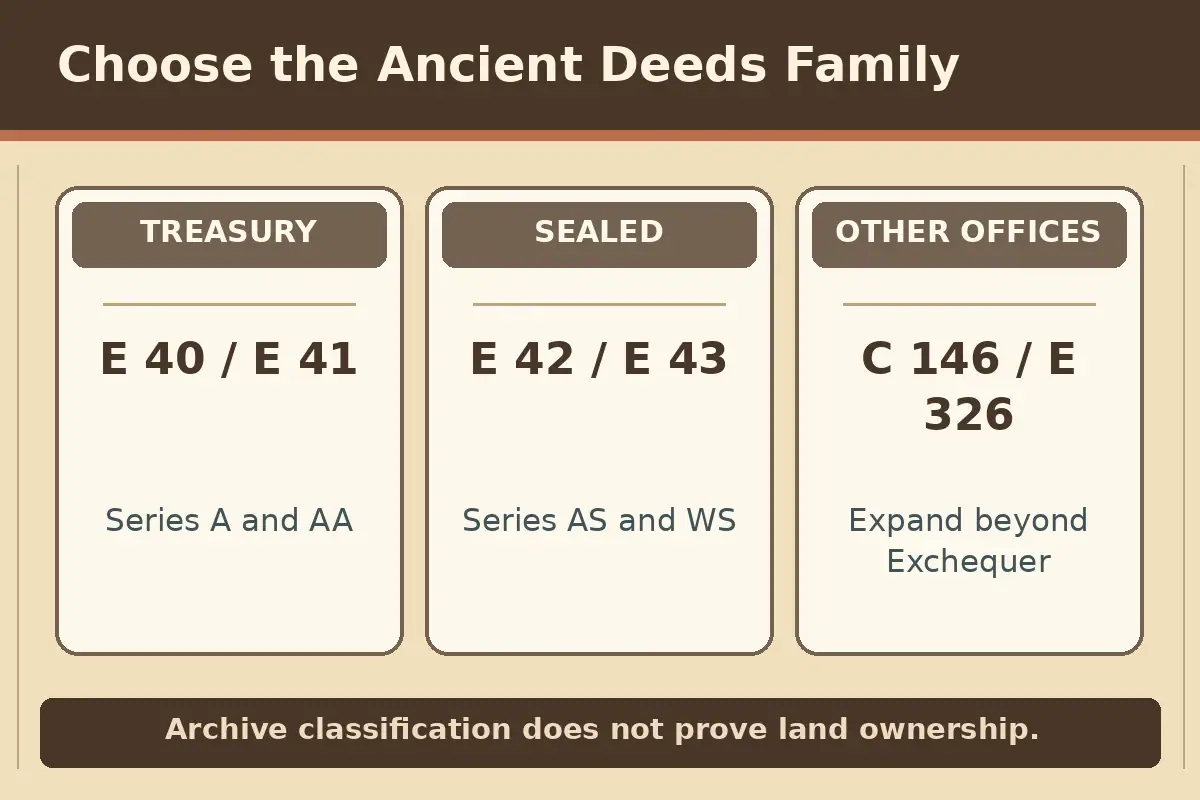
The National Archives’ land ownership and deeds guide describes ancient deeds that arrived in Crown or court custody, for example through litigation, government property or voluntary enrolment. In the nineteenth century many documents were gathered by originating office, age, physical size or seals. These classifications are not historical neighborhoods and should never be presented as a single local land registry. E 40 and its neighboring series contain deeds associated with the Exchequer Treasury of Receipt, rather than all medieval land transactions in England.
For the Exchequer group the archive identifies Ancient Deeds Series A (E 40, about 1100–1603), AA (E 41, about 1100–1642), AS (E 42, about 1100–1590) and WS (E 43, 1271–1513). Their time spans overlap, so you cannot choose a single series using century alone. Other deeds appear in C 146–149, E 326–330 and additional departments. Begin with both place and document type. The fact that a seal is preserved may help explain why a document ended up in an adjacent series; it does not create a separate legal jurisdiction.
Search Names and Places Across Several Series
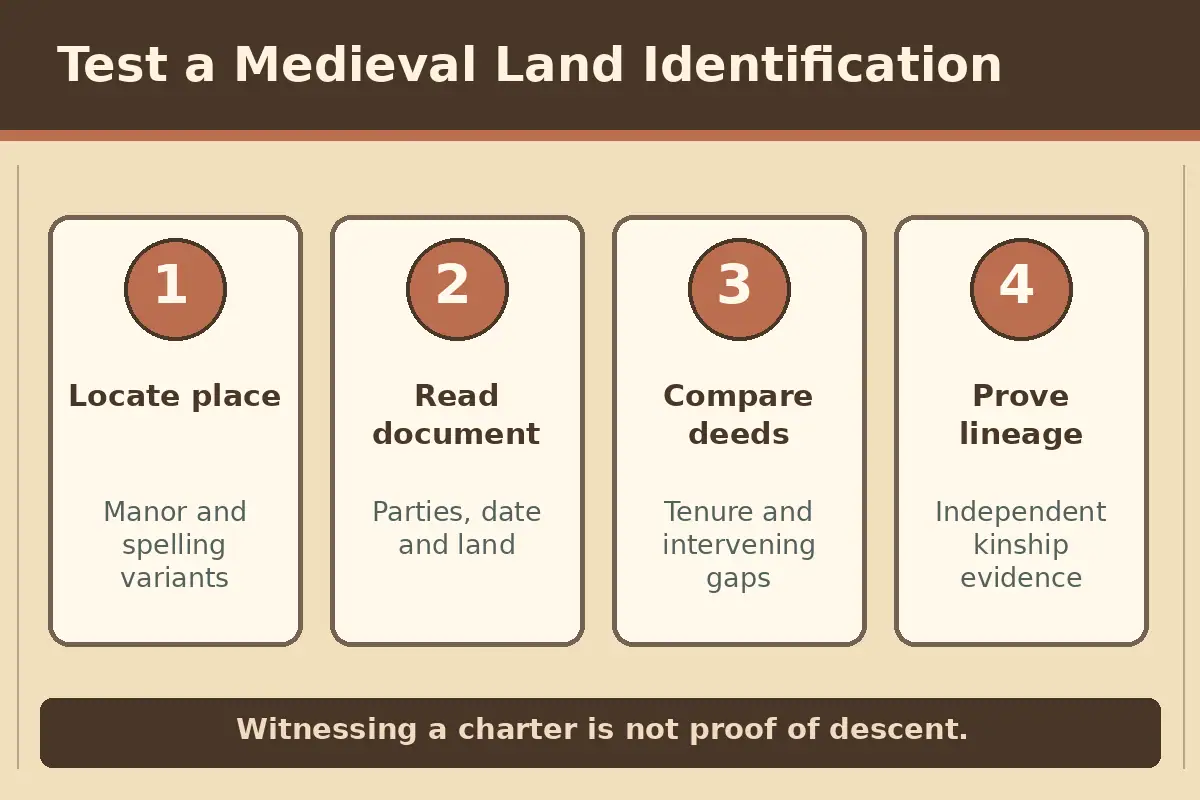
Identify a historic manor, parish, village or estate name and its variants before searching Discovery. A place-name search with the word “deed,” narrowed by a plausible period, can locate useful catalogue descriptions. Search within E 40, E 41 and E 42 when relevant, then expand to other ancient-deed series if an expected transaction is missing. Historical indexing varies: some entries emphasize the main parties, others the parcel or an earlier owner. Search both Latinized and vernacular spellings where supported by the documents, but do not invent a translation for a personal name.
Save the complete archival piece reference for each candidate, along with record date, described transaction and repository. If the catalogue provides only a summary, mark the deed as uninspected until the manuscript or authorized image is read. Multiple deeds can concern the same named manor over centuries; shared place names do not demonstrate a chain of inheritance. A modern county boundary may not reflect medieval administrative geography. Record whether the place refers to a residence, landholding, court, lordship or property transferred rather than treating every geographical name as an address.
Identify Grantor, Grantee, Witnesses and Land
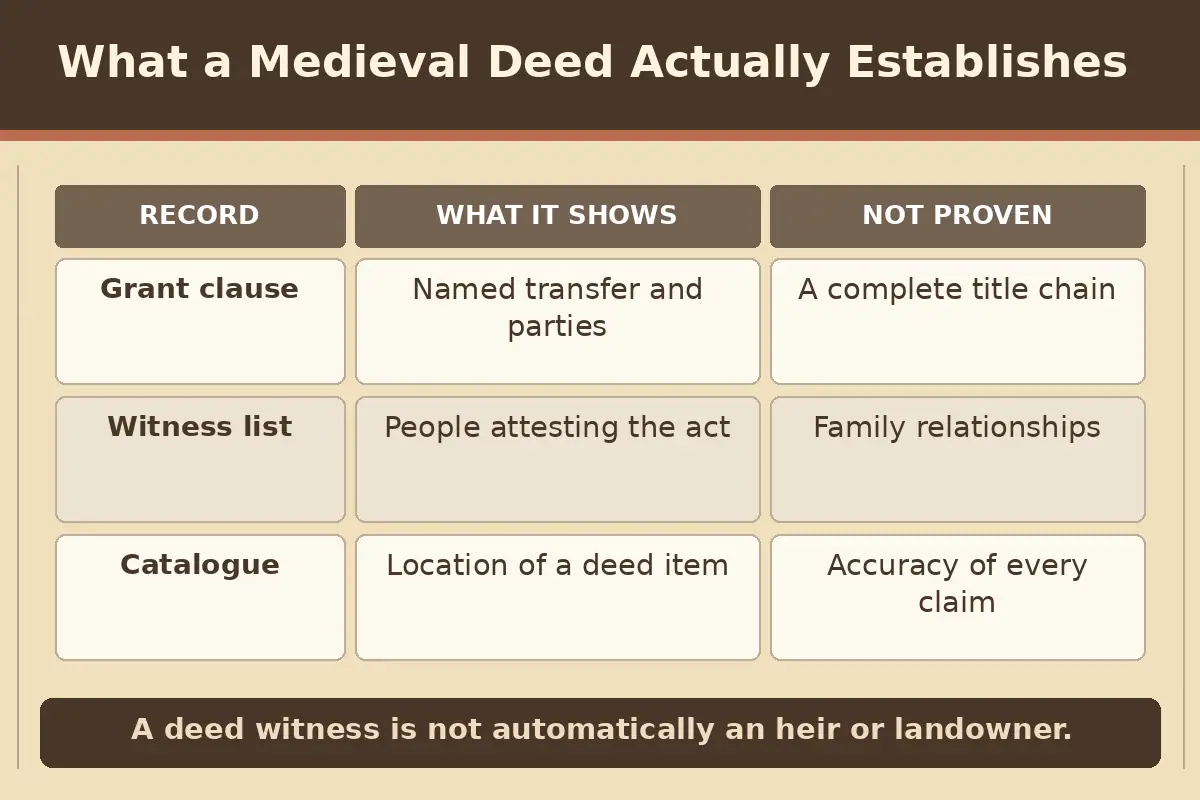
When reading an original deed, distinguish the person giving or transferring an interest from the person receiving it. Note the estate or property described, any annual rent, service, conditions, dates and named witnesses, using the original wording where readable. A person who witnesses a transaction may be a local associate, officer or unrelated neighbor. A grantor’s family relationship may be explicitly stated, but the absence of a relationship formula does not license one to be supplied from a family tree. Do not label every surnamed witness an heir.
The TNA guide to religious houses and their lands explains why deed series inherited after monastic dissolution are especially significant and why one must search outside a single series. Religious institutions, tenants and lay patrons can feature together in the same conveyance. A grant to a religious house documents a legal instrument and its parties, not necessarily a birth connection between the lay names appearing. Be careful with Latin case endings, abbreviated religious titles and regnal years; a calendar-date conversion should be cited rather than assumed.
Distinguish an Original Deed From an Enrolled Copy
A loose charter in an Ancient Deeds series is different from a deed copied or enrolled in a court record. The National Archives’ land guide directs researchers separately to enrolment and registration records. An enrolled transaction may use a dispute or court procedure, sometimes fictitious, as a device for recording the transfer. Neither form is a universal modern title certificate. Confirm which document class you hold before naming it “the property deed” in a citation. A seal attached to a charter supports its physical documentary form; authentication still requires proper analysis.
Build a transaction ledger with three columns for the action described, the date and the parties’ stated roles. Then maintain a second ledger for physical provenance: archive series, folio or piece and why that office held the document. These are distinct questions. Even several deeds for the same place can leave long gaps, overlapping interests, tenancies and rights that cannot be reduced to a single straight line of owners. Do not interpret an ancient rent or service clause using modern freehold assumptions without appropriate legal context.
Link a Medieval Name to a Family Cautiously
Medieval records often repeat common forenames, use patronymics, alias forms and names taken from places. Check contemporaneous witnesses, occupations, tenures, neighboring estates and repeated transactions to separate namesakes. A reference to “son of” or “widow of” is valuable original wording, but a corresponding relationship still needs testing against the date and surrounding documentary evidence. A single deed mentioning William of a village does not establish which later William in a genealogy is his descendant. Preserve competing identities rather than combining them to fill a gap.
A place-name crosswalk should record original and current spellings, historic jurisdiction, approximate extent and every source where the land can be located. A boundary description may mention hedges, streams or neighbors whose locations have changed. Maps can help interpret a geography but cannot prove a legal line of descent. If the records appear to contradict one another, check whether they describe different parcels or different kinds of tenure. Only after these distinctions are resolved should you consider a continuous ownership hypothesis.
More Records and Archives Guides
How We Research Ancient Deed Evidence
We start with the historical property question and relevant date, search the artificial deed series and their neighboring collections, then record the full piece reference and original wording of parties, land and conditions. We use a role table to distinguish grantor, grantee, witness, tenant and institution. Every citation identifies whether the original was examined or merely located through Discovery. A separate title-chain column remains explicitly blank where an intervening transaction has not been found.
The National Archives guides on deeds and religious land provide a supported starting framework; they do not establish the ownership of a particular family without the original instruments. We avoid claiming that a surviving deed represents every land transaction or that a name establishes kinship. Historical terms are interpreted in context, and conflicting dates remain visible until resolved. For editorial disclosure consult GenHis affiliate disclosure. No land-lookup service or commercial relationship is implied.
No. It is one artificial archive series among many from different offices and collections.
They are arranged by documentary origin and later archival classification, not consecutive centuries.
No. The recorded role is witness; kinship needs separate evidence.
No. Interpret the instrument’s transaction and type of interest before asserting title.
Yes, but confirm identity through place, time, roles and independent records rather than surname alone.