
Medieval English Pipe Rolls E 372 can answer a precise archival question, but it must be read for the purpose for which the office created the record. The practical answer is to identify the relevant series and custodian, select the original item and its dates, then separate the explicit entry from every unverified biographical inference. This guide gives a source-specific search route and the evidence limits that prevent false family-history conclusions.
Use a Royal Account to Answer a Financial Question
A pipe roll is an Exchequer audit record of money accounted for in relation to the Crown, not a village census and not a deed register. The earliest surviving roll covers the financial year 1129–1130; a nearly continuous sequence exists from 1155. Entries can name sheriffs, officials, debtors, tenants and recipients of royal expenditure, making the series valuable for a documented medieval family and locality. Yet a named payment does not automatically establish ownership or kinship.
State the precise question: was a named person charged a debt, paying a fine, receiving royal alms or serving as an official? Start with a securely evidenced county and historical date. A family pedigree assembled centuries later is not itself proof that a matching Latinized name belongs to the same person. The question should be one administrative act, not an attempt to find every person of the surname in the roll.
Find E 372 by Regnal Year and County
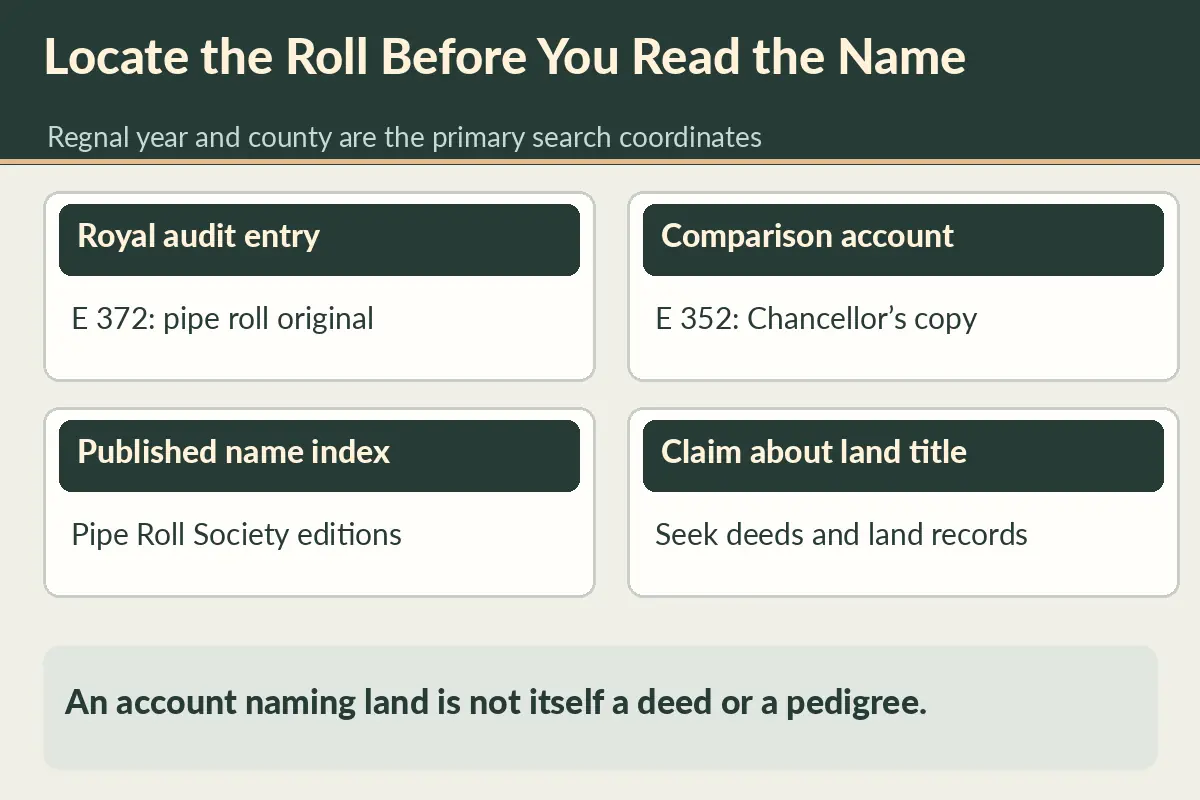
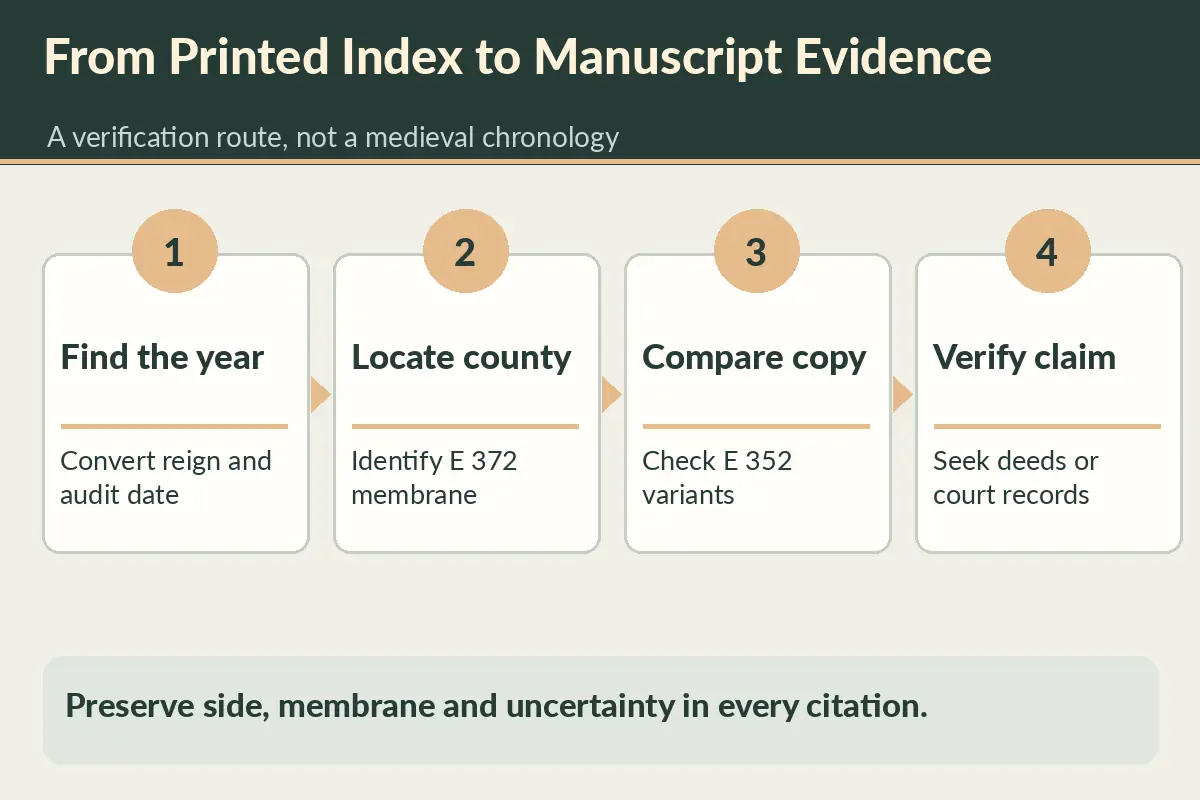
The original pipe rolls are preserved in E 372, and largely parallel Chancellor’s copies in E 352. The archive’s guide warns that original series and printed editions require different navigation. Search by monarch and regnal year, then county account and the relevant membrane. Regnal years do not necessarily align with modern calendar years, so preserve the original heading and convert dates cautiously.
Discover catalogue entries for the relevant piece and record how it was selected. Many earlier editions published by the Pipe Roll Society include useful name indexes and translations or expansions, but a printed extract is not the same as reading the entire roll. Check spelling, omissions and the surrounding county account when the identity decision matters. Use the published reference to locate manuscript wording rather than treating an editorial index as primary proof.
Read the Physical Roll Without Losing Place
A pipe roll was built from sewn parchment membranes or rotuli; both faces and backs (dorse) could be used. A citation to a piece without the membrane and side may be difficult to reconstruct. If you use a modern image or transcription, capture the named county, year, membrane, face/dorse and line context. A name may recur in both arrears and later debt adjustments, sometimes copied forward rather than newly assessed.
Do not count a debt repeated across several financial years as independent evidence of multiple loans or separate properties. Keep a record of the wording, amount, currency and whether the amount is newly imposed, carried forward, collected or discharged. The account structure often matters more than a standalone translation of the person’s name.
Distinguish Debt, Fine, Rent, and Payment
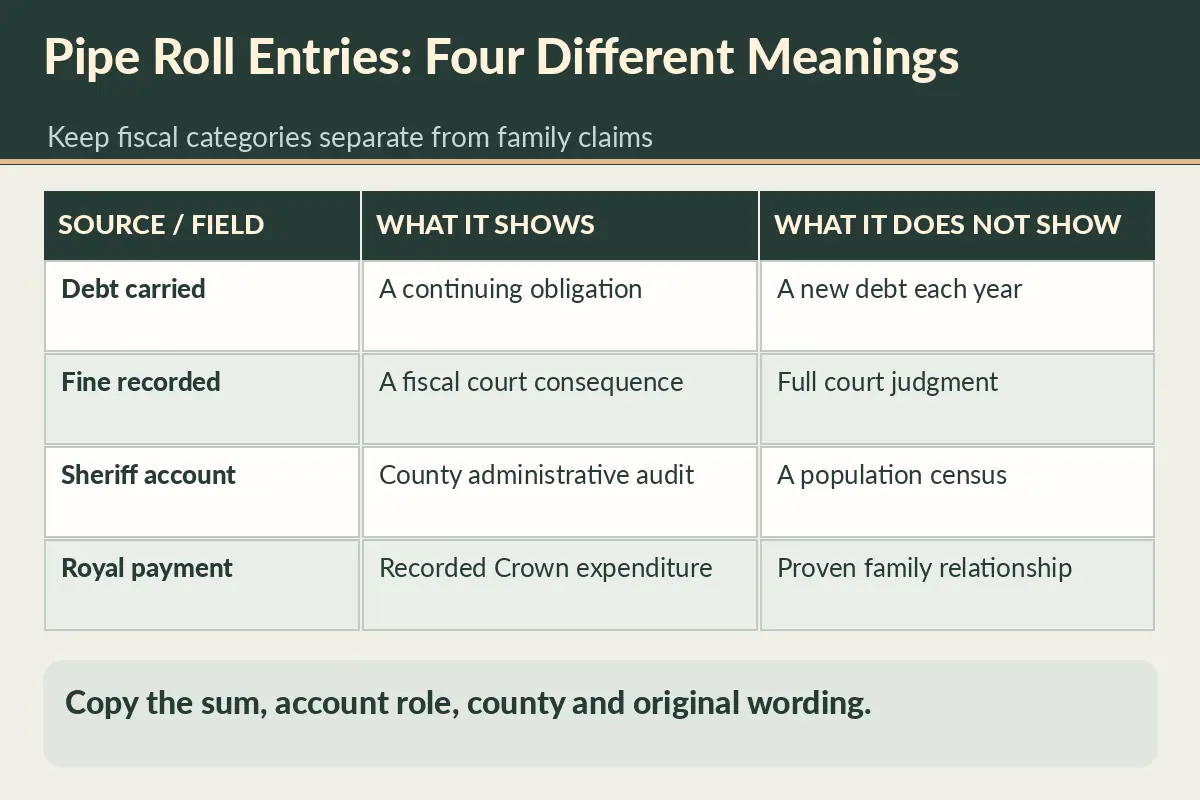
The rolls record payments to the Crown, unpaid obligations, royal spending, judicial penalties, land rents and other fiscal acts. For genealogy, a name on a line may identify a debtor or someone making payment on another’s behalf. Terms of liability, office or tenure can be technical and differ by century. A fine in an Exchequer account is not necessarily a criminal conviction, and an entry naming land is not automatically a freehold deed.
Set up separate columns for person, role in the accounting, sum, place, time and the exact Latin wording. If the roll records money for a royal manor, identify whether it is revenue due, a fee, a deduction or a crown grant. Consult deed, inquisition or manorial sources for landholding, where available, before claiming that the family owned or occupied the property.
Check the Duplicate in E 352 When Wording Is Unclear
The National Archives explains that two copies of the audit were generally made. The Chancellor’s rolls in E 352 are largely duplicative of E 372 but can contain minor and sometimes substantial differences. Treat the second roll as a comparison copy from an associated administrative process, not necessarily as an independent eyewitness account. Variants may help resolve a place name, figure or abbreviation.
Record each series and its precise membrane citation side by side. If one roll omits a clause, describe the difference without silently repairing the manuscript. A transcription may normalize medieval spelling while the original retains a form useful for identity testing. Keep the original letters separate from editorial expansion and English translation.
Avoid Confusing Medieval Place Names and Titles
County boundaries, shrieval jurisdictions, legal districts and place names changed. A person described in the account for one county might be liable for an obligation tied to land or business elsewhere. Likewise, “de” before a name may be a locative designation rather than reliable proof of a modern hereditary surname. Compare contemporary references to determine whether similar names represent the same person.
Build a chronological identity table spanning any repeated notices. Note office title, associates, financial obligation, county and distinctive property description, not just name similarity. A reported relationship needs a source that actually states it. Avoid turning “son of” from a later compiled pedigree into a phrase purportedly found in the medieval Exchequer record.
Use Later Rolls and Related Series Carefully
Pipe rolls continued long after 1300, but the contents and accounting practices changed. Elements such as farms, persistent debts and foreign accounts could be handled differently over time, with relevant material also found in E 364 and associated Exchequer records. The archive’s medieval guide describes such shifts. A person missing from a later pipe roll may have ceased to owe money, changed accounting treatment or simply fallen outside the surviving coverage.
For an allegation about a judicial fine, inspect the relevant court record and identify the event distinct from the Exchequer transaction. For a royal grant, seek the relevant Chancery enrolment. For a vessel or customs payment, use appropriate maritime or customs accounts. Each step connects a fiscal reference to its administrative origin without assuming that the summary account describes the entire incident.
Write the Finding as a Narrow, Testable Claim
A defensible result names the audited year, E 372 piece, county, membrane, line and the original or translated debt phrase. It states whether money was owed, paid, carried forward or recorded as royal spending. Record if you examined a printed edition only, a catalogue description or an original-image reproduction; these do not carry identical citation weight.
For a hypothetical “Robert of Elmsford,” an amount recorded against him does not prove that he inherited Elmsford manor. Seek independent contemporary land and relationship evidence. If the identity is uncertain, preserve alternative candidates and specify the next record that could decide the matter. Medieval evidence is strongest when its legal and administrative category is respected.
How We Research the Original Series and Source Limits
Our research begins with the custodian’s official guidance and the related archival description. We check series titles, date ranges, administrative purpose, historical jurisdictions and the named person’s role before converting a finding aid into a claim. An online index, a digitized item and a scholarly transcription are described separately. When two names may refer to different people, we preserve both candidates, compare original documents and record which independent detail could settle the question. These diagrams show research logic, not facsimiles of authentic documents.
More Records and Archives Guides
Citations, Access Limits, and Affiliate Disclosure
The official archival sources establish the following specific scope: E 372 original pipe rolls and parallel E 352 Chancellor rolls, earliest 1129–1130, near-continuous from 1155; Pipe rolls Exchequer financial audits do not capture all Crown income and expense. Check individual item access and current copying rules; a catalogue entry is not a promise that every leaf is digitized or name searchable. Record the repository, series, item, date, folio or page, original headings, and exact retrieval path. Log missing results by the years and places actually searched rather than inferring that no event occurred. See the site’s affiliate disclosure before using commercial links.
No. They record royal financial accounting, not comprehensive populations.
The originals are in E 372; corresponding Chancellor’s rolls are in E 352.
The earliest surviving roll is for 1129–1130, with a nearly continuous run from 1155.
No. Determine the specific fiscal role and seek separate title evidence.
They are valuable finding aids, but significant claims should be checked against the roll and its context.