
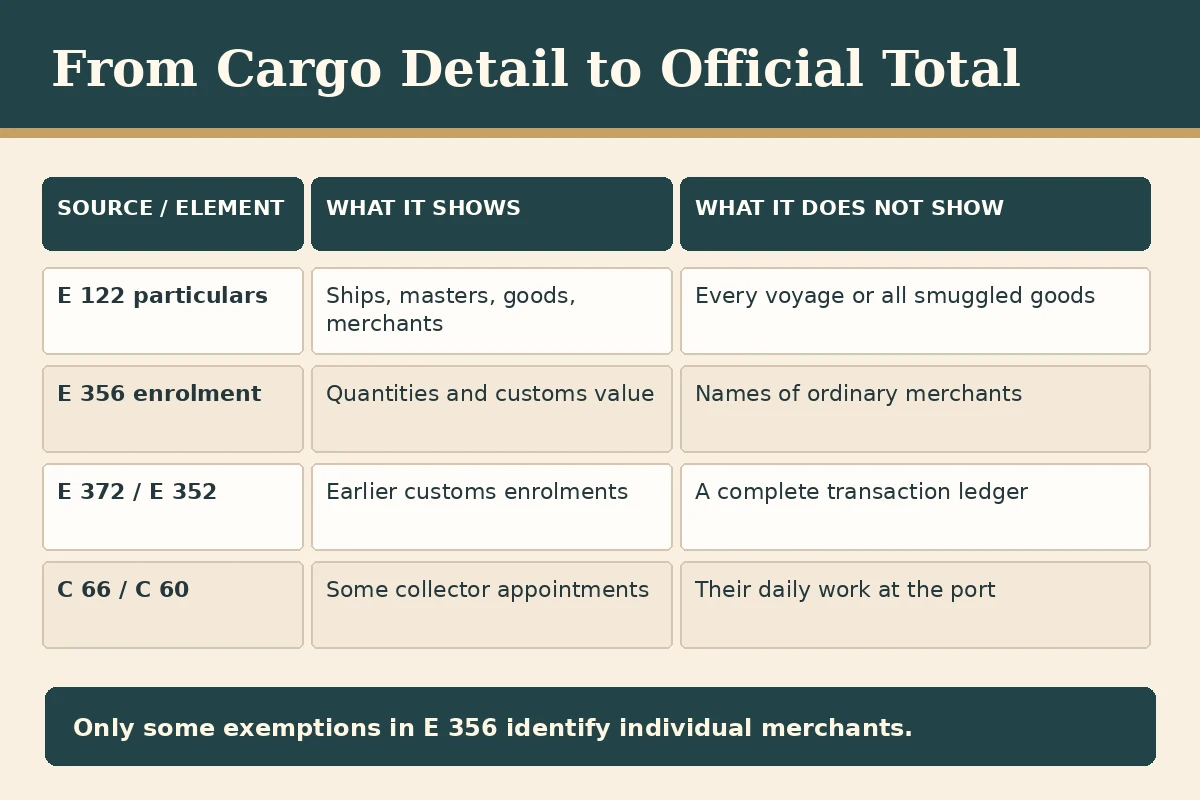
Enrolled customs accounts in E 356 document customs revenue and trade quantities, not a complete list of everyone who shipped goods through a medieval English port. The National Archives explains that from 1323 the Exchequer enrolled customs accounts on special foreign rolls in E 356. Their totals can identify quantities imported or exported and the value of customs assessed. Individual merchants appear only in particular circumstances, such as an exemption. For a merchant biography, an E 356 figure is a lead to other evidence, not proof of a personal voyage.
The central research mistake is to read every level of the accounting process as if it contained identical details. The port officer’s particulars, a summarized account, and the eventual Exchequer enrolment served different purposes. Before 1323, customs entries were enrolled on pipe rolls E 372 and Chancellor’s rolls E 352 instead. Set the account period, port and duty before opening a catalogue search. Otherwise the correct historical person can disappear behind a modern term or a record made in another accounting series.
Route the account by date and duty type
First identify the approximate year and the port. Then establish which duty you are researching: wool customs, petty custom, subsidy, tunnage, poundage or a locally levied due. These categories did not all begin at the same time or cover the same goods. The National Archives’ customs guide describes changes from the late thirteenth to fifteenth centuries. A tax label appearing in a secondary history should be checked against the language of the primary account before being used as a keyword.
For accounts enrolled before 1323, search E 372 and where appropriate its Chancellor’s roll counterpart E 352. For the later medieval period, start with E 356, remembering that related summary material can also occur in E 364 and other Exchequer series. Do not infer an exact fiscal date from a catalogue range alone. The accounting period, date of arrival of goods and day the final account was audited can differ. Record the terms written on the roll before converting a regnal-year reference.
A port may have several nearby customs jurisdictions or a trading connection with another landing place. Look for historic spellings of the port and the name of any customs collector. A county place index may help, but a search restricted to a modern town boundary can overlook an offshore anchorage or a subsidiary creek. Keep both the original place-name and your modern geographical interpretation in the research notes.

Distinguish particulars, accounting and enrolment
The detailed customs books or rolls were kept by port officials and usually recorded ships, masters, merchants, goods and amounts liable for duty. Some survive as E 122 particulars of customs accounts. After the audit, an accounting statement was prepared and then enrolled by the Exchequer. E 356 mostly preserves the enrolled level, where sums and quantities were more important than individual shippers. A missing merchant’s name in E 356 tells little about whether that person traded at the port.
The guide specifically warns that merchants are normally unnamed in E 356 unless exempt from a payment in a particular instance. If a name appears, copy why it was included and resist turning the exception into a complete career. An exempt merchant named once does not prove every cargo he handled or whether he was on a ship. If a detailed E 122 account survives for that port and year, compare the cargo and person fields with the E 356 totals cautiously.
Printed editions of port records can offer excellent indexes, but an editor may abbreviate commodity names or silently normalize currencies. Cite both the publication and the E-series source when possible. If you read only a catalogue description, do not present its summary as a transcription. Specify the level of evidence: a named original entry, a summarized account, or a modern editorial reconstruction. The distinction becomes important when identifying two merchants who share a surname.
Explain what a customs payment actually means
An entry for wool customs can establish that a specified quantity entered the official revenue accounting system. It does not automatically identify who owned all the wool, who produced it, or who physically transported it. The merchant named in a detailed record might have shipped goods for another owner. The ship’s master may have no connection to the merchant’s family. Separate the roles “merchant,” “master,” “collector,” and “person exempted” in your worksheet.
A customs account is not a complete traffic census. The National Archives warns that only a sample of the detailed books survived, while smuggling and evasion also limit what official records could capture. Port totals therefore should not be converted into precise claims about all trade volume or the number of emigrants. An account lacking a named cargo cannot establish that a vessel did not sail. It establishes only that the inspected accounting material did not document it in the way you expected.
If a collection records several duties, do not sum their monetary values without proving that they cover distinct transactions. More than one tax could apply to a shipment and different account formats may aggregate goods differently. Some figures represent outstanding obligations rather than cash received. Reconcile the duties and periods before comparing a port with another place. The resulting research note should state exactly which tax, period, commodity and official account produced each number.
Verify a merchant or customs official independently
For a possible merchant ancestor, search E 122 particulars, local borough accounts, deeds or other commercial documents for a named transaction. For a customs collector, check appointments recorded on patent rolls C 66 or fine rolls C 60 where relevant. An appointment establishes an official designation, not uninterrupted service or residence near the port. Keep occupational roles, dates and places on a separate timeline and seek a second distinctive identifier before joining scattered mentions into one person.
A practical example is a fictional wool exporter named John of the Quay. E 356 might preserve a quantity of taxed wool in a given port and fiscal year but no John. A particular account in E 122 might name John as the merchant for one shipment. A local deed might then identify a man of that name in the parish. Only direct connections support the claim that these records concern one individual; spelling similarity by itself is not enough.
End the search with a transparent ledger: port and jurisdiction, period, duty, series and item, original wording, persons explicitly named, and assertions that remain untested. Note whether a record was viewed or only located. When no relevant account survives, state which dates and finding aids were inspected rather than saying the person never traded. The chief value of E 356 is financial context; individual identity must be established on its own evidence.

More Records and Archives Guides
How We Research E 356 Records
We use The National Archives’ medieval customs guide for the E 356/E 122 division, its pipe rolls guide for earlier E 372/E 352, and its port books guide to distinguish later customs evidence. These references describe record systems, not any unsupplied merchant or shipment.
Our method treats original particulars, summary accounts, enrolments and later printed editions as separate evidence layers. We avoid interpreting an unlisted person as an absent trader and never count a ledger total as a passenger manifest. The affiliate disclosure describes editorial policy; the archive links here are research references, not an implied paid partnership.
The Enrolled Customs’ Accounts, including customs accounts placed on special foreign rolls from 1323.
Look in E 372 pipe rolls and E 352 Chancellor’s rolls for the pre-1323 period.
No. It normally records quantities and customs value, with individuals named only in some exceptional cases.
Surviving particulars in E 122 are more likely to give ship, master, merchant and cargo detail.
No. Survival is incomplete, and noncompliance and different accounting routes limit negative conclusions.