
The Privy Council registers in PC 2 record government business rather than a complete narrative of what happened after a decision. Their surviving sequence begins in 1540 and extends into the twentieth century. An entry may summarize proceedings, reproduce an order, mention a proclamation or report a committee matter. For genealogists and local historians, that can locate an individual or community in official business. It cannot, without more evidence, prove that a requested favor was granted, that an instruction reached its recipient or that a change occurred in a parish.
Begin with a precise proposition: “the Council considered this petition,” “the Council directed an official to act,” or “the authority carried out an instruction.” Those are different claims. The National Archives distinguishes the PC 2 registers from correspondence in PC 1 and supplementary minutes in PC 4. A name in an index points to an entry, not to a complete case file. Record dates as given and treat an old calendar or printed digest as a finding aid until you check the underlying entry.
Choose a reign, date and subject before searching
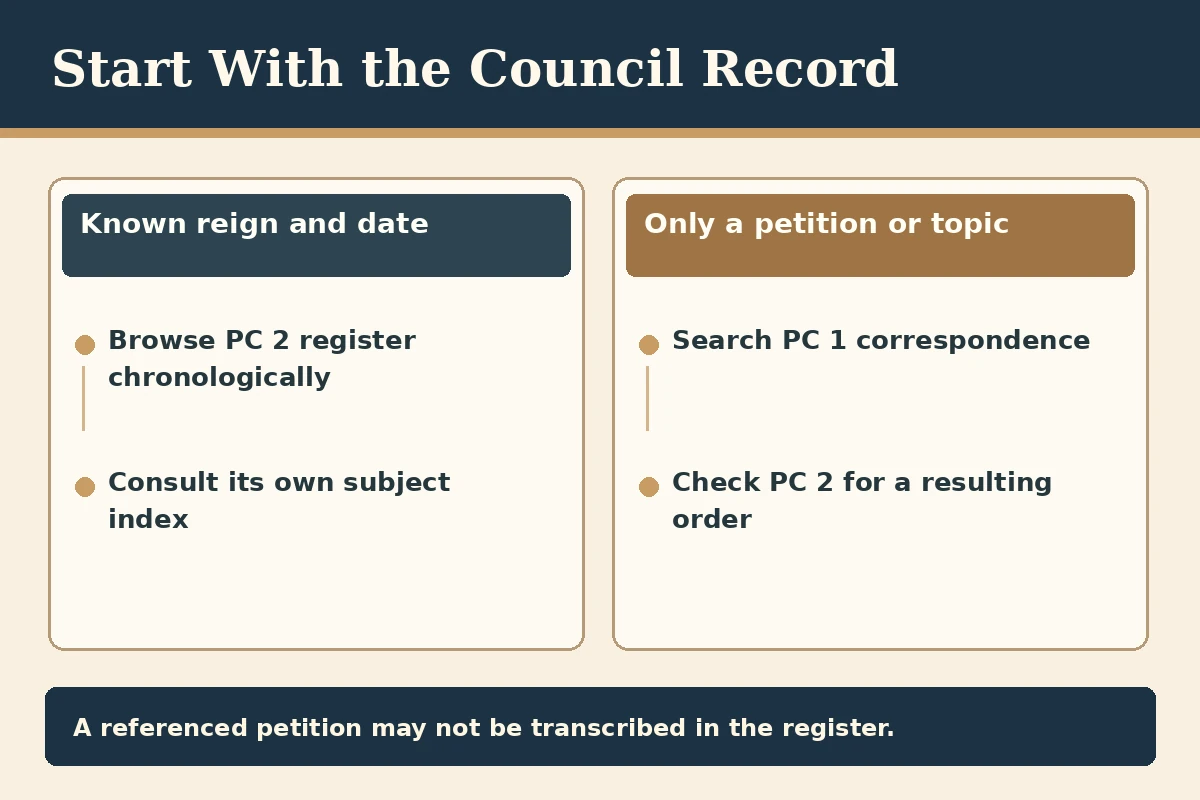
PC 2 is arranged mainly by reign and date, and individual registers usually provide subject indexes. If you know a royal reign and an approximate event date, begin with the applicable volume, then check the subject index and nearby entries. Do not assume an index term is the language used by the petitioner. Government topics may be filed under an institution, locality or administrative subject instead of a modern surname. Write down the exact register reference, folio or page and the date used by the clerk.
If you possess only a reported complaint or a petition copy, start by searching Privy Council correspondence in PC 1, then trace any referenced meeting or decision into PC 2. A petition might be referred to in a register without its full wording being copied. Searching the full petition text for a phrase that never entered the register can therefore produce a misleading negative result. Compare the petitioner, place and subject across records; similar complaints could have generated several decisions over time.
The registers have gaps. The National Archives identifies missing spans including June 1582 to February 1586 and January 1602 to May 1613. It also notes that civil-war-era registers are blank for part of 1645–1649. In a missing period, search associated state papers or other collections where appropriate, but mark any reconstruction as indirect. A gap in PC 2 is not evidence that the Council was inactive or that the supposed petitioner never existed.
Separate a discussion from a binding direction
Identify the entry’s documentary verb before summarizing it. A matter “referred” to officials is not an approved request. A decision “ordered” is evidence of a direction, but delivery, enforcement and compliance are separate issues. An entry may mention a petition, committee report, proclamation or outgoing letter, and these have distinct functions. Quote the smallest decisive phrase in your notes and explain whether it records a recommendation, a procedural step or a settled instruction.
PC 4 contains supplementary minutes from 1670 to 1928, including business that did not necessarily produce an order or further action. For the applicable period, comparing a PC 4 minute with PC 2 can reveal a procedural stage absent from a simple index entry. Do not draw a straight arrow from PC 4 to PC 2 unless a date or text establishes the connection. The official series are related but not interchangeable chronological installments.
For older registers, pay attention to the transcription layer. A scholarly edition or the published Acts of the Privy Council may help identify an entry, but abbreviated text can hide qualifying words. The National Archives lists seventeenth-century transcripts and printed finding aids. Note whether you read the full original, a facsimile, an edition or only a searchable catalogue summary. These are different levels of direct evidence.

Test whether an order changed anything outside London
An order to a local officer provides a useful lead for county, borough, port or parish records. The receiving office might have maintained letters, accounts, minutes or court proceedings documenting what occurred. If the order concerned a license, search for subsequent exercise of the licensed activity; if it directed a payment, look for disbursement or receipt. The outcome should be described only as strongly as the later source permits. An order issued at Whitehall is not a receipt from the field.
Research implementation by named authority rather than relying on identical surnames. Record the office and jurisdiction of the official, then check whether the same office handled the matter in the relevant year. A Council minute about a local dispute may involve a town corporation, customs officer or military authority. Those repositories could be geographically distant from the petitioner’s home, and an apparent name match could represent a completely different official.
Consider a hypothetical request for permission to conduct a trade. PC 1 might preserve a petitioner’s account of hardship; PC 2 might record a license; a town minute could indicate whether the local body recognized it. Only the three together can support the sequence. If the local record is missing, state that no implementation evidence was found in the named set of documents. Do not substitute the Council’s intention for local performance.
Record limits and preserve competing explanations
For every useful entry, maintain columns for the exact archival reference, meeting date, documentary role, person or place named, literal wording and the proposition supported. Add a second column for what it does not establish. This prevents a single dramatic mention from becoming an unsupported family story. If a later account describes the result, cite it independently and evaluate whether its author had access to the original action or simply repeated an older assertion.
An apparent missing entry calls for a coverage audit. Check the reign, the calendar system, variant place spellings, the volume’s index and the published edition’s scope. Consider an alternative administrative series when the responsibility lay elsewhere. The Council’s correspondence, indexes and registers have suffered historical loss and dispersal. A narrow negative search does not justify the statement that the government never considered the issue.
When finishing a family or locality note, distinguish the original governmental phrase from your interpretation in plain English. Specify whether the source names an individual, an officeholder, an institution or a group. A committee list is not proof of every member’s attendance. A licensed activity is not proof of a lifetime career. The durable result is a transparent chain of individual propositions and the records that actually support them.

More Records and Archives Guides
How We Research PC 2 Records
This guide is based on The National Archives’ Privy Council research guide and its early modern political history overview. A published PC 2 document example shows how a particular entry may be cited. These sources establish the series and research method, not the facts of any unsupplied family case.
We treat a register minute, a petition letter, an order and evidence of compliance as different sources. When possible, compare a full image or transcript with the catalogue record, record gaps in survival, and leave unresolved outcomes unresolved. The affiliate disclosure explains the site’s editorial transparency; this article makes no claim about an unverified paid archive service.
The earliest surviving Privy Council registers date from 1540, although the Council kept records earlier.
Often not. An entry may only mention a petition; look for related correspondence in PC 1.
Supplementary minutes from 1670 to 1928, sometimes for business that never became an order.
No. Search the receiving authority’s records for implementation or response.
No. Search gaps, indexes, variants and related series before framing a limited negative conclusion.