
Irish dog licence books can be a useful address-level source when conventional census or land records leave a gap. Start with a historical Petty Sessions district and approximate date, then consult the National Archives of Ireland’s CS/PS/2 series. The official court-records guide confirms that dog licence registers record names and addresses. A licensed dog is not, however, documentary proof of owning a property or of a relationship to every person living nearby.
Place Dog Licences Within the Petty Sessions Archive
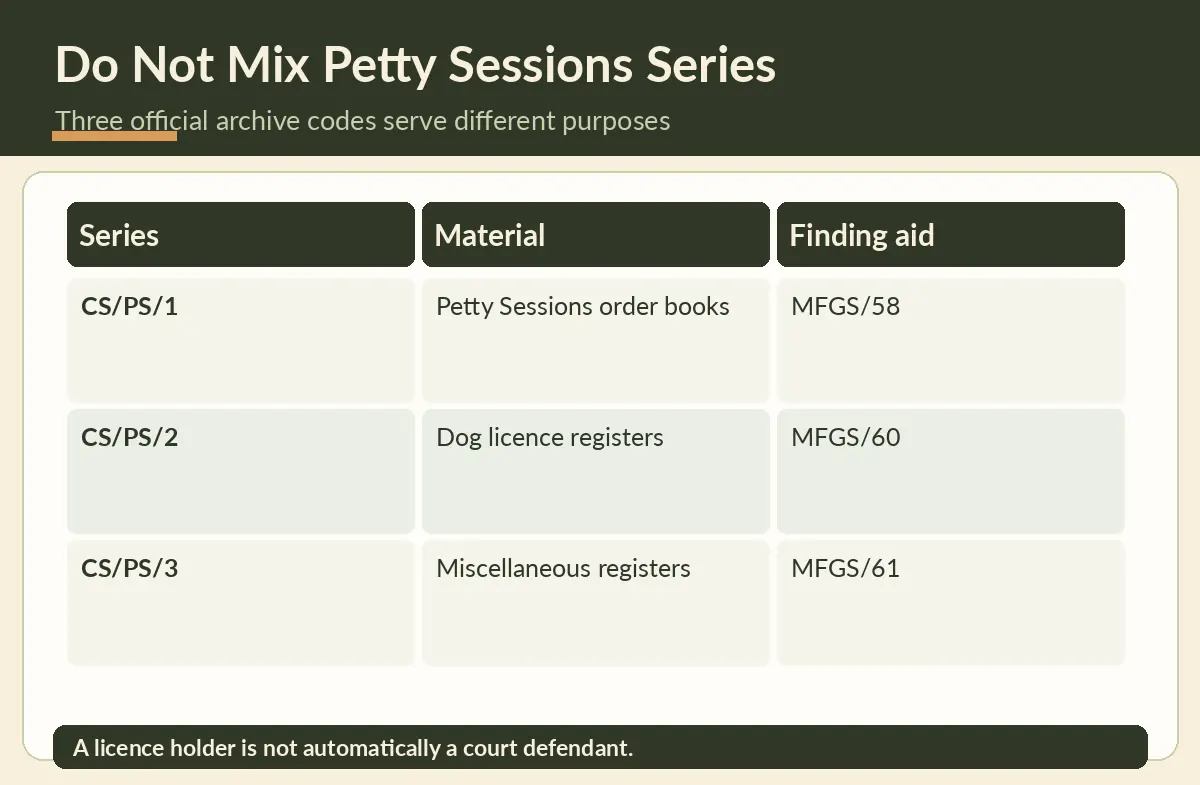
Petty Sessions courts operated as local forums whose surviving administrative material goes beyond prosecutions. The National Archives of Ireland describes more than 11,000 order-book volumes, largely dating from 1851 to 1924, with important gaps. Within this broad group, CS/PS/1 denotes order books, CS/PS/2 dog licence registers and CS/PS/3 miscellaneous records. These are separate archival series and should not be cited interchangeably.
A licence entry is an administrative record of a named person associated with a licence at a specified place and time. Its usefulness for family history comes from local names and addresses, not from making the licence holder a landowner or an animal’s lifelong keeper. Do not assume that every surviving Petty Sessions book has an identical annual sequence, and avoid projecting the broad order-book span onto every dog licence volume.
Find the Right Court District Before Searching Names
Identify the townland, village, town or address in a contemporary source, then establish the historical Petty Sessions district and court location. The Archives warns that court districts can cross county boundaries. A present-day county search alone may therefore miss the book that served an ancestor’s locality. Keep the court location distinct from the person’s residential address and the county heading in a modern index.
Draft a locality crosswalk with event date, historical parish or townland, court district, courthouse and repository reference. If your only clue is a county, search an authoritative geographical or court finding aid before picking a dog licence volume. A negative result in an adjacent court district says little about the person’s actual residence; the administrative boundary is part of the search hypothesis, not a minor convenience.

Locate CS/PS/2 and the MFGS/60 Finding Aid
The National Archives identifies CS/PS/2 as the original dog licence series and MFGS/60 as the associated microfilm finding-aid reference. The same guide gives MFGS/58 for order books and MFGS/61 for miscellaneous materials; using the wrong code can send a researcher to an unrelated record type. Search the online catalogue, then consult reading-room finding aids for books not described sufficiently online.
The finding aids may list the Archives reference, district, court location and dates. FamilySearch also offers a name-searchable Irish dog licence index and image collection, drawing an index from Findmypast; verify the original line because database coverage differs from the Archives inventory. A range in an official guide tells you where to look, not that every licence holder has been indexed by name. Record the full item or film reference, the volume’s actual dates and the page inspected. Confirm access arrangements with the custodian rather than assuming a name-search page displays complete images.
Extract Addresses Without Inventing Ownership
Transcribe the holder’s name, written address, date and any licence number or other visible field, but do not invent fields absent from the actual form. Identify the source as the dog licence register, not as a census return. The given address may be the location used for registration rather than a continuous home over several years. A short spelling variant or a name repeated in the same district can reflect separate people.
Use a comparative address timeline. Place a licence-holder observation next to a separately dated census, valuation, directory, civil entry or parish record. Mark what each record expressly says: the licence may associate a named person with an address; a valuation may identify an occupier or rateable interest; a deed may establish a particular legal transfer. These distinct concepts should not collapse into a single claim that the applicant owned the home.
Distinguish the Licence Series From Court Order Books
A reader may encounter a Petty Sessions order book concerning a dog-related offense and assume it is the same as the licensing register. It is not. CS/PS/1 records court cases, parties and outcomes as entered by the court, while CS/PS/2 serves a licensing function. A fine or complaint would require its own order-book reference and context. You must not infer that every licensed person appeared in court as a defendant.
Conversely, a surname in a dog-related court case is not automatically the licence holder with the same name. Align court district, year, townland, recorded role and any available address. When evidence conflicts, keep the two records separate until another source tests identity. The official series descriptions make clear why the archival distinction matters.
Test a Same-Name Irish Resident Example
Imagine two hypothetical women named Mary Byrne in neighboring districts. One dog licence register associates a Mary Byrne with a townland in one court district; another record concerns a Mary Byrne in a market town across the county boundary. A baptism naming Mary Byrne as a parent does not resolve which licence entry applies. Gather husband or other household names from independent sources, compare exact addresses and dates, and preserve both candidates.
A strong result might be the same townland and a compatible household sequence across several years. Even that result is a carefully supported identity inference rather than a licence-proven family tie. The correct outcome may remain unresolved. Never treat unusual licence details as a substitute for an independent birth, marriage or household connection.
Document Gaps and Search Limits Explicitly
Irish record survival is uneven, and the National Archives describes substantial gaps in Petty Sessions holdings. Do not equate a missing book with a person failing to license a dog. Check that the district and dates are represented, then record which finding aids or volumes were inspected. If access is in person or on microfilm, note that limitation rather than implying comprehensive online name searching.
Alternate searches should answer the research question: a valuation for occupancy, a civil certificate for identity, or a directory for address may be useful. They are not replacements for a missing dog licence entry and cannot reconstruct its wording. A credible research log separates “source not found,” “book not preserved” and “book searched with no matching name.”

More Records and Archives Guides
How We Research Irish Dog Licence Evidence
We first verify the historical court district and identify the correct CS/PS/2 volume or MFGS/60 reference from the National Archives of Ireland. We then transcribe the line faithfully and test the name-and-address combination in independently dated records. This avoids converting a licensing address into proof of a household, kinship or legal title and avoids searching only a modern county boundary.
Our citation includes repository, CS/PS/2 reference, Petty Sessions district, courthouse, volume dates, page and person as written. Note any unavailable ranges and uncertain handwriting. For how we disclose any commercial research links, see our affiliate disclosure.
No. A named licence holder and address do not establish land title or even continuous residence.
The National Archives of Ireland lists them under CS/PS/2, with MFGS/60 as the related microfilm finding-aid series.
Yes. Use the historical court district and court location rather than assuming it fits modern county boundaries.
Do not assume so. The Archives describes catalogue and reading-room finding aids, with uneven coverage and access.
Compare the recorded address and date with independent census, valuation, directory or civil records before identifying a family member.