
The National Library of Ireland’s free Catholic Parish Registers site contains images of baptisms and marriages filmed from most Catholic parishes in Ireland and Northern Ireland, largely up to 1880. It is an image collection organized by parish and date, not a searchable name index. Successful research therefore begins with a plausible historic Catholic parish, a time range and a precise reading of the original register image. A baptism can identify witnesses or godparents and reported parents, but its date is not automatically the date of birth and a shared surname does not establish kinship.
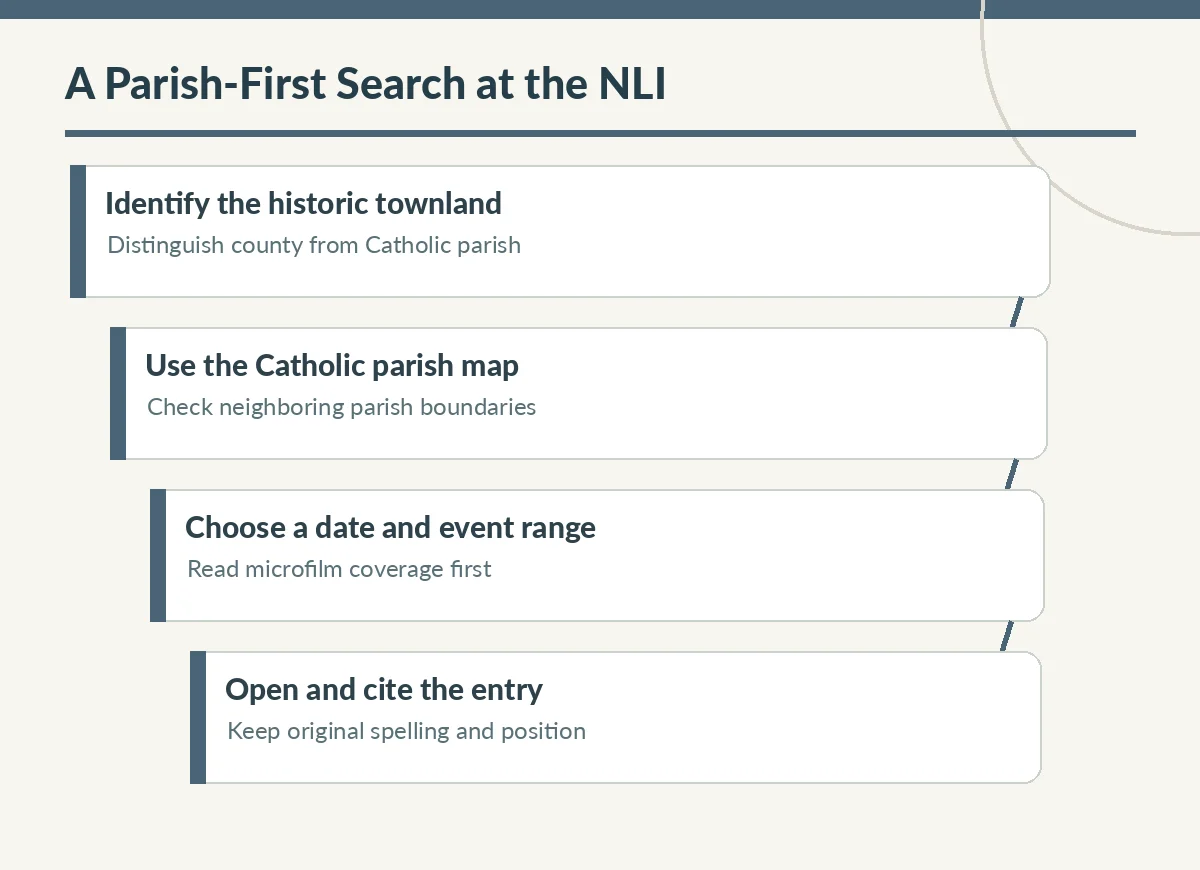
Locate the historical Catholic parish before searching a person
Use the NLI parish-name search or interactive map to select the Catholic parish, then review its register list and beginning and ending dates. Do not confuse a civil parish, Church of Ireland parish, townland or modern administrative county with the Catholic jurisdiction used by the priest. One family might live near a parish boundary and use a neighboring church. If you only know an American birthplace of ‘County Cork,’ you need a smaller locality from immigration, marriage or family records before a systematic page search is realistic. Our guide “Ontario Roman Catholic Registers, 1760–1923” covers how to find baptisms and marriages by parish.
The NLI map is designed to browse Catholic parish coverage; it does not prove that everyone residing within its outline had their sacrament in that parish. Record the parish name, diocese if supplied, register event, date span and microfilm reference before opening an image. Where the parish is a later creation or historical boundaries are uncertain, consult neighboring parishes and note alternatives explicitly. A negative result in one parish is not a countywide negative result. For a related choice, see our guide “Acadian Parish Registers, 1702–1755”.
Browse the actual baptism or marriage page by date
On a parish page, click the register or microfilm reference, open the image viewer and use the event/date filter to narrow a range. NLI explains that the filter tags are captured at page level and can differ from the general register date labels. Move across adjacent images when a page begins or ends mid-month or a priest mixed baptisms and marriages in one book. Transcribe the heading and nearby entries so you do not inadvertently attach a date at the top of a previous page to the next page’s names. For a related choice, see our guide “Danish Parish Registers”.
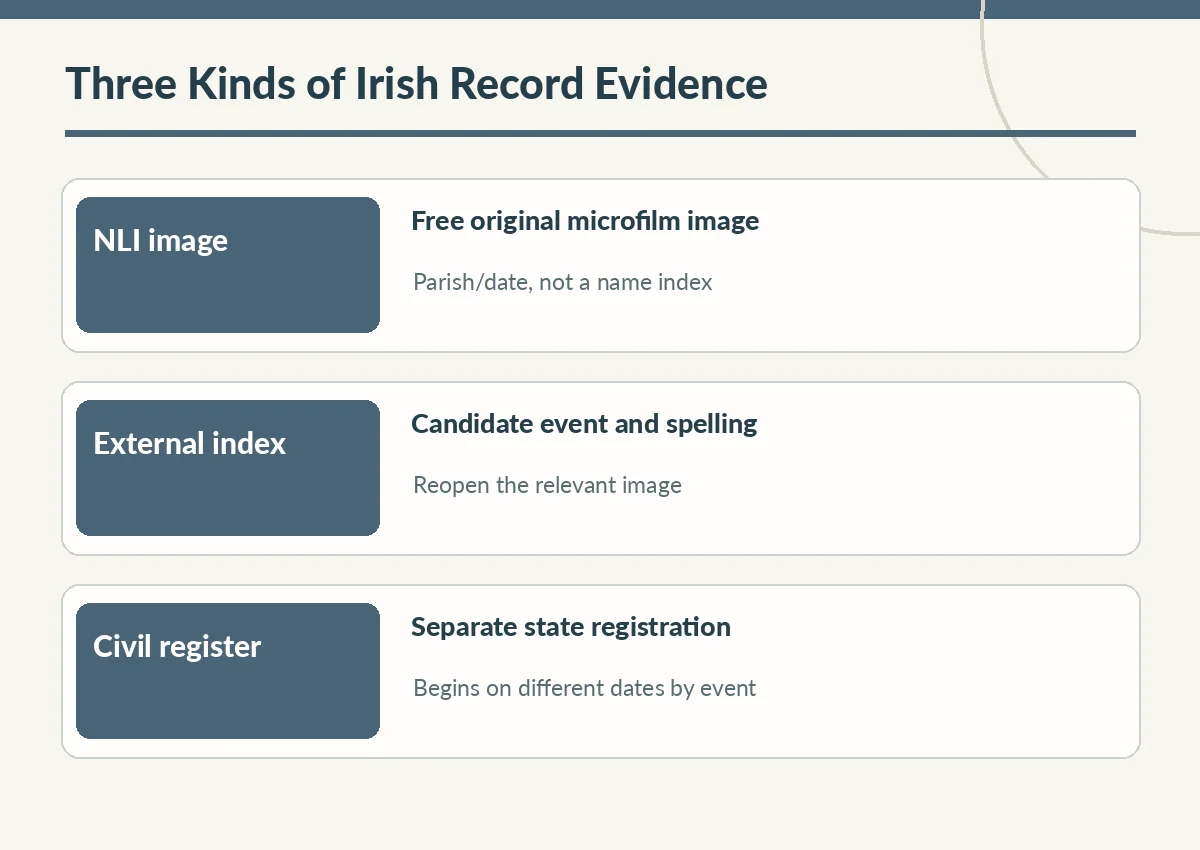
When an online index on another site suggests a year and parish, use that as a route to the NLI image, not as a substitute. NLI explicitly states it does not provide a personal name search for its images, although some external services index many registers. On the actual page, capture the first and last readable date, the entry as written, any page or film identifier and uncertainty symbols for faded letters. If an entry is absent, widen dates and neighboring registers only after recording the initial search. Our guide “County Cork Parish Registers” covers a related question.
Separate baptism date from a documented birth date
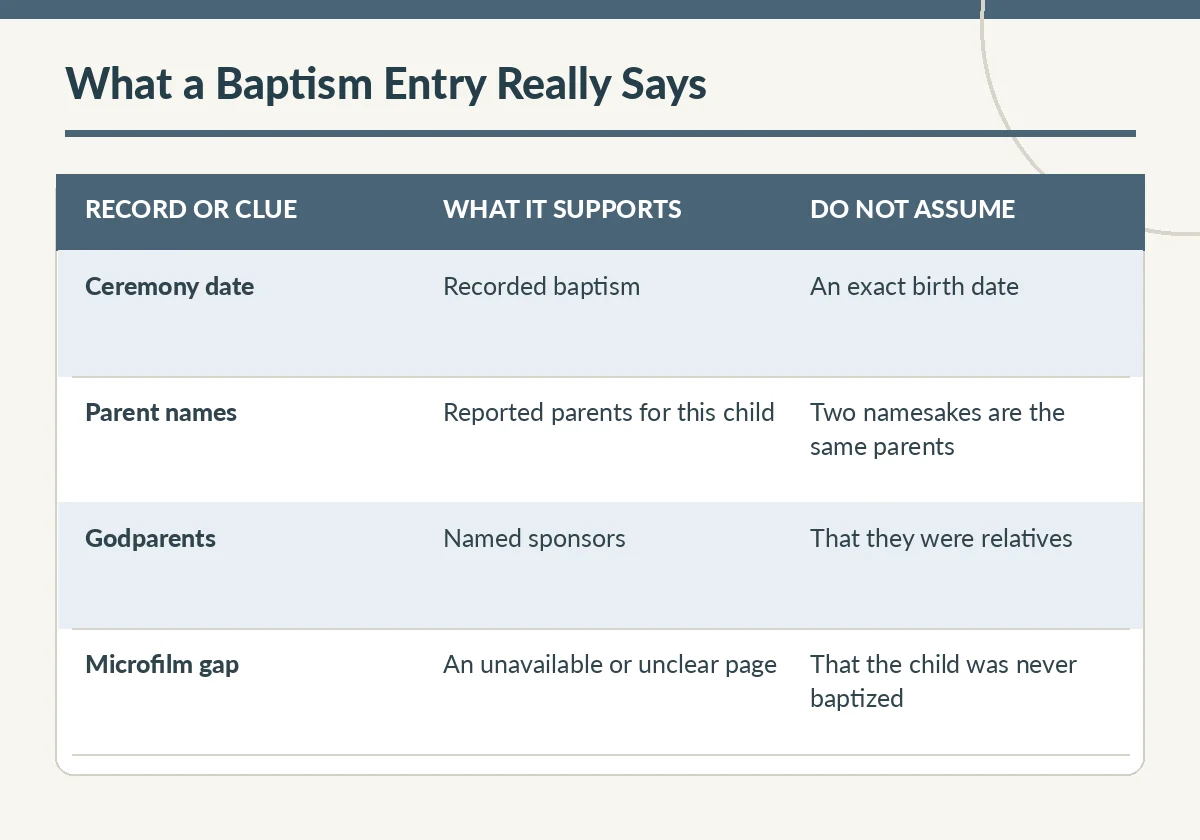
A baptism entry generally records a church ceremony. It may supply the child’s name, parent names and sponsors, but coverage and format vary by priest, region and date. Some entries state a birth date separately; many do not. Write ‘baptized on’ for the sacramental entry and do not automatically transform that into ‘born on.’ Check whether the cleric used Latin forenames or standard abbreviations, and preserve the original spelling in your transcription next to any normalized search form.
For a fictional record reading ‘Joannes’ or ‘Maria,’ compare the parent’s name and townland or address before declaring an English equivalent in the tree. The NLI explains that given names may appear in Latin whereas surnames were not translated. If a mother’s surname appears, copy exactly as written; do not assume that an unclear name is certainly her maiden surname without checking the column format and nearby entries. Verify the parent-child link against an independent marriage, later census or civil registration where available.
| Original field | Useful inference | What remains unknown |
|---|---|---|
| Baptism date | Ceremony was entered | Exact birth date unless stated |
| Two parents named | Reported parental relationship | Identity among namesakes |
| Sponsors | Godparent or witness role | Blood kinship |
| Townland note | A reported locality | Lifetime residence |
Use sponsors and marriage witnesses as leads, not relatives by default
Godparents or sponsors can help distinguish common-name families when entries share townlands and recurring associates. Record every sponsor’s full name in an association ledger with date, parish, child’s parents and source image. A witness with the same surname might be kin, a neighbor or simply someone present; do not label them ‘uncle’ or ‘sister’ without a separate linking record. Maintain each relationship as a testable hypothesis, not an assertion copied into a family tree.
Marriage registers may supply a date, spouses, witnesses and occasionally residence or parentage; what is entered varies dramatically by register. An index listing two names and a year cannot always tell whether you have the correct couple among several same-name candidates. Browse the full page to see how the priest structured entries and whether one witness appears repeatedly. A frequent witness may have held a church role rather than been related to every couple.
Plan for faded microfilm, missing years and uneven coverage
NLI digitized microfilm produced from work chiefly done in the 1950s and 1960s. The underlying books could already be damaged or faint. The viewer offers brightness, contrast and inversion controls; use them to test hard-to-read lines and compare letter shapes across the page. A torn leaf, changed ink or missing volume can explain a failed search. Some parishes have registers beginning much later than the family’s expected event, and most NLI microfilms end around 1880. If that is your next decision, our guide “Drumcree and Portadown Catholic Registers” explains how to read NLI Films 05586/04–05.
For events after the filmed period, contact the parish or relevant diocesan archive to ask about lawful access and coverage; do not promise an open online image. Catholic parish recording and civil registration operate on different timelines. The NLI notes Irish state registration of births, marriages and deaths from 1864, with non-Catholic marriages from 1845. A pre-1864 Catholic baptism may be the strongest early lead; a later baptism should also be compared with a civil birth entry when one survives. For the fuller picture, see our guide “County Wicklow Catholic Parish Registers”.
Resolve similar entries with a parish evidence ledger
Imagine two baptisms of girls named Catherine Murphy in nearby parishes and within the same year. For each, copy the recorded ceremony date, parent names, sponsors, townland, microfilm link and uncertainty about handwriting. Then look for the parents’ marriage, a sibling sequence with repeating address, and a later migration record naming a narrower origin. A one-name match is not a proof decision; conflicting sponsorship patterns cannot prove different parentage by themselves either.
Keep one row for ‘entry found,’ one for ‘interpretation,’ and one for ‘independent check’ rather than hiding conflicting possibilities. A useful citation includes NLI, Catholic parish and diocese, type and date of register, image or microfilm number, and exact entry position if pages are unnumbered. This method preserves what the original source really said and makes a second researcher able to reopen it. For the next step, our guide “Galway Catholic Parish Registers” explains how to find baptisms by parish and microfilm.
More Records and Archives Guides
How We Research NLI Catholic Parish Images
We compared the NLI’s current About and Help pages with its family-history guidance and Ireland’s government description of the service. The research steps reflect the actual parish/date interface, the absence of a built-in name index and the important distinction between microfilm coverage and a complete parish archive. The hypothetical Murphy comparison does not refer to a verified family, and all English-name renderings are editorial aids rather than copied source facts.
We do not recommend any paid transcription provider as necessary: the NLI images themselves are available without payment. If external indexes are used, verify their terms and each matching original image. See our affiliate disclosure; this guide contains no affiliate links.
No. NLI provides an image viewer organized by Catholic parish, event and date, not a site-wide person-name index.
No. NLI filmed records mainly up to about 1880; coverage start and end dates differ by parish.
Not necessarily. Record the sacramental date as written; only give a separate birth date if the entry or other evidence supports it.
No. Sponsors are documented associates, and kinship requires another source or an explicit statement.
Use NLI brightness, contrast and inversion controls, inspect adjacent lettering, and record illegible readings instead of guessing.