
Danish parish registers are usually searched by a documented sogn (parish), event type and approximate date rather than by treating one database’s surname result as proof. The Danish National Archives, Rigsarkivet, makes digitized church books available through Arkivalieronline. Start by identifying the correct historical parish; choose a baptism, marriage, confirmation or death sequence; then read the full entry and its neighboring pages. Books before approximately 1814 were organized differently from later parallel parish volumes. Their names, arrangements and access limits are central to an accurate search.
Locate a Danish sogn before choosing a church volume
A village, farm, mailing address and parish are not interchangeable. The archive’s church-book guide tells researchers to establish place, time and name before searching. Find the residence from an independent census, marriage or migration clue, then place that locality in the historical ecclesiastical district. Do not assume a present-day municipality matches a nineteenth-century parish. Record both the place as written in the old source and the parish name selected in Arkivalieronline.
If an expected entry is absent, test adjoining parishes and whether a church ceremony occurred somewhere other than the family’s normal residence. An index may describe the mother’s residence or a later copying date rather than the actual event site. In Schleswig or Southern Jutland, jurisdictional and denominational history warrants particular care. Keep your search notes by parish and period so an unsuccessful page browse does not become the inaccurate general claim that Denmark has no record of the family. For the next step, our guide “Denmark 1845 Census” explains how to use the New birthplace column to locate an ancestral parish.

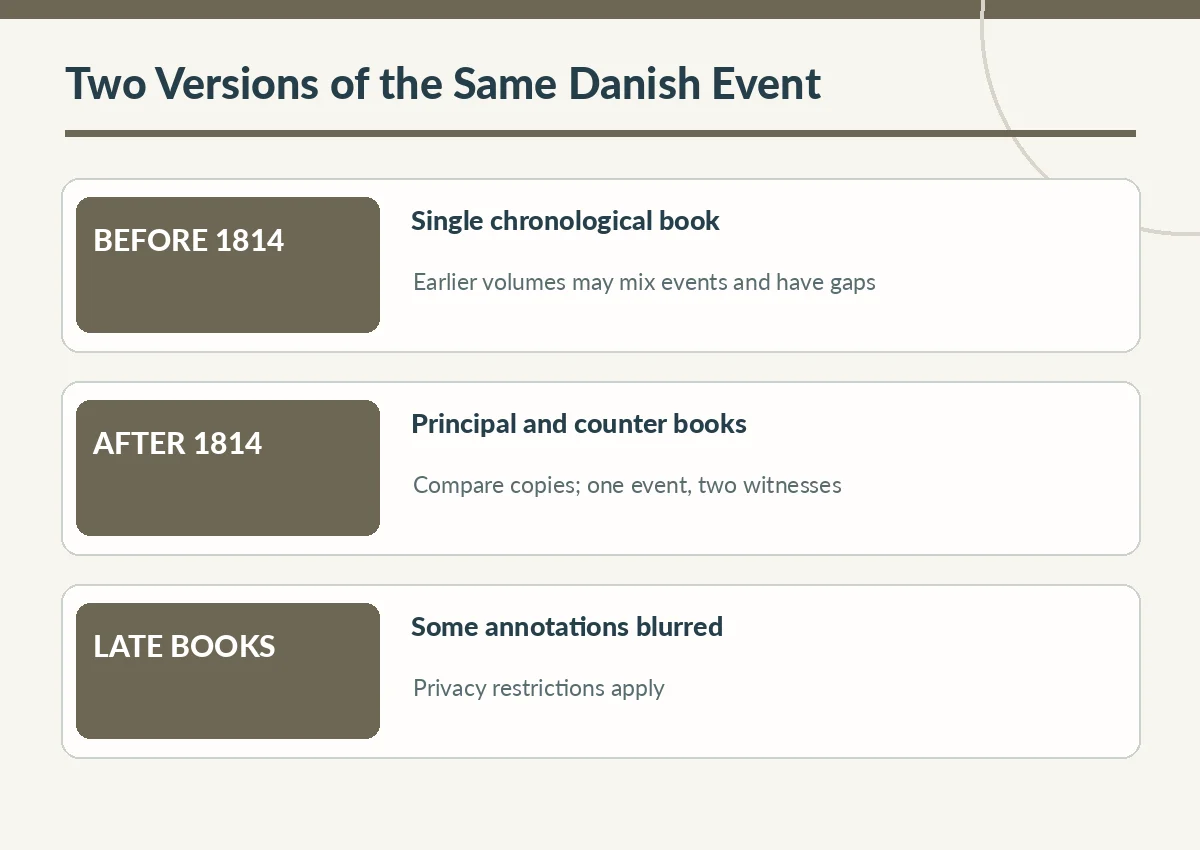
Choose pre-1814 chronology or the later paired registers
Older Danish church books, often labeled enesteministerialbog, can mix baptisms, marriages and burials in running chronology or informal columns. Rigsarkivet explains that nationwide church-book recordkeeping was ordered in the seventeenth century, but many early volumes were lost to fires or never kept uniformly. Do not hunt for a standardized baptism table on a 1700 page if its minister recorded several kinds of events sequentially. Establish the book’s date limits and inspect its opening headings.
From around 1814, Danish parishes generally kept two books, the hovedministerialbog (minister’s principal volume) and kontraministerialbog (counter or clerk copy). They were intended as matching witnesses but are not two independent ceremonies. If the writing or dates disagree, transcribe both and seek another source. The presence of duplicate volumes may rescue an entry with damaged writing; it does not prove that every year or parish has complete digital images.
Read the Arkivalieronline abbreviations before browsing pages
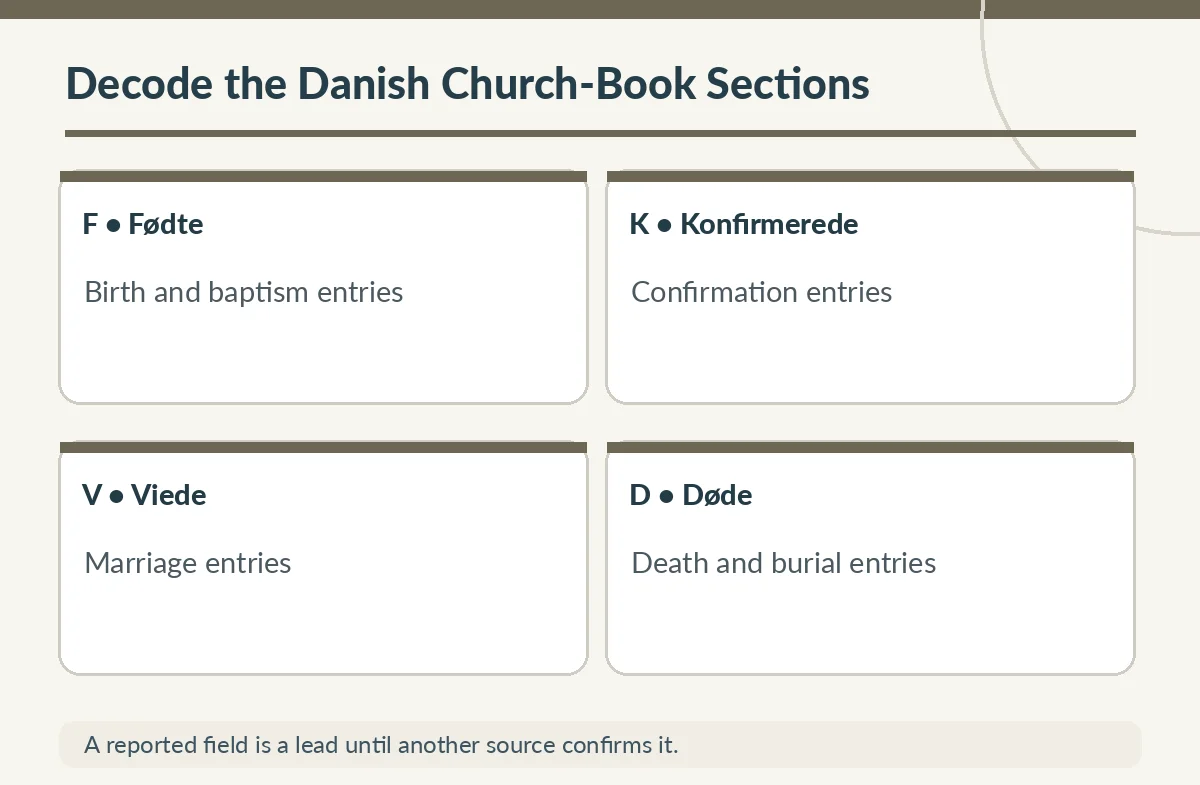
The archive identifies F for Fødte (births), K for Konfirmerede (confirmations), V for Viede (marriages), and D for Døde (deaths). Some books also include A departures, T arrivals and J cross-reference lists, mainly in the 1814–1875 arrangement. These are guides to sections, not guarantees that a particular parish supplied a complete run of names and movements.
Start with the event class matching the question. A baptism entry may name godparents and a residence, while a marriage entry can reveal parties’ localities; fields differ by period and volume. Write the Danish column title and your English interpretation in separate lines. When images are segmented by gender and record type, verify that you entered the correct segment. Browsing the wrong half of a volume can create a false no-result conclusion even where the original entry survives.
Compare dates, parents and witnesses without over-reading kinship
A birth date and baptism date may differ. Enter each with its own label; do not simply replace a baptism date with an inferred birthday. The father’s occupation, mother’s name, residence and sponsors can help separate children bearing the same first names. But a witness or godparent is not automatically an aunt, uncle or biological relative. Design an evidence grid in which each name and relationship appears exactly as the book reports it, alongside another independently located record.
Imagine two Anders Nielsen baptisms occurring in nearby parishes: birth year and surname alone cannot select the right one. Compare the mothers, farms, known siblings and a later confirmation entry. A child’s name could be recorded differently across events; track patronymics and fixed surnames without imposing a modern spelling as original. If the two ministerial copies agree, that confirms how the event was recorded; it still does not independently establish every parentage assertion.
Respect late-book privacy and blurred birth annotations
The Danish National Archives has blurred some birth-entry remark fields beginning in 1892 for privacy, with coverage extending into the twentieth century. The archive provides an access-request route for eligible cases. A blurred field is not a hint to be reconstructed from a thumbnail or bypassed through a different cached copy. Later volumes may also have closure rules protecting personal identity numbers; use the archive’s current guidance.
Historical availability varies by type, date and holding. A scanable book is not necessarily an unrestricted modern vital certificate, and a blank index result is not permission to disclose private family facts. If you are researching a person who could still be alive, follow lawful access and consent rules. Cite only information that you could legitimately view; do not infer concealed annotations from adjacent visible lines or attach speculative sensitive details to a named individual.
Cite the volume, entry and image rather than only a name index
A reproducible citation includes repository, archive or parish, book type, chronological range, event classification, page or entry number as written, and image identifier. If the scan gives an online image count but the manuscript gives a page or folio, save both. A single scan may contain two book pages; verify which side holds your person. Keep a brief original-language transcription for ambiguous abbreviations and distinguish supplied translations from text actually on the paper. Our guide “Finnish HisKi Church Records” covers a related question.
Save a negative-search ledger stating which parish, record type, years and pages were checked. For a marriage not found in the groom’s parish, test the bride’s parish before concluding the couple married elsewhere. Cross-check relevant Danish censuses and moving registers, while acknowledging that a list of arrivals or departures may be incomplete. Good genealogy allows a second researcher to retrace both a positive result and a carefully bounded unsuccessful search. Our guide “Norwegian Parish Registers” covers a related question.
More Records and Archives Guides
How We Research Danish Church Books
We compared Rigsarkivet’s official Arkivalieronline guide and its detailed church-book instructions with the Danish National Archives’ access-restriction page. The surviving evidence supports the date distinction around 1814, the principal/counter book terminology, the named event abbreviations, and the privacy treatment of some later remarks. We avoided implying that record availability is uniform across all parishes or that a duplicate is a fully independent witness.
The examples are illustrative only, and no real private family is claimed to have been found. These are archival research steps, not an endorsement of a subscription or an assertion that public records prove genetic relationships. See our affiliate disclosure. Always record which volume and which copy you actually inspected.
Not reliably. The core archive route is parish, event type and period, followed by page inspection; name indexes have uneven coverage.
After about 1814, a minister’s hovedministerialbog and a clerk’s kontraministerialbog generally record the same events in separate copies.
They label births, confirmations, marriages and deaths, respectively. Some books also show arrivals and departures.
The Danish National Archives masks sensitive annotations in portions of birth entries from 1892 onward; authorized access may require an application.
No. Sponsors are recorded participants. Prove any suggested kinship from independent records.