
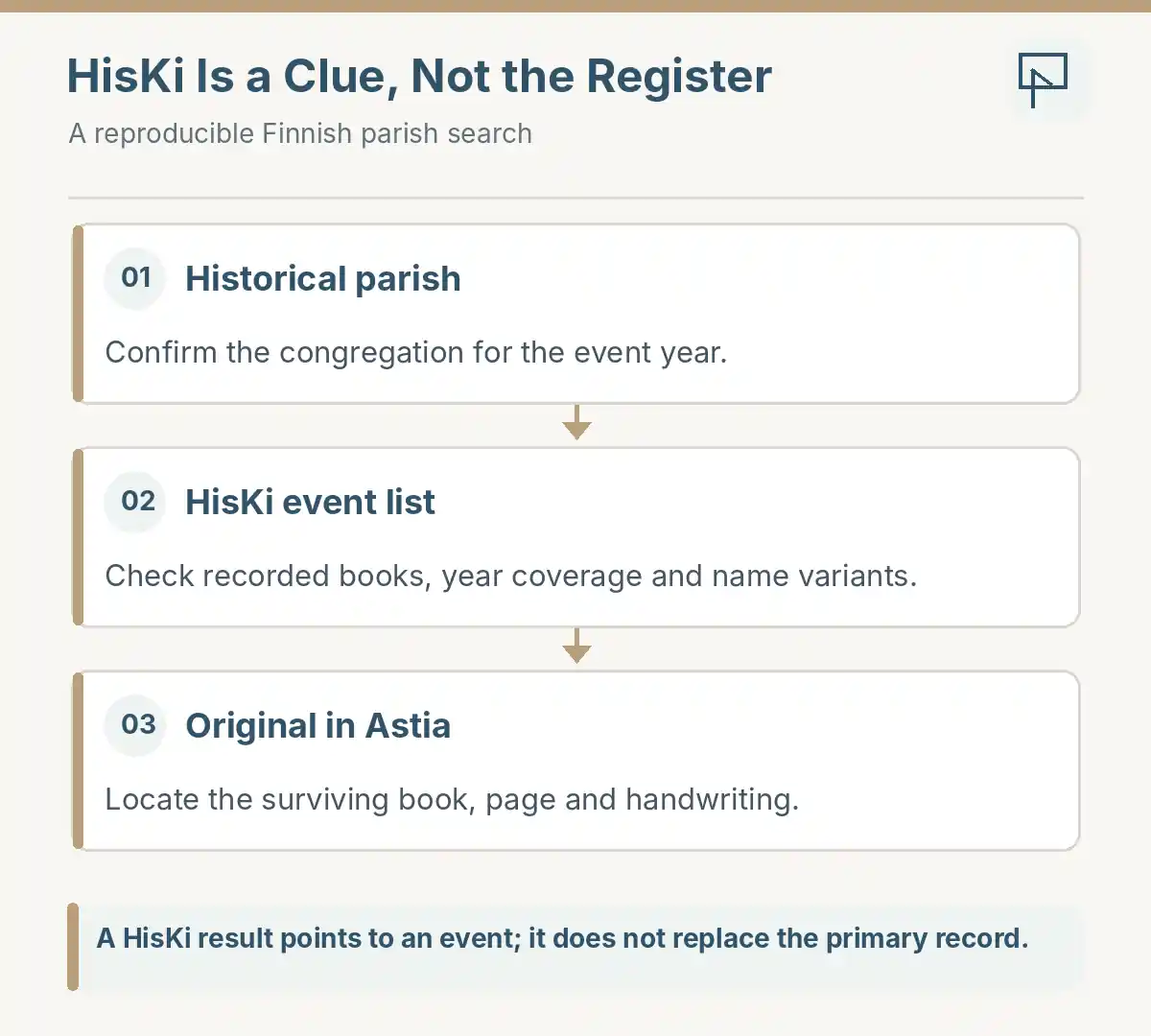
HisKi, maintained by the Genealogical Society of Finland, indexes historical parish events such as baptisms, marriages and burials. It can point to a likely church-book entry, but the Society explicitly warns that the data are incomplete and can contain copying or indexing errors. Use the place and event type to reach a short list of candidates, then inspect a surviving original in the relevant archive. HisKi is a search aid, not a substitute for a baptism register or a complete census of Finnish families.
Begin with the parish that existed at the event date
Before entering a family name, establish where the event happened and which parish served that village at that time. Finland has undergone parish divisions and changes in administrative boundaries, so a present-day municipality is not always the church jurisdiction for an eighteenth-century baptism. The Genealogical Society offers an Information on Finnish Parishes database with historical descriptions, churches and clergy to help resolve this. Write the historical parish, village or farm name, event date range, confession when known and original spelling variants. Lutheran parish records are prominent in HisKi; Orthodox or other religious records may need a different record route. A family’s residence in one parish does not establish that every child was baptized there, especially during moves or temporary work.
Read HisKi’s coverage years before interpreting silence
HisKi opens with a parish list and map; select the parish or a relevant group, then review which event books and year spans have actually been entered. The Society reports that coverage varies sharply across parishes and events. One locality may have useful eighteenth-century burial indexes while another lacks a searchable marriage span, even if a physical church book survives. Record the visible coverage interval and whether you searched a specific book class. Search neighboring parishes where documented movement makes that plausible, but avoid treating a blank result as proof of absence from the area. HisKi originally used earlier handwritten copies of church books, creating potential error at more than one transcription stage. That is why an apparently exact date still needs checking in the source guidance and original.
Use wildcards for Finnish and Swedish name variants
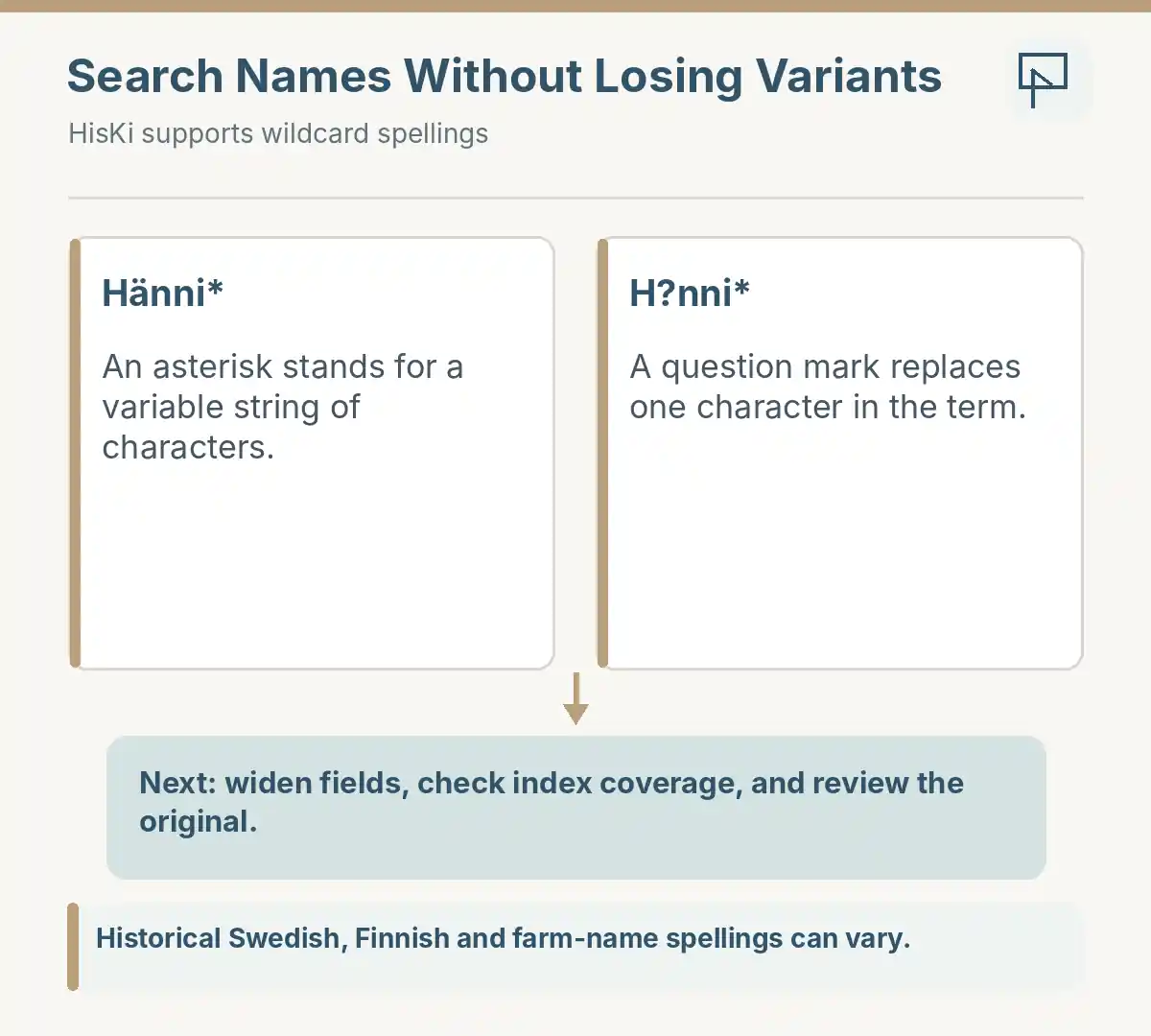
Historical first names, surnames, patronymics and farm names shift in spelling; clergy might write Swedish even for Finnish-speaking residents. HisKi supports an asterisk as a flexible string of characters and a question mark for one character. For instance, the Society uses Hänni* and H?nni* as examples of a wider family of spellings. Start with the smallest number of fields that plausibly distinguish candidates; a guessed mother’s surname or patronymic can exclude a correct entry. Test variant dates, shortened given names and nearby place names, recording each search string. Do not erase accents or grammatical endings in your transcription just to match an Americanized family surname. Search precision is not proof of identity: it is a way to find a source that needs reading. A null search may reflect book coverage, normalization, spelling or missing original pages.
Move from the HisKi row into the historical book
A baptism list and a later communion or confirmation book answer different questions. Find the corresponding historical birth, marriage or death volume in the National Archives’ Astia service or another identified holding. The Society’s parish-record guide explains how original digital church books are made available, with access limits for more recent entries. Confirm the correct parish, year and page; then transcribe dates and parents, village or farm, godparents or other details only when they are actually written. Record which date is a baptism rather than the date of birth. Handwriting, ink damage and successive copybooks can explain apparent contradictions, and the index may have omitted a note. If there is no digital image, cite the catalogue and investigate consultation or access rules rather than fabricating an original.
Avoid confusing HisKi with Finnish communion books
The distinction matters because a prior-looking result for the same family could represent an entirely different type of evidence. HisKi is mainly an index of historical events; rippikirjat or communion books follow households and religious participation over periods, sometimes giving page references that help trace a move. Neither source should overwrite the other. An indexed baptism might identify a parent in one year; a later household ledger could list someone with the same name and an approximate birth date. Build a two-column comparison of person, household, dates and parish and add any contradictory details. Confirmation or communion books often repeat information from earlier pages; such copied dates can be wrong. Look for independent continuity and original event evidence instead of treating neighboring names on a page as automatic proof of blood relationship.
Cite the archival volume and keep an unsuccessful-search log
A durable Finnish citation needs the parish, record type, volume or year span, page or image where available, the custody platform and access date. Store the exact name spelling in the image, the HisKi indexed wording and a separate normalized search name. For unsuccessful searches, record parish, covered book, years, wildcards, filters and whether originals were checked. Distinguish four cases: an absent index result within covered years, no index entries for that event book, an unreadable or missing original page, and a genuine negative finding reached through adequate source review. Each leads to a different next step. This small discipline prevents multiple people with similar patronymics from being collapsed into one line and makes a research conclusion reproducible.

For a precise search example, imagine a reported 1815 baptism in one parish, but an index gives only a name and 1816. Search both years in the selected baptism list, then review which years are actually indexed. Test the name in Swedish and Finnish forms without adding unproven parents as mandatory filters. Consult the original baptism page and record what its event date truly denotes. If the original shows a different farm, preserve that conflict and seek a connected communion or moving record. This is a method illustration, not a claim that any real indexed family had these details.
More Records and Archives Guides
How We Research HisKi Versus Astia
We checked HisKi against the Genealogical Society’s search and limitation guide and separately used its original parish register guide for archive and access statements. We do not assume nationwide completeness or that every old entry has a public image. The spelling exercises are demonstrations of search syntax, not assertions about a particular ancestor. Any relationships with commercial services are described in our affiliate disclosure.
No. Coverage varies by parish, event type and entered year span. Always inspect the book selection and dates before treating a no-result search as meaningful.
Not automatically. A baptism record describes a religious event and may or may not give a separate birth date. Consult the original entry.
Yes. The Society describes selecting one or more parishes or a region for searches, but broad results still require locality verification.
An asterisk substitutes a variable string and a question mark substitutes one character. They help search historical spellings without assuming a fixed modern name.
No. HisKi chiefly indexes event books; communion or confirmation books track households and religious participation and may carry copied dates.