
Finnish communion books, commonly called rippikirjat, can track people in a parish across a series of church record volumes. Start with a confirmed locality and a dated event, identify the correct parish and volume period, then read the household page and its references to other pages or registers. These books are vital for reconstructing residence and movements, but a person listed near another person is not necessarily a child or spouse. Confirm relationships with births, marriages, moving registers and other independently dated evidence before adding new ancestors to a tree.
Choose the parish and the exact rippikirja volume
The Genealogical Society of Finland describes parish population records as a central tool for family historians, including communion or confirmation books, vital-event registers and moving records. Each parish has its own surviving date ranges and catalog conventions. A locality may have had Lutheran, Orthodox or other communities using different registration traditions; do not assume one rippikirja sequence covers everyone who lived nearby. Start by establishing the historical parish, village or farm from a dated certificate or an earlier household entry. Check the parish holdings inventory rather than searching every volume solely by surname. For a related choice, see our guide “Swedish Household Examination Rolls”.
Within a parish, a single volume covers a defined span of years and organizes people by farm, village, household or other local arrangement. Households can be split across pages, and marginal references may point backward or forward. Open the original image and record the page, parish, book title and year range. The Finnish National Archives Astia service, the Finland Family History Association and other catalogs can display different image sets or indexes. Check present-day access and privacy restrictions, especially for later books. Search aids do not automatically replace the handwritten record.
Transcribe the household without inventing a pedigree
A communion-book page may identify residents, birth information, religious participation and movement notes, with contents changing by date and parish. Learn the period’s Swedish- or Finnish-language column headings and abbreviations instead of relying entirely on modern translations. Identify the heading for the farm or locality, then read each line in relation to the column rather than assuming the first line is a biological father. Names and patronymics may change presentation across records. Preserve original spellings and label normalized surnames in your own notes. Our guide “Finnish HisKi Church Records” adds more detail on this.
Create separate columns for exactly stated facts and researcher interpretations. A birth year in a later communion book may be copied from an earlier volume and can be incorrect in both places; an apparent agreement is not fully independent corroboration. List the child-parent relationship as “reported” or “inferred” until a birth record or another reliable source connects the names. Communal living arrangements, servants, relatives, apprentices and widowed people may appear together. Treat adjacent household members as associates first and examine the source’s actual labels before deciding their relationship.
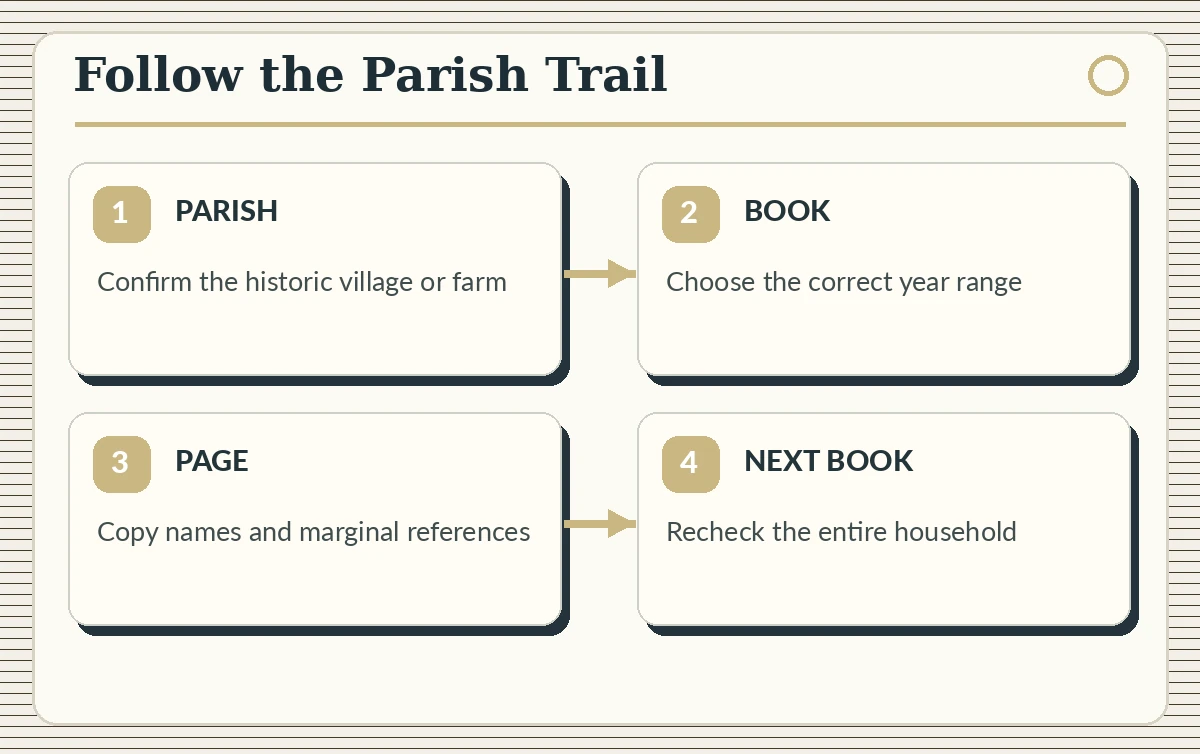
Follow page references into the next book period
The strongest rippikirja workflow is longitudinal. Begin with the known person in one defined volume and inspect marginal notations or page references that point to another household or the next period. Open the identified page rather than assuming page numbering carries unchanged between volumes. Compare birth details, spouse, children, occupation, residence and any dates of arrival or departure. Make an explicit link between two page images with a reason. When a person disappears from one book, this may reflect a move, death, marriage, different household or gap in the record.
If the page suggests migration, consult the parish’s muuttaneet or moving-in/moving-out records where preserved. Record both the sending and receiving parish and check whether the dates and identity agree. A migration note can lead to a new volume, but a missed entry does not necessarily mean the journey never occurred. The goal is a chain of time-anchored source pages rather than one huge name-search result. Keep volume and page references in your research log so the complete route can be reproduced. For a related choice, see our guide “Swedish Moving-In and Moving-Out Registers”.
| Check | Evidence to record | Do not infer |
|---|---|---|
| PARISH | Confirm the historic village or farm | A name alone is proof of identity |
| POSSIBLE | Relationship is a hypothesis | The index replaces the original |
| DECISION | Preserve conflicts and uncertainty | Unverified kinship or an event |
Compare children, marriages and religious annotations carefully
For a proposed parent-child link, pair the communion-book household with the parish’s birth or baptism register for the approximate date. The birth entry may identify parents, residence and a different patronymic form. For a marriage, read the marriage register and compare spouses, age, former residence and related documents. Entries for confession or communion serve a religious and administrative purpose; they are not civil declarations of ownership, nor definitive proof of a person’s conduct. Historic religious labels require context rather than modern value judgments.
Where sources conflict, retain the line-level transcription and source dates. If two brothers shared a given name in nearby villages, their page references can create convincing but wrong combined histories. Use the records on both sides of a move to check spouse and birth information and seek a third source before merging the identities. Be sensitive to living people and to changes of jurisdiction; permissions and available digital periods vary. Note whether a negative result followed a thorough page browse or only an online index search.

Test a fictional household transfer between parishes
Imagine a fictional Liisa Mäkelä listed on a farm page around 1860. A marginal note suggests a move, while a second parish has a person of the same name and age. Do not claim they are identical immediately. Copy the original note and date, search the first parish’s outgoing-move register, and check the second parish’s incoming register or first communion-book appearance. Compare any birth parish, spouse and occupation that appear. Link the two entries only if the cumulative evidence distinguishes the target from a namesake.
If the connecting move ledger is missing, make the uncertainty visible: the source shows a disappearance and a candidate new residence, not yet a proved transfer. Return to an independently verified birth or marriage record to identify the same person, then proceed to the next volume. The explicit page-to-page continuity trail is a useful output even when the proposed kinship remains uncertain. Use a simple table with page, dates, household, original note, confidence and next source. Our guide “French Tables Décennales” covers a related question.

How We Research Finnish Communion Books
We consulted the Genealogical Society of Finland guide on parish registers, online holdings and reading-room limitations and compared parish inventory examples. Our Liisa scenario is fictional. We distinguish residence from kinship, and use sequential rippikirjat pages plus vital and moving records rather than deriving a family tree from one household arrangement.
More Records and Archives Guides
Official archive guides for finnish communion books
www.genealogia.fi — Genealogical Society of Finland: parish books, digital coverage, Astia and access.
www.genealogia.fi — Genealogical Society of Finland: Astia, HisKi and digitization resources.
hiski.genealogia.fi — Parish inventory example: series and year ranges for communion and moving books.
These sources are provided for archival research, not as paid endorsements. Review the GenHis affiliate disclosure. Coverage, digitization and access conditions can change. Historical documents may contain outmoded or biased labels; interpret them in context, and avoid sharing private information about living people.
A historical parish communion or household book recording residents and church-related details over a volume period.
Not necessarily. Use vital records and explicit relationship evidence before asserting parentage.
Check marginal page references and available outgoing and incoming moving registers.
No. Survival, digitization and access restrictions depend on parish, year, faith community and custodian.
No. Years may be copied between volumes; compare independently dated baptism, marriage and move records.