
Dutch huwelijksbijlagen are supporting documents submitted in connection with a civil marriage. They may contain copies or extracts of birth records, deceased parents’ death records, parental consent or the bridegroom’s military-status certificate. To find them, first establish the municipality, year and act number of the marriage in the civil register; then locate the corresponding attachments in the appropriate archival inventory. These papers can help reconstruct a family, but an attachment is a document with its own date and source history, not an automatic proof that the people in two same-name entries are identical.
Start with the marriage act and the municipality
The Netherlands introduced civil registration in 1811. The Nationaal Archief explains that births, marriages and deaths are registered per municipality, commonly in duplicate, with archival custody varying by province and institution. This makes the marriage act the most reliable starting point for an attachment search: note the spouses’ full names, marriage date, municipality and act number. Do not begin by guessing a nationwide packet number from the bridegroom’s surname. An archival catalog may group attachments by year and act range rather than by an individually searchable name.
The Nationaal Archief lists distinct collections of huwelijksbijlagen for municipalities including The Hague and parts of South Holland. Its guidance explains that some municipal originals are held in municipal archives, while court copies may be in national custody. Identify the actual keeper and inventory; an online birth-marriage-death search can find an indexed marriage but may not expose attachment images. Write down the inventory number and year range, and check access or digitization status before assuming the packet can be downloaded.
Know the types of evidence that may be attached
According to the Dutch national archive, marriage attachments can include copies of the parties’ birth or baptism records, death acts for a parent, documents recording consent and evidence of the bridegroom’s military status. The exact contents vary from case to case. A missing parent’s death extract does not show that the parent was alive; the document may simply not have been required, retained or digitized. Conversely, a certificate in the packet may have been copied for this marriage many years after the original event. Our guide “Dutch Population Registers from 1850” adds more detail on this.
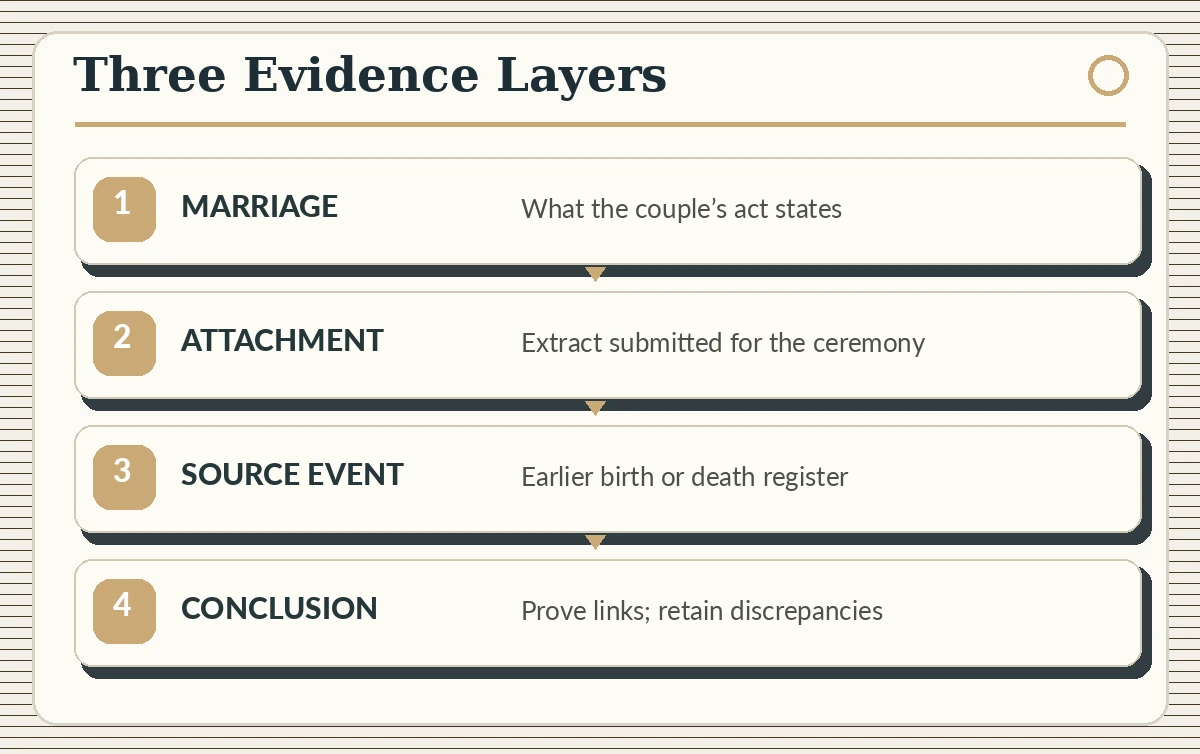
Transcribe each attachment as a separate source, capturing its issuer, date, named person and original event being certified. An extract repeating a birth date supplies evidence about a birth, but it may omit witnesses or other details of the full original. Where practical, use the stated birth municipality and date to find the original birth act. This creates a three-level chain: the marriage act, the supporting copy and the primary register entry. Do not label a military-status document as proof the man served in an army without reading what it actually says.

Search the huwelijksbijlagen inventory by act range
For an example of archival structure, the Nationaal Archief inventory 3.064.03 covers The Hague marriage supplements for 1811–1898 and organizes parts by year and numbered marriage-act ranges. Not every year has a complete surviving volume: its inventory explicitly notes a missing year at the beginning of the sequence. An act number from the marriage register helps identify the proper packet or inventory unit. If the surname is absent from an online name index, that alone is not enough to conclude the supplements do not survive.
Open the inventory description, find the matching municipality and marriage year, then locate the volume covering the act number. If images are not published online, follow the archive’s stated request or reading-room procedure. Keep the archive access number and inventory number in your log. The precise order of papers inside a packet can differ; inspect all items, front and back, before deciding which family facts it contributes. A catalog entry for a volume is not itself the documentary proof of a named person’s parentage.
| Check | Evidence to record | Do not infer |
|---|---|---|
| MARRIAGE ACT | Copy spouses, town, year, number | A name alone is proof of identity |
| ATTACHMENT | Extract submitted for the ceremony | The index replaces the original |
| CONCLUSION | Prove links; retain discrepancies | Unverified kinship or an event |
Understand conservation, access and historical gaps
The Nationaal Archief explains that Dutch marriage attachments were generally retained up to 1932 and that after that date most were destroyed, with specific exceptions for certain foreign acts and medical statements. This historical retention rule is not a guarantee that every pre-1932 municipal packet survived. Local deposit histories, missing inventories and later privacy rules matter. Its South Holland guide also distinguishes the release intervals for civil birth, marriage and death acts; verify current rules before ordering any specific record, especially if a living person may be involved. Our guide “Sicilian Birth Records” covers a related question.
If attachments are missing, do not fill their contents from speculation. Return to the marriage act and use its stated parents, ages or residences, then look for original birth acts in the named municipalities and contemporary death records where supported. A municipality changing boundaries or spelling may need catalog investigation. Record whether the loss is confirmed by an archive inventory, the item is merely undigitized, or a name query failed. These are three different research outcomes and require different next actions. Our guide “French Tables Décennales” covers a related question.
Work a fictional attachment-to-parent audit
Imagine a fictional 1887 marriage act for Anna de Vries and Pieter van Dijk in The Hague. The act points to an attachment packet with a copy of Pieter’s baptism and a certificate about a deceased parent. Read each paper, noting that the baptism copy was issued later than the event it reports. Compare the stated parent to the original baptism register and the marriage act. If a parent’s name differs by one letter, preserve both versions and seek a further record rather than silently choosing one.
Now suppose two Pieter van Dijks were born in the same town. One matching birth extract is not enough by itself if the marriage packet cannot be securely tied to the numbered act. The combination of year, municipality, act number, spouse and packet location makes the case stronger. Keep each layer’s citation and explicitly distinguish direct statements from your conclusion. A marriage-file audit should end with verifiable parental evidence or a carefully labeled gap, not a name-based pedigree imported without sources.

How We Research Dutch Marriage Papers
We checked the Nationaal Archief guidance on South Holland civil registration and huwelijksbijlagen and its The Hague inventory for preserved periods, document examples and act-number arrangements. Our couple is fictional. We avoid presuming that all possible attachments exist and test copied statements against their earlier event registers whenever accessible.
More Records and Archives Guides
Official archive guides for dutch marriage papers
Nationaal Archief: civil registration custody, marriage attachments, retention and privacy (www.nationaalarchief.nl).
Inventory 3.064.03 of the Nationaal Archief: The Hague marriage supplements, 1811–1898 (www.nationaalarchief.nl).
Nationaal Archief: Sluipwijk huwelijksbijlagen contents, citation and access (www.nationaalarchief.nl).
These sources are provided for archival research, not as paid endorsements. Review the GenHis affiliate disclosure. Coverage, digitization and access conditions can change. Historical documents may contain outmoded or biased labels; interpret them in context, and avoid sharing private information about living people.
They are supporting documents filed for a civil marriage, often including copies of birth or other records.
First identify the municipality, marriage year and act number; then locate the matching archival inventory unit.
No. A military-status certificate can document a status, but the exact wording must be read.
Most were destroyed after 1932, with specific categories of exceptions; consult the archive for current holdings.
No. Contents vary. Compare each surviving document with the marriage act and original birth or death records.