
Dutch bevolkingsregister records track municipal residents over time, often noting addresses, household membership and arrivals or departures. They are not one-day census snapshots or deed books. Start with the municipality and approximate decade, find the relevant historical population-register series, follow the household through successive pages or cards, and compare reported births, marriages and deaths with civil registration. This approach can recover a move that a simple name index misses while avoiding the mistake of treating registered residence as property ownership.
Understand the continuous registration system after 1850
The Dutch Center for Family History, CBG, identifies population registers from about 1850 among the principal genealogy sources, alongside civil registration from 1811 and earlier church books. Open Archives describes the January 1850 municipal duty to maintain continuous population registration. Unlike a decennial census, a register can be updated as household members arrive, depart, marry or die.
Local practice and preserved volumes are not identical nationwide. A listing may be current for a period of years rather than on one precise enumeration day. Copy the volume dates and update dates separately. A household roster copied from a register can contain people whose periods of residence do not fully overlap. Reconstruct the chronology before assuming they all shared an address simultaneously.
Find the municipality and the right version of the register
Locate the last documented Dutch place from a birth, marriage or migration record. Then identify the municipal or regional archive responsible for the historical location. CBG lists local and regional repositories as important sources. Search a municipality’s collection description before relying on a national index; municipal record organization, scans and privacy rules differ.
At Amsterdam, for example, the city archive describes long-running bevolkingsregister records, family cards in use from 1893 to 1939 and later individual cards. That is a local example, not proof that every Dutch municipality made the same transition in exactly those years. For another town, confirm the series name, years, geographic arrangement and access rules with the responsible archive.

Follow one household across addresses and cards
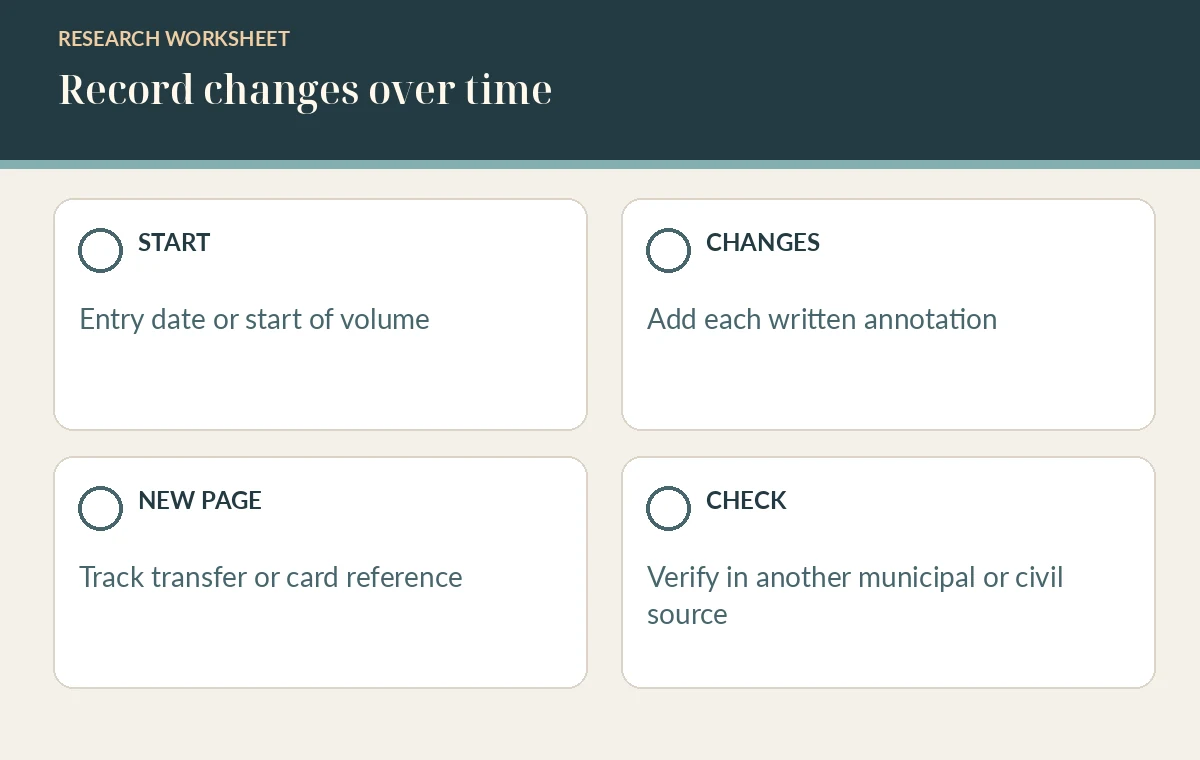
Use the earliest reliable address or identified household member, then examine the whole original page or family card. Capture name spellings, birthplaces, relationship descriptions, occupation, address, stated arrivals, departures and marginal annotations where present. Some updates can be squeezed into columns or linked to a new register number, so do not transcribe just the most legible line.
Build an ordered movement log: “recorded at address A,” “departure entered,” “arrival at address B,” then “confirmed in civil act.” Where an origin or destination municipality is named, use it as the next repository clue. Historical street renumbering and municipal boundary changes require special care: the same written street name or number may not identify the same physical home across decades.
| Evidence source | What it can support | What it does not establish |
|---|---|---|
| Municipal bevolkingsregister | Reported residence, household and movements | Property ownership or exact biological link |
| Civil birth or marriage act | Recorded civil event and named parties | All years of residence |
| Land or deed record | Specific legal interest in a property | Who actually lived there each year |
Read family relationships without assuming a fixed household
A family card might label a head, spouse, child, relative, boarder or unrelated resident. Read those role words with the page and dates. A child may have moved out before a later sibling arrived, or a servant could be listed as living at the address without belonging to the family by descent. Keep relationships reported by the register separate from biological claims established by original birth or marriage acts.
A fictional example: a household card lists Anna de Vries and a man with the same surname who arrived three years later. Without a stated relationship and corroborating civil record, a shared surname and address do not prove they were siblings. Compare birthplaces and birth acts, then mark the family connection “unresolved” if the evidence still does not distinguish kinship from lodging.

Separate the municipal record from a civil registration act
A bevolkingsregister might report a date or location for a marriage, birth or death but was maintained for resident administration. Treat that entry as a clue and search the underlying civil-registration act from the correct municipality. Compare the original names, ages, spouses and parents; note discrepancies rather than editing the municipal record to match a preferred tree. To go further, our guide “Dutch Marriage Supplements” shows how to find parents in huwelijksbijlagen.
Property claims require an entirely different evidentiary route. The resident named as household head or registered occupier might have rented rooms. A deed, cadastral source or property archive is needed to establish legal title. This distinction is especially important in urban family-history narratives, where a detailed address chronology can otherwise be mistaken for an ownership chain.
Recover a failed name search with place-first browsing
Names may be indexed incompletely, normalized differently or unavailable online for the relevant series. Search surname variants and historical given-name forms, but switch promptly to municipality, street, register period and neighboring household when an index fails. Open Archives can help discover indexed population-register entries from multiple repositories; it is not a guarantee that every original image from every municipality is included.
Record the platform and the actual archive holding separately. If a derivative listing omits the movement dates, use it only to reach the original municipal page. A source citation should give archive, collection name, municipality, register series or card type, year range, page or card identifier and stable link where available.
Write a safe conclusion from an address history
A strong conclusion names the specific interval in which someone was registered at an address, with citation to the surviving page. It does not infer the exact move date when the register offers only an undated correction, and it does not label a person a homeowner from registration alone. Treat later personal cards and information about living people under current repository access rules.
End with a three-way audit: what the municipal register explicitly reports, what an independent civil act verifies and which relationship or movement remains a hypothesis. That division makes a family story clearer and prevents a shared address or surname from turning into an unsupported branch of the family tree.
How We Research Netherlands Population Registers Bevolkingsregister
We compared CBG’s overview of Dutch core family-history sources with the Open Archives description of continuous municipal registration and Amsterdam City Archives’ specific family-card history. The Amsterdam dates are labeled as a local example. Our fictional household is only a reasoning exercise; all title, kinship and civil-event claims require their own source.
More Records and Archives Guides
Archive catalogs and original-source guides for dutch population registers
CBG: essential Dutch civil, church and population records (cbg.nl).
Open Archives: municipal population-register index scope and 1850 starting framework (openarchieven.nl).
Amsterdam City Archives: information recorded and local family-card dates (amsterdam.nl).
These links lead to official or archival research resources, not approved paid endorsements. Read the GenHis affiliate disclosure. Access conditions and digitization coverage may change. Research historical people with appropriate context; do not disclose private details about living people or treat allegations and administrative labels as proven facts.
A Dutch municipal population register that tracks residents and changes over time.
The continuous municipal system is generally traced to 1850, with local differences in records and access.
No. Check recorded household roles and independent civil documents.
No. Registration of residence is distinct from legal property title.
Verify municipality, years and series, then use archive catalogs or browse images by address or household.