
The apparent completeness of an 1850 family group can be deceptive: it names free residents but gives no relationship field, while the distinct schedule for enslaved people generally omits their personal names. For an accurate genealogy, you need two separate search tracks and a record-by-record test of any proposed family association. This guide shows how to read the original fields and avoid turning a list of co-residents into an unsupported pedigree.
Understand the change to individual names in 1850
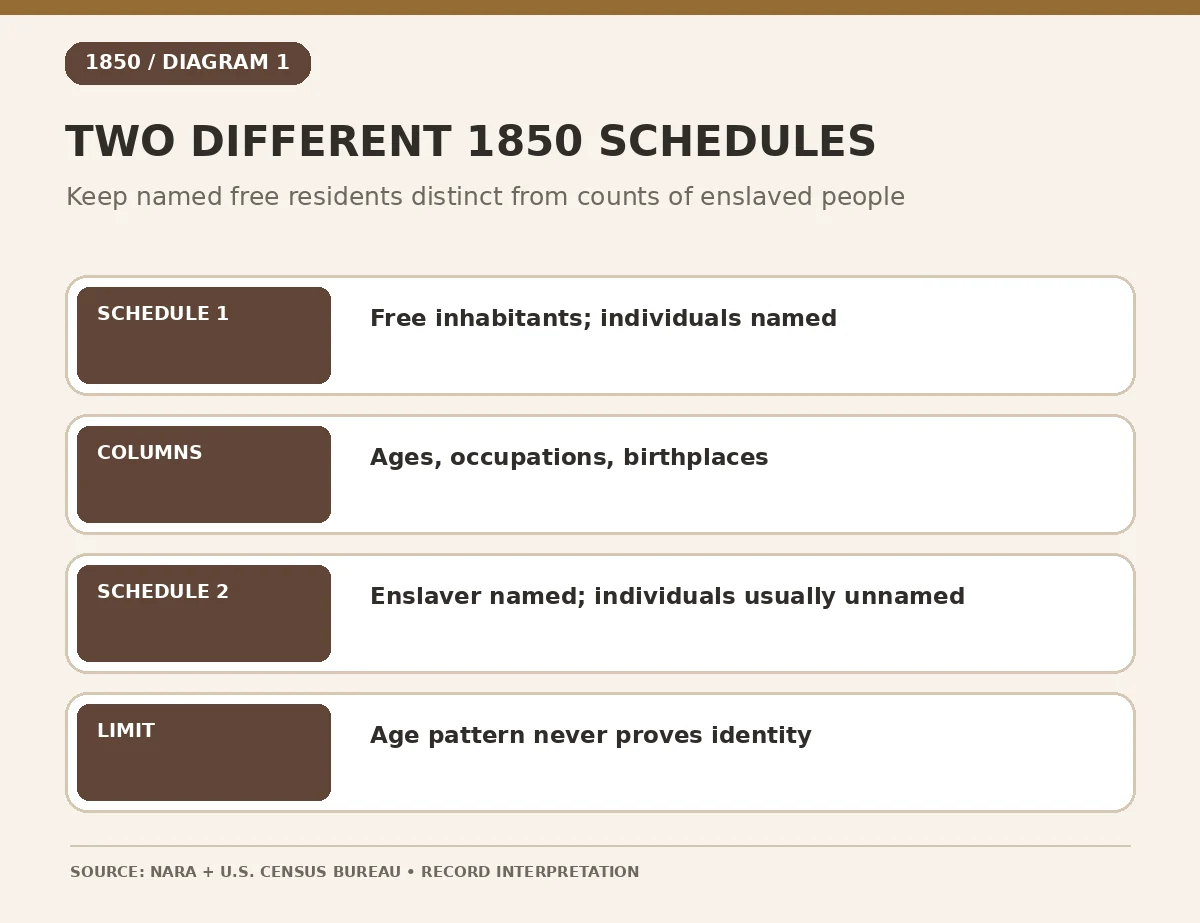
In 1850, U.S. federal enumerators listed each free inhabitant by name, moving well beyond the head-of-household tallies used in earlier decades. That makes this census a valuable bridge for children, widowed adults, migrant households, and workers. The word free is a crucial qualifier: people held in slavery were generally enumerated on a separate schedule rather than named alongside free inhabitants. Start at the National Archives 1850 field guide, not with assumptions generated by an online tree.
The census day for this schedule was June 1, 1850, although people were visited later. Copy the dwelling and family sequence numbers, each name as written, age, sex, recorded racial classification, occupation, real-estate amount, birthplace, and any marked schooling or literacy fields. The original did not ask for each person’s relationship to the head. A household with a shared surname could include unrelated residents; a child listed after an adult is not automatically that adult’s biological child.
Read occupations and real-estate values carefully
The occupation column in the 1850 free schedule was directed to male persons over fifteen, so an unmarked occupation for a woman does not show that she performed no work. A real-estate value is an enumerator’s recorded report, not a property deed, a precise appraisal, or evidence the household owned every acre around it. If ownership matters, follow county deed and tax records. The schedule does not yet include the separate personal-estate value column that researchers may recognize from 1860.
Place of birth is generally a state, territory, or country, not an exact town. Compare the birthplace of the oldest and youngest named individuals as a migration clue, while remembering that birthplaces are reported information and can be wrong. A child listed as born in another state may suggest that the household lived there, but does not by itself prove that all listed adults accompanied the child. Write the inference and its alternatives explicitly in your worksheet.
Search neighboring entries and competing people
Search an index by surname with a wide birth-year window and then narrow by historical county, given-name variations, and known neighbors. Capture the image before evaluating the household; index results may omit nearby people, column headings, and lines carrying shared family numbers. Read the page before and after each candidate. For common names, compare a second candidate rather than choosing whichever result the search platform ranks first.
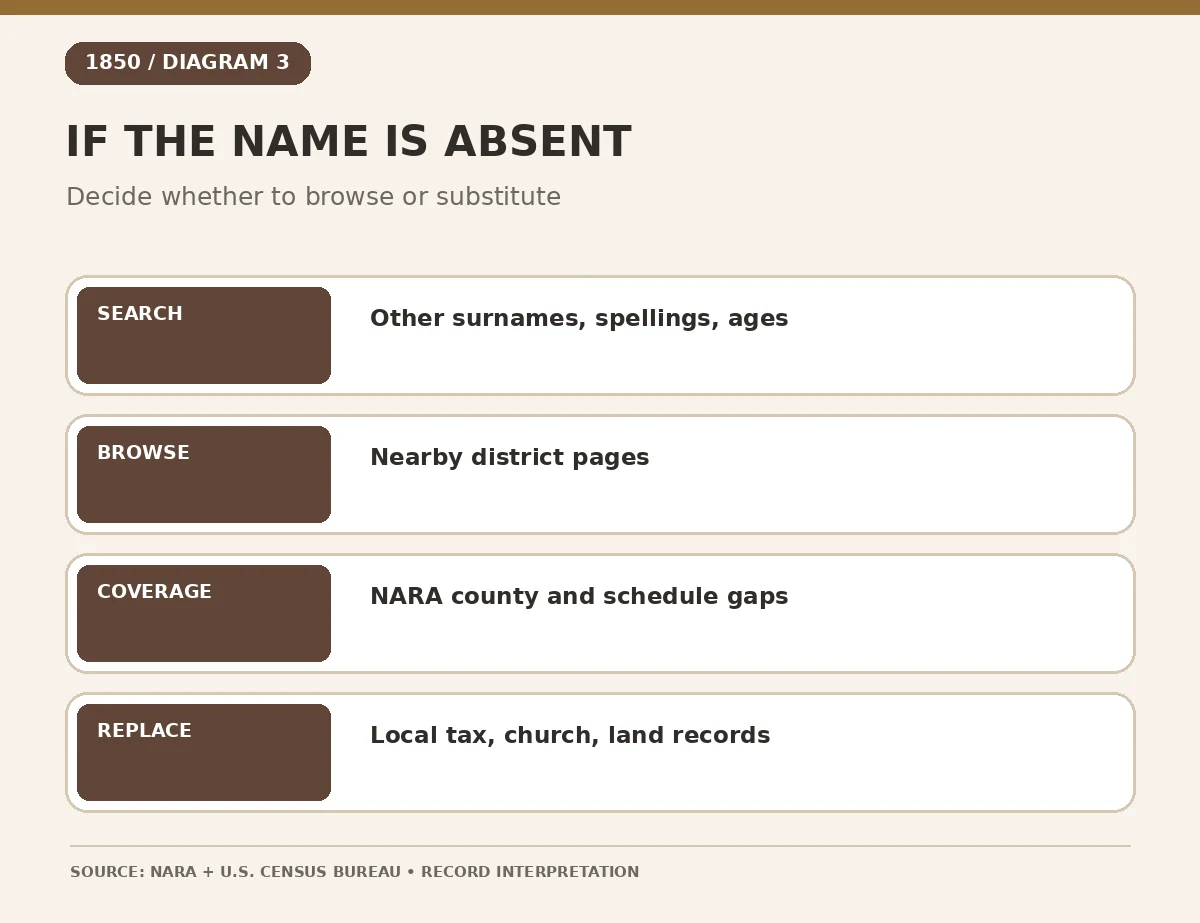
When a person appears to be missing, search individuals separately, try a household member’s unusual first name, and browse a likely district manually. A person absent from one home may have been working or boarding elsewhere. Distinguish a genuine conflicting enumeration from two indexed versions of the same record. The Census Bureau’s original form description identifies what each row and number actually means.
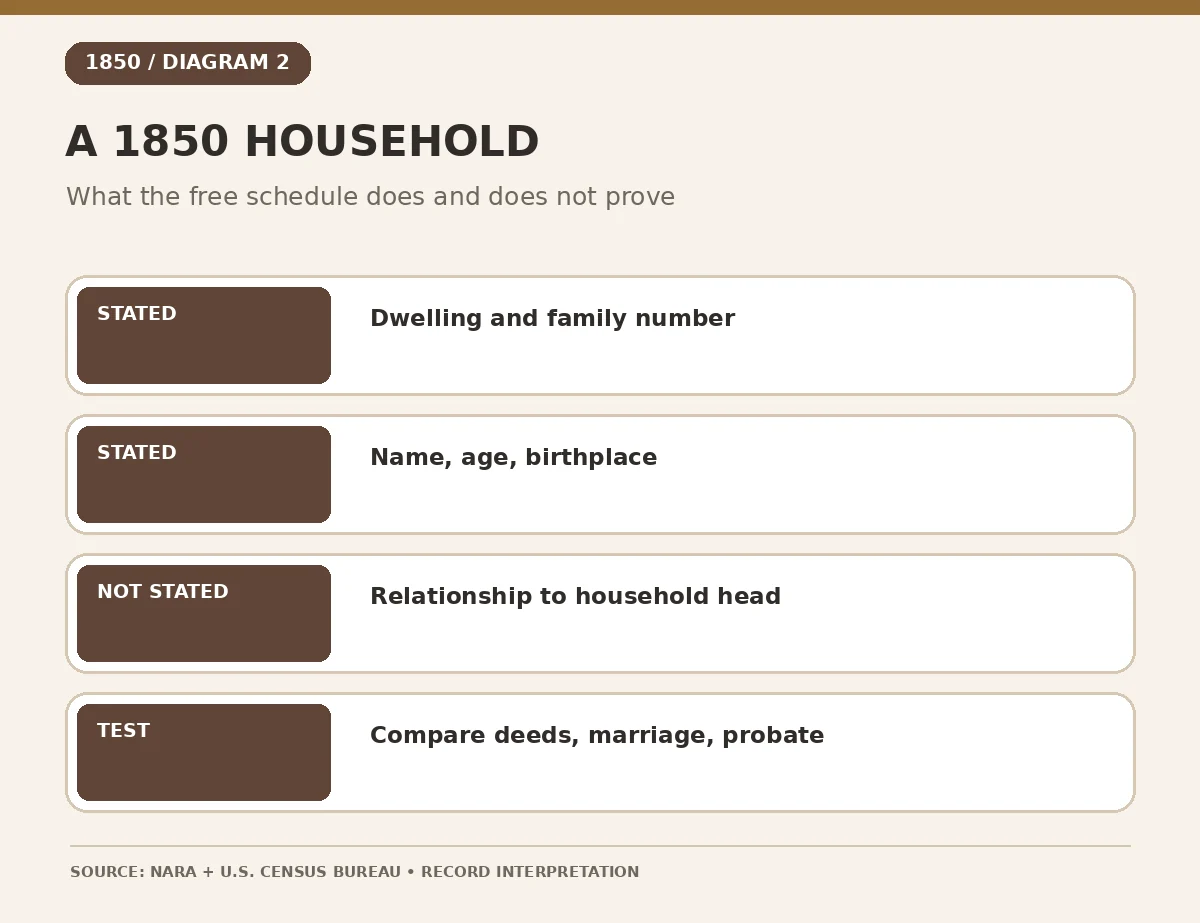
| Record feature | Direct statement | Not established |
|---|---|---|
| Free Schedule 1 | Free residents listed individually | Relationships not asked |
| Schedule 2 | Enslaver named; age/sex entries | Enslaved people usually unnamed |
| Real estate | Reported value for free person | Not a deed or exact price |
Keep the separate enslaved-person schedule distinct
The 1850 census also had a separate Schedule 2 for enslaved persons. It usually records the enslaver’s name alongside ages, sex, and a recorded color classification of enslaved people, generally without their names. That is a serious archival limitation rather than an invitation to select a name from an adjacent source. Do not treat a nearby free household, a surname match, or a similar age as proof that a particular enslaved person has been identified. Special local exceptions should be evaluated in the original image, not generalized to the whole nation. Our guide “1790 U.S. Census” goes into more detail.
If tracing an ancestor enslaved in 1850, begin with reliably established later records, then investigate probate, estate transactions, bills of sale, court papers, and manumission or plantation documentation for that exact locality. A slaveholder-name match can identify a research target, but it does not establish an ancestor’s enslaver or parent. The FamilySearch slave-schedule description explains the separation and its restricted set of indexed fields.
Account for missing locations and special copies
The 1850 schedules have known local gaps. For example, NARA’s detailed overview lists missing population schedules for Contra Costa, San Francisco, and Santa Clara counties in California, as well as certain Tennessee civil districts. Those facts should lead to a jurisdiction-specific replacement plan, not a blanket claim that an entire state’s records are gone. Check the exact year, district and record type before treating silence as meaningful. Our guide “1860 U.S. Census” shows how to check property columns and two separate schedules.
Utah illustrates why a census copy must be identified precisely. NARA discusses an 1851 territorial enumeration and differences between the surviving federal copy and the original territorial version, including misleading representations of slavery. If that area is relevant, consult the custodial description and original images before publishing a firm conclusion. This is a specialized exception that cannot be resolved from a universal search-result snippet.
Create a source-backed household evidence sheet
Create a row for each named inhabitant with page citation, household number, written name, age, birthplace, occupation, and relationship status marked ‘not stated’. Keep a separate note for hypotheses tested using other records. Record whether an image was inspected, since a name copied from an index can conceal transcription errors. If an original feature is unreadable, state ‘unreadable’ rather than silently substituting an expected value. Our guide “1870 U.S. Census” goes into more detail.
Once the sheet is complete, compare the group with 1860 and the nearest local marriage, land, probate or church records. Residence continuity, unusual given names, and corroborated independent dates can identify a family more reliably than a surname alone. End the analysis with confirmed facts, plausible inferences, and unresolved questions. The inability of the 1850 form to explicitly describe relationships is part of the finding, not a flaw to fill with a guessed pedigree. To go further, our guide “1880 U.S. Census” shows how to use relationships and parents’ birthplaces correctly.
More Records and Archives Guides
How We Research These Original Records
We compared the two surviving 1850 schedule designs, the published list of county gaps, and the Census Bureau’s explanation of the change to individually named free residents. That audit dictated a two-schedule illustration and a conspicuous warning that household proximity or an enslaved person’s age does not establish identity.
Sources and archive boundaries: The 1850 National Archives inventory identifies the special local gaps. The Census Bureau schedules distinguish records made for free and enslaved populations. The 1850 slave-schedule collection further establishes why a name search cannot identify most enslaved residents.
Disclosure and use limitations: Historical schedules can contain discriminatory terms and profound omissions. We describe these as source characteristics rather than adopt those classifications as a measure of identity. No institution cited here sponsors this page; GenHis discloses commercial relationships on its policy page. Check the image custodian for current access rules.
It listed each free inhabitant by name; enslaved persons were generally counted without names on a separate schedule.
No. Relationship-to-head was not an explicit 1850 population column.
It is a reported census value; verify legal ownership in deeds and tax records.
A matching age is not sufficient. Seek independent, person-specific documentary evidence.
Confirm the known gap on NARA and investigate tax, land, court, and other surviving local sources.